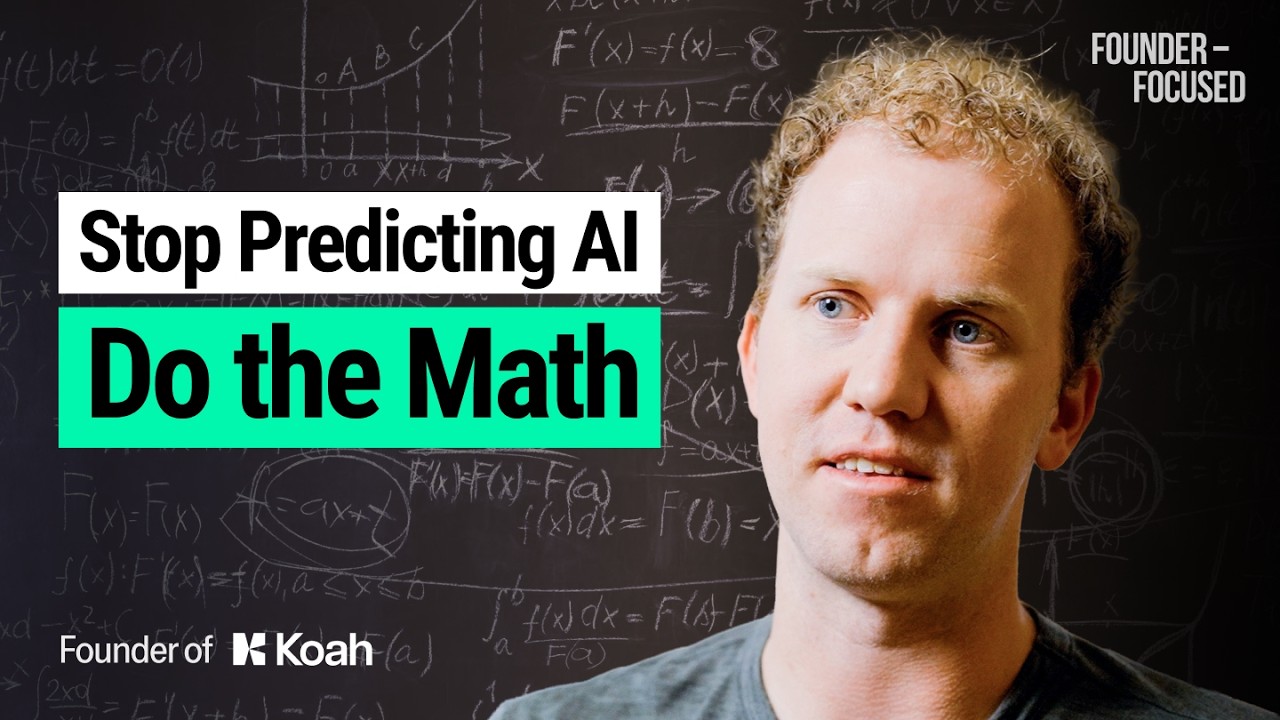
Nic Baird is the co-founder and CEO of Koah Labs, an ad monetization platform for AI tools that has raised $26 million and is reaching single-digit millions of users. He is also a world-class competitive sailor, and the episode explores how his approach to decision-making under uncertainty in sailing directly shaped how he builds companies. The core idea is that the best decisions in business, career, and life are statistical bets: you assign probabilities to outcomes based on the information you have, weigh the downside risk, and size your investment accordingly, rather than relying on gut instinct or waiting for certainty.
How Sailing Teaches Probabilistic Decision-Making
Competitive sailing, the kind Nic does, is closer to Formula 1 than leisurely cruising: fast, high-performance racing where split-second tactical decisions determine whether you win or lose.
Nic grew up sailing professionally with his dad, competed at the Youth World Championships finishing third and fourth in two different classes, and won three national championships before college.
Sailing is a useful mental model for decision-making under uncertainty, more so than chess (which is theoretically solvable) or poker (which has too many hidden variables).
In sailing, you constantly face choices with incomplete information: wind shifts, currents, competitor behavior. You can never be certain, but you can assign probabilities.
A concrete example: in San Francisco Bay, the land heats faster than the ocean, creating a predictable sea breeze. Experienced sailors know the temperature differential and pressure conditions that trigger it, so they can position themselves ahead of time.
The key lesson: when you are highly confident in a prediction, you still have to account for what the rest of the market (or fleet) is doing.
If you are 90% sure the wind will shift left but the entire fleet goes right, you have to ask whether they know something you don’t. The risk of being wrong when everyone else is positioned differently is very high, so you mitigate: you might go left but not commit fully.
This maps directly to business: even when the data supports your thesis, you size your bet according to your confidence level and the cost of being wrong.
Nic frames all major life decisions this way:
Low-stakes example: if there is an 80% chance of rain, bring an umbrella. The cost of being wrong (carrying an umbrella unnecessarily) is trivial compared to the cost of not bringing one when it rains.
High-stakes example: he turned down paid professional sailing opportunities to pursue startups, because the expected value of a low-probability, high-reward outcome (building a massive business) outweighed the certainty of a smaller payoff (being a top sailor).
His reasoning: a 1% chance of making a trillion dollars has an expected value of $10 billion, which beats a 100% chance of making a million dollars.
Becoming a Builder by Being Around Builders
Nic’s path to founding Koah Labs ran through South Park Commons (SPC), a San Francisco-based community of founders backed by a venture capital firm.
He originally planned to join a Series B or Series C startup but discovered SPC instead, which gave him exposure to exceptional builders who taught him how to build things himself.
He describes two forces at play: the driving force (curiosity, excitement, wanting to solve problems for others) and the pulling-back force (doubt, friction, difficulty). Being around builders reduced the friction and gave him the confidence that he was capable of building on his own.
His co-founders Mike and Heric were the fastest builders he had ever seen, shipping something new every month. He joined them for a hackathon, they had a good experience, and decided to start a company together.
Nic’s advice: the single most important thing you can do is be around other builders, people who are curious, shipping things, and encouraging. Environment and community are the primary motivators.
He also emphasizes the importance of building for customers who are actively asking for what you are making. When people are requesting your product and willing to pay for it, it erases doubt and pulls ideas out of you because you are focused on solving the problem, not questioning whether you can.
Why Subscriptions Killed AI Apps and Ads Will Save Them
The original idea for Koah Labs came from co-founder Mike, who envisioned an “AdSense for AI” about a year before they built it. The idea was too early: in 2024, the entire industry was pushing subscriptions as the monetization model for AI, following ChatGPT’s precedent.
Consumer VCs were preaching that ads were dead and that users would pay for AI because it was so useful. Nic took the contrarian view.
The problem with subscriptions for AI apps: inference costs (tokens) are extremely expensive, and most users are not willing or able to pay a subscription fee high enough to cover those costs.
A friend of theirs built an AI storytelling tool for parents and kids. Engagement was incredible, with fan mail from parents saying it was the first time they really connected with their children. But he was losing tens of thousands of a month despite having a subscription, because not enough users would pay. He eventually shut down and took a B2B SaaS job.
This is the problem Koah Labs was built to solve: give AI developers a sustainable revenue source through ads so they can scale without the inference-cost death spiral.
Nic’s conviction came from talking directly to customers who were asking for this solution and willing to pay for it, even when the broader market narrative said ads were dead. He argues that customers who are actively using and requesting a product have a more accurate picture of where the market will be in 6 to 12 months than analysts looking at aggregate trends.
Can Ads Actually Improve the User Experience?
The common assumption is that ads degrade user experience. Koah Labs ran a test that challenged this: they capped ad frequency to one-tenth of the previous level and measured the impact.
What they found: when they showed fewer ads, user engagement on the app went down and churn went up. This suggests the ads they were serving were high-quality and actually encouraged users to spend more time in the app.
The implication: well-targeted, relevant ads in an AI context can be a positive part of the experience rather than a nuisance, similar to how a knowledgeable local sailor uses information others do not have to make a move that looks wrong until it pays off.
Pivoting from an Agentic Social Network to Ad Monetization
Before Koah Labs, the team spent several months building an agentic professional social network: a personal AI agent that would represent you, reach out to your network, and proactively find opportunities for you, similar to how agents represent actors or athletes.
They got strong engagement but could not figure out how to monetize it. More importantly, users in 2024 were still very cautious about giving an agent access to their email, personal information, and the ability to act on their behalf. The market was not ready for that level of agentic behavior.
This led them to pivot to Koah Labs, where the monetization path was clearer and the market need was more immediate.
The Real Bottleneck Is Human Trust, Not Technology
Technology is advancing far faster than consumer behavior can keep up. The future is here but not equally distributed.
People might trust an agent to buy a pair of socks (low consequence) but not a car or an investment portfolio (high consequence). Trust is currently limited to low-stakes decisions.
Over time, as agents prove themselves through case studies and early adopters, Nic believes people will gradually delegate higher-stakes decisions to them, but this takes years because human psychology adapts slowly.
Nic’s stance: the technology is ready, but the market is not. The job of a founder is to position the company to react when the market catches up, not to force adoption before trust exists.