-
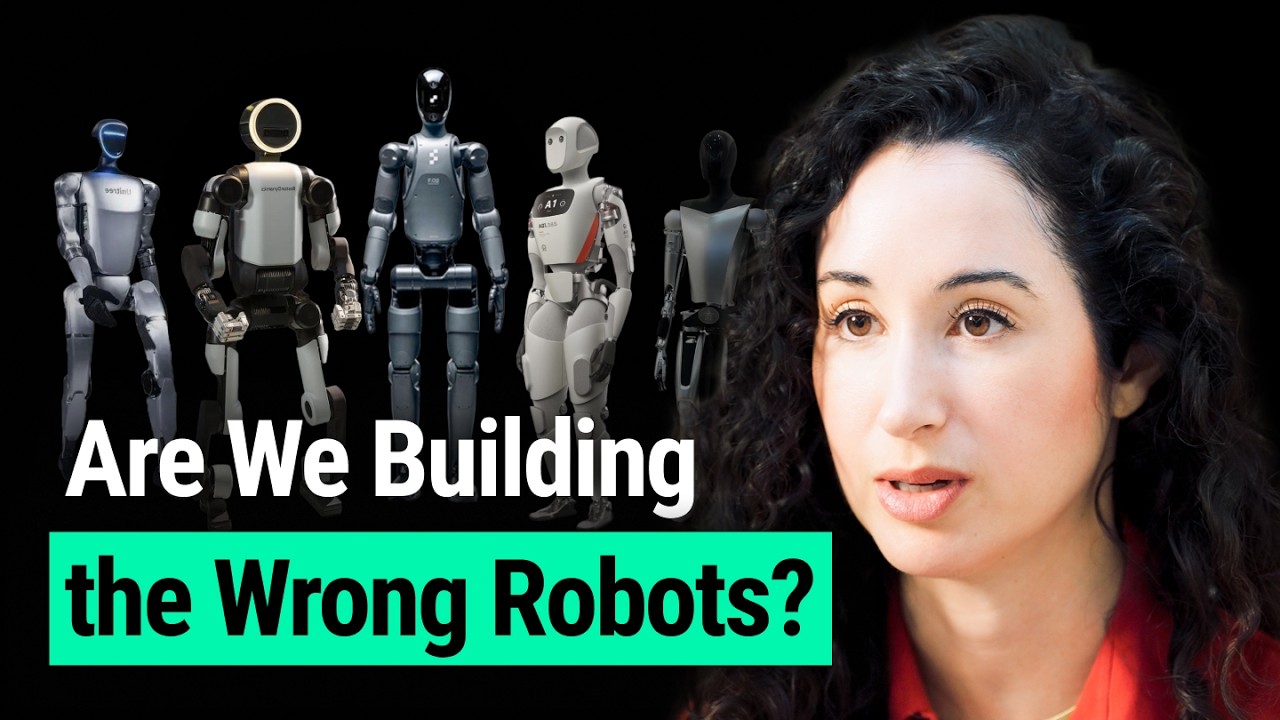
Katie Quan is a robot choreographer, roboticist, researcher, entrepreneur, and artist who runs Art Lab (AI Robot Technology) and teaches at the Stanford Robotics Center. Her work sits at the intersection of robotics, AI, dance, and human-centered design, and she argues that the field is too narrowly focused on humanoid utility robots when the real opportunity is in making robots that are legible, inspiring, and emotionally resonant companions for people.
- She grew up in the Bay Area loving both math and dance, became a professional dancer with the Metropolitan Opera Ballet in New York, and later pivoted into robotics after her father’s hospital stay made her aware of how opaque and oppressive medical machines can feel to vulnerable people.
- Her central thesis: as billions of robots enter everyday spaces (homes, hospitals, offices), the grand challenge is not just intelligence or dexterity but human-robot interaction — making robots that people can understand, feel safe with, and even delight in.
-
The “ChatGPT moment” for robotics is coming, but intelligence isn’t the bottleneck
- Quan believes we are approaching a moment analogous to ChatGPT for robotics, where AI models will make robots dramatically more capable in unstructured human environments.
- Her lab is building a Vision Language Interaction (VLI) model — the first kind of model that takes its behavioral impetus from humans in the environment, maps human input to robot actions, and measures success based on human emotional response (e.g., is the person’s positive affect increasing?).
- Unlike LLMs that act on text, VLI closes the loop by reading whether the robot’s action actually made the human feel better, safer, or more engaged.
- The goal is robots that can naturally and intuitively socialize, not just execute tasks.
- She argues the real unsolved problem is not raw intelligence but legibility and emotional resonance — can the human understand what the robot is doing and why, and does the interaction feel good?
-
The field is trapped in a “humanoid imagination” that limits what robots can be
- Most humanoid companies build robots that look like humans because they’re meant for human spaces, but Quan argues this sets expectations impossibly high — people’s mirror neurons fire, they expect human-level capability, and the robot inevitably disappoints.
- She challenges the field to broaden its aperture: robots don’t have to be humanoid to be useful or meaningful.
- Paro, a soft seal robot from the mid-2010s, provided companionship for ailing and lonely people — no humanoid form required.
- Robots have helped children with autism learn social skills.
- The classic framing of “dirty, dull, and dangerous” tasks has locked the field into a utility-only paradigm, when robots could also be companions, educators, artists, and sources of wonder.
- Her question to the field: is a humanoid that can do your dishes really what a 77-year-old immigrant father wants, or is there something more meaningful we could build?
-
Music Mode: a proof point that robots can make people feel something
- While an artist in residence at Google, Quan worked with 200 mobile manipulators that were wiping tables, sorting trash, and resetting conference rooms. Engineers had grown ambivalent toward them — “it’s fine, it’s a cute robot.”
- She initially wanted robots to play music, but her colleague Tom proposed a breakthrough: what if the robot’s own movement data became the music?
- Working with composer Peter van Straten, they built software called Music Mode that mapped each joint movement to a different musical sample — gripper open/close made a “cling cling,” torso rotation made a deep bass “boom.”
- It was a combinatorics problem: every combination of joint movements produced a different sonic output.
- When shipped across all 200 robots, the response was overwhelming — people emailed saying they cried at their desks, that they never thought a machine could make them feel that way.
- Nine robots sorting trash simultaneously, all in Music Mode, created a symphony.
- For Quan, this was proof that people want to feel something from their technologies, not just have tasks completed.
-
Dancing with robots revealed both the transcendent and the humbling
- Her first experience dancing with a robot in 2017 felt transcendent — she created choreography for the machine, it performed it, and then she danced with it. She felt herself on a long continuum of humans and tools, from stone tools to fire to modern computers.
- But years of working with robots have made her acutely aware of how remarkable humans are by comparison.
- Every mundane human act — opening an unfamiliar door handle with unpredictable friction, walking down novel stairs, carrying an object, socializing with precise timing — requires dexterity and acuity that took not just a lifetime to develop but generations of evolution encoded in DNA.
- Robots she works with lack the expressive potential of even an ordinary person.
- She references Aristotle’s idea that humans should be called Homo technae (tool-making beings) rather than Homo sapiens — our uniqueness lies in our relationship with tools, not raw intelligence.
-
“You can build anything. The question is why.”
- Quan teaches CS 334: Robots and Arts at Stanford, cross-listed between computer science and theater/performance studies. Students must use AI and robots to make a creative statement with political, philosophical, or social substance — not just demonstrate a technical trick.
- On the first day, she frames the central question of the class: Stanford researchers are 3D printing organs, running autonomous cars, using LLMs to design DNA sequences for new life forms. Everything seems possible.
- When you can build almost anything quickly and easily, the interesting question is not “what should I build?” but “why am I building it?”
- Time is the one resource that cannot be scaled or recovered. How you spend it is one of the biggest choices you make.
- She tells students that knowing your why — your authentic values and the statement you want to make — is what carries you through the inevitable frustration, debugging, and failure that come with hard, high-impact work.
- She draws on her dance training: showing up to an audition against 400 people for 4 spots means you better be good, and when you’re not, you go home and get better.
- She references Stanford professor Mark Skylar Scott, whose goal is to 3D print a human heart and estimates it will take 25 years — a challenge worthy of a life’s attention because the impact is literally life-altering.
- Her closing thought: she never sees herself delegating the pursuit of hard, meaningful problems built with people who inspire her.