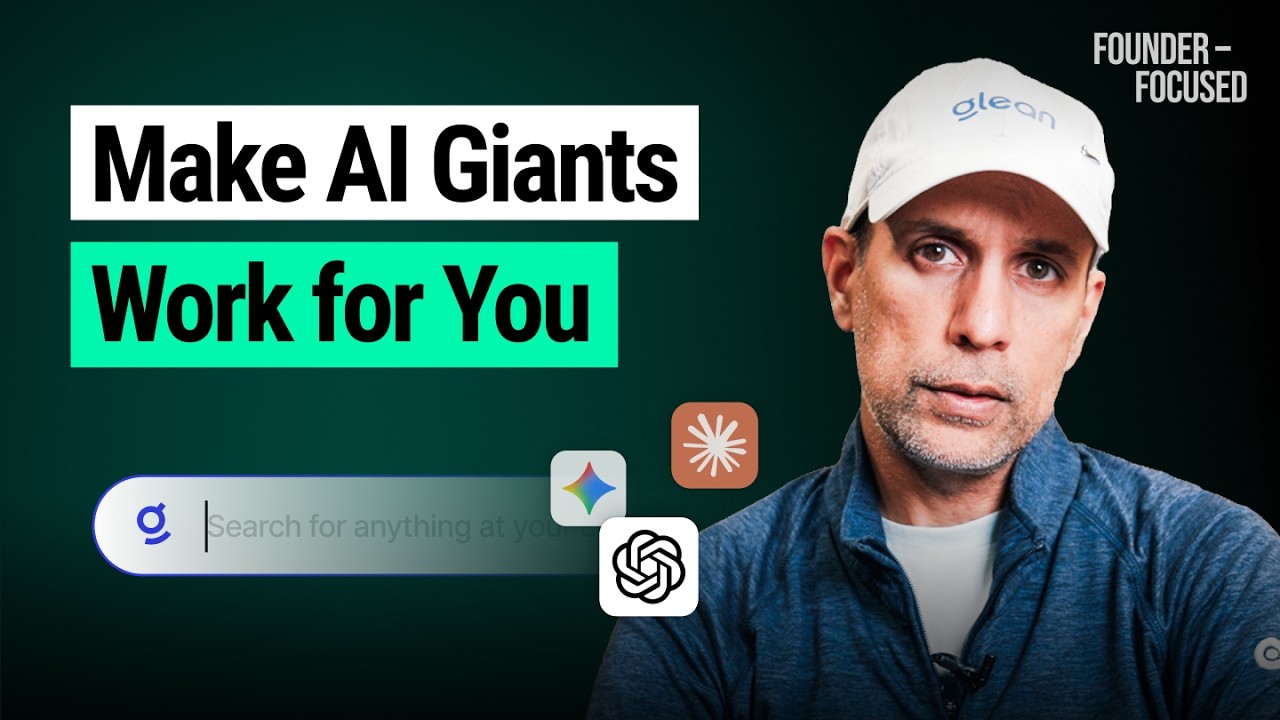
Arvind Jain, founder and CEO of Glean, explains how he built two unicorn companies (Rubric and Glean) by focusing on real workplace problems, leveraging existing technology instead of reinventing it, and maintaining deep conviction through years of stealth development before launching.
Glean is an enterprise AI platform that works like a more powerful, company-specific version of ChatGPT, connected to all of an organization’s data and knowledge so employees can ask questions or delegate tasks using both enterprise context and general world knowledge.
The company started in early 2019, making it one of the earliest enterprise generative AI companies, and has grown to over 1,000 employees with a valuation reflecting its position as a pure-play enterprise AI business.
Why He Started Glean After Already Building a Unicorn
After Rubric’s success, Jain noticed his own company’s per-person productivity was declining despite growing business metrics.
Employees most frequently complained about two things: not being able to find information inside the company and not being able to locate the right people to help with tasks.
Jain recognized this was a universal problem, not unique to Rubric, and felt motivated to solve it because reducing that frustration would meaningfully improve productivity for workers everywhere.
He didn’t set out to start another company; he wanted to solve a technical problem and build a product, and starting a company was the means to do that well.
The Two-Year Stealth Mode That Built a $7B Company
Enterprise search is technically difficult because it requires unifying many types of data (documents, images, tickets) in different formats and building deep understanding of business activity and patterns.
The category had a reputation problem: past enterprise search products had universally failed, and enterprises were fatigued and skeptical about buying search solutions.
Jain spent two years in stealth mode, personally reaching out to industry leaders on LinkedIn to get feedback, often without response, which he describes as a humbling but formative experience that built his resilience.
His conviction came from personal experience: he knew how many hours he himself spent searching for information at work, and every person he spoke to confirmed the same struggle.
The team used Glean internally and found they couldn’t live without it after building the first version, which gave them confidence in its value.
They offered the product for free to 20 design partner companies for two years.
Employees at those companies became strong advocates; in one or two cases, security teams tried to shut Glean down and employees revolted, refusing to let the product be removed.
Word of mouth spread organically, and by the time Glean announced general availability, customers were already expecting to pay and converted smoothly.
Investors, including Wingpack, approached Glean rather than the other way around, because by 2022 people had already experienced the product and recognized its quality.
Build Less, Win More: The Strategic Philosophy
A startup’s primary weapons are focus and speed, and Glean’s strategy is to avoid reinventing what already exists.
Rather than training their own foundational language models, Glean leverages models from companies like Google, OpenAI, and Anthropic (GPT-5, Claude, Gemini).
Enterprise customers actually prefer this because they want solutions to problems, not technology for its own sake.
This allows Glean to dedicate all engineering resources to the problems others aren’t solving: bringing enterprise context into AI so models understand how a specific company works, what its data means, and how to complete tasks within that environment.
As a pure-play enterprise AI company with no other product lines or legacy systems, Glean invests more focused effort into making AI effective in enterprises than any other company.
Jain emphasizes that founders must maintain belief and conviction in their idea, especially when investors are lukewarm or potential hires are less enthusiastic, because the problem that inspired the idea still exists and the founder’s job is to stay true to it rather than kill it prematurely.