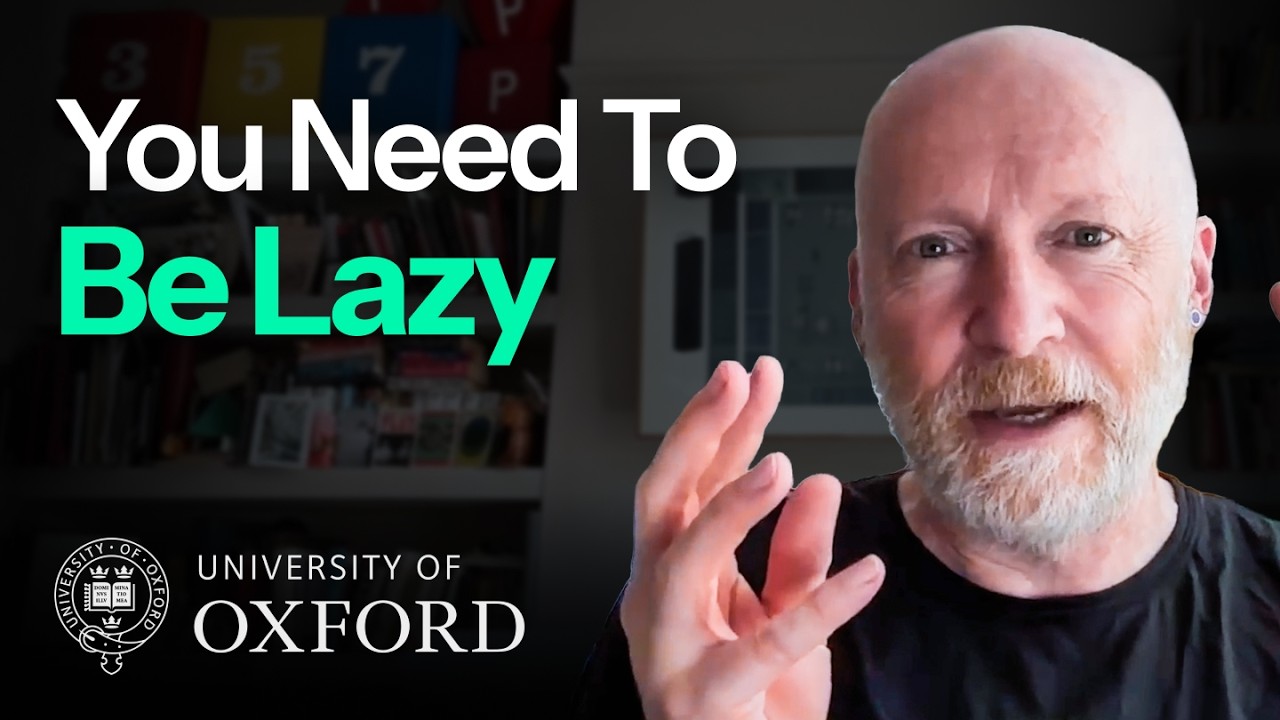
Marcus du Sautoy, Oxford mathematician and Simony Professor for Public Understanding of Science, examines whether AI can match human creativity, arguing that creativity comes in three distinct forms and that humans retain a unique advantage in transformational creativity and the drive for efficient shortcuts, making AI best understood as a collaborator rather than a competitor.
Three types of creativity
Exploratory creativity pushes existing rules to their limits without breaking them — Bach’s music exemplifies this by exhausting the Baroque rule set.
Combinational creativity merges distinct domains — fusion cooking applies European techniques to Asian ingredients; du Sautoy uses it by importing geometric methods into number theory.
Transformational creativity breaks the rules entirely, creating new frameworks — early 20th-century serialism discarded harmonic structure for a 12-tone row; this is the rarest and hardest form for AI.
AI’s creative profile
AI excels at exploratory creativity: it learns past styles and extends them within established boundaries.
AI is strong at combinational creativity: it can transfer patterns from one discipline to another.
AI struggles with transformational creativity: it optimizes within learned statistical distributions rather than intentionally shattering conventions.
Mathematics as a creative discipline
Du Sautoy fell in love with mathematics through a teacher who revealed its creative side — Fibonacci numbers governing natural growth, non-Euclidean geometries inventing worlds with no physical reality.
Unlike sciences, mathematics need not match empirical reality; it explores self-consistent rule systems, akin to a novelist setting premises and following their consequences.
AlphaGo’s move 37 as machine creativity
In game two against Lee Sedol, AlphaGo played move 37 deep in the board early on — commentators called it a mistake, but it won the game and changed human Go strategy permanently.
Du Sautoy classifies this as transformational creativity: humans had settled on a local maximum; AlphaGo revealed a higher peak across a valley humans couldn’t see.
The strategy emerged from the system’s self-play learning, not from human-coded rules — a human programmer would likely have deleted the “bad” line of code.
AI as a digital telescope
AI acts like Galileo’s telescope: it reveals patterns in vast digital spaces humans cannot search unaided.
Example: an AI found a counterexample to a decades-old mathematical conjecture, not by proving it true but by spotting a structural contradiction — du Sautoy prefers “augmented intelligence” over “artificial intelligence.”
Human laziness as an engine of innovation
Humans are “a lazy species” — like lions conserving energy for a short burst — and this drives lateral thinking and shortcuts.
Mathematics evolved from this mentality: faced with laborious computation, humans invent algorithms that solve whole classes of problems instantly.
Gauss and the power of the shortcut
As a child, Gauss summed 1 to 100 by pairing first and last (1+100, 2+99…) to get 50 pairs of 101 = 5,050 — the teacher’s busywork became a universal algorithm.
The shortcut works at any scale; the laborious method does not. This algorithmic thinking is the seed of computing.
Human-AI complementarity
AI has no aversion to brute force; it will churn through the dumb way indefinitely. Humans supply the intention and the shortcut.
The strongest future combines human passion for elegant shortcuts with AI’s tireless execution — AI is a collaborator, not a competitor.