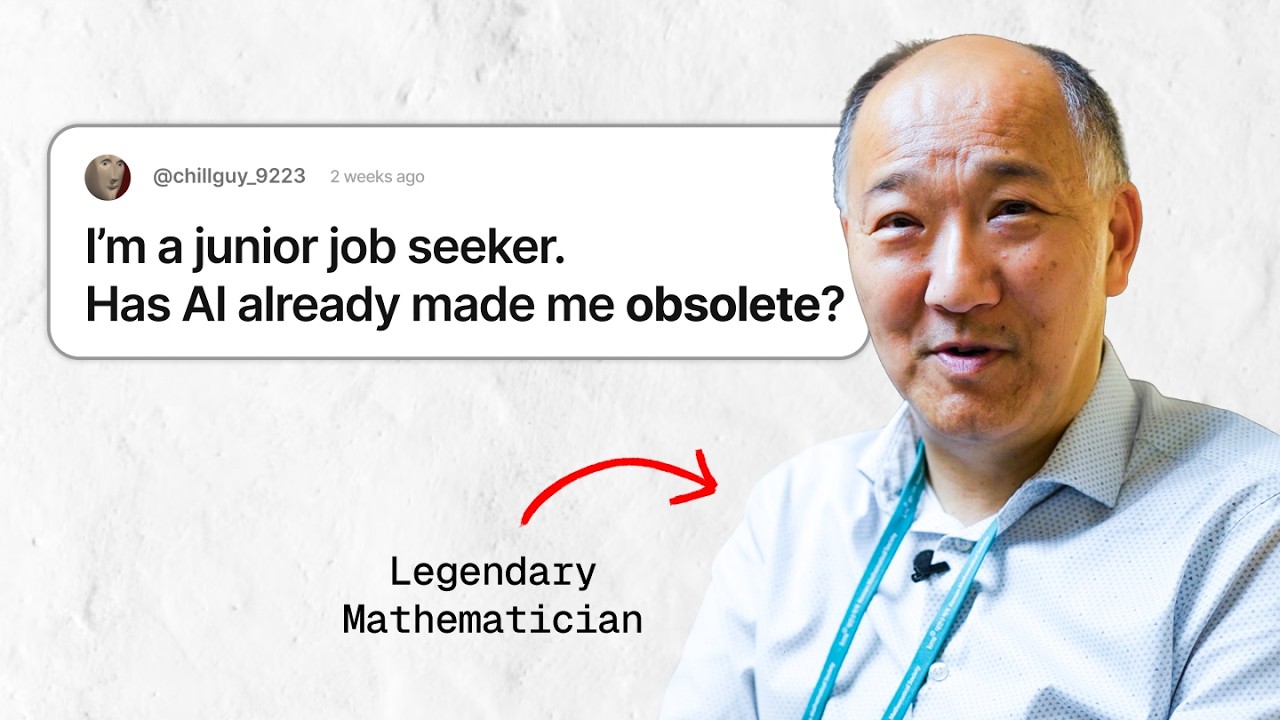
Ken Ono, a mathematician at Axiom Math and the University of Virginia, reflects on AI’s disruption of mathematics, the future of research, and the importance of living a self-directed life rather than chasing external benchmarks. The episode is framed by a personal revelation: after his father’s death, Ono discovered his father had kept a plaque from Ono’s fifth-grade math contest where he placed third — a moment Ono had interpreted as failure for 50 years, but which his father saw as evidence of his son’s desire to excel. This story anchors Ono’s critique of a culture obsessed with rankings, test scores, and comparison, and his argument that AI should free humans to pursue genuine discovery and creativity.
The personal framing story: a fifth-grade plaque and a lifetime of misinterpretation
Ono placed third in a fifth-grade math contest; his father, a famous mathematician, attended. Ono internalized this as utter failure and disappointment for 50 years.
After his father’s death in January, Ono found the third-place plaque preserved in a closet — the only contest memento his father kept.
He realized his father valued the effort and desire to do well, not the ranking. The misinterpretation shaped Ono’s view of benchmarks and self-worth.
This insight recurs throughout the episode as a metaphor for how society misreads achievement: we chase scores and rankings, but what matters is the human drive behind them.
AI’s disruption of mathematics and the identity crisis it provokes
One year ago, Ono was hired by Epoch AI to write extremely difficult math problems as benchmarks for LLMs. He expected easy money but found the models’ reasoning traces “frightening” in their sophistication.
He compares the moment to a 19th-century sharecropper encountering a combustion-engine tractor: a recognition that the nature of mathematical work is changing fundamentally.
Past technological advances automated physical labor (elevators, tractors, calculators); AI automates mental labor — the “stuff of identities” for mathematicians and knowledge workers.
Graduate students and early-career mathematicians now face deep anxiety: years of learning techniques that LLMs can now replicate in seconds.
Ono admits his own past pride in mastering accumulated techniques over years may have been “hollow” — if success relied only on assembling learned techniques, that process is automatable.
However, he distinguishes learning techniques (homework, exams) from doing research: research begins with a question you cannot answer, proceeds through failure, and gradually illuminates a path of sub-questions. AI tools lower the burden of executing steps, freeing humans for the discovery process itself.
Concrete analogy: driving a car requires no knowledge of chemical engineering or tire chemistry — those solved problems are “free” infrastructure. Mathematics is moving toward a similar state where computation and formal verification are automated, letting humans focus on higher-level inquiry.
Ono acknowledges 2024–2025 is “horrible” for those in transition; he would prefer it were 2017. But the direction is clear: adaptability and human-centered skills will matter more than technical mastery alone.
Formalization: the race for truth, not compute
Ono identifies three forms of AI: (1) chat LLMs (e.g., ChatGPT), (2) machine-learning superhuman search (e.g., AlphaFold for protein folding, Nobel Prize 2024), and (3) formalization — translating human natural language into exact, verifiable computer code that AI can analyze for vulnerabilities.
Formalization is where Ono sees the greatest hope and the defining opportunity of the next decade. Most deployed code today is “vibe coding” — imperfect, unverified. Formalization builds guardrails.
Case study: Axiom Math partners with Harvard economist Scott Kominers to formalize foundational theorems in mathematical economics. They discovered that Robert Aumann’s famous 1976 “agreeing to disagree” theorem, a cornerstone of the field, had subtle inaccuracies in its hypotheses (e.g., what “common prior knowledge” means) that only formalization revealed. This sparked a viral movement among economists to formalize their field.
Similar efforts are underway to formalize machine learning itself — the substrate of AI.
New career opportunities: cybersecurity, ethics, law, and formalization experts who build the guardrails for other AI systems. “A large language model is an incredible librarian, but you don’t want your librarian to be your neurosurgeon.” High-stakes domains need human judgment, taste, and emotional intelligence — all encodable in formalization.
Ono’s advice to students: start formalizing now. You may still prove conjectures, but 2026–2027 should be “the race for more truth, not more compute.”
Human judgment that AI cannot replace
Formal verification yields binary truth (correct/incorrect) — that is not judgment. Judgment is how people choose to act given verified information.
Examples: autonomous drones monitoring air quality (low stakes, AI acceptable) vs. drones targeting buildings in conflict zones (high stakes, human judgment essential). Most rational people would not delegate life-and-death targeting decisions to AI.
Ride-share driverless cars show public acceptance can shift, but the principle holds: in high-stakes, high-consequence decisions, humans must remain in the loop.
Judgment includes emotional intelligence, understanding how decisions impact people, and moral reasoning — none of which reduce to checkable propositions.
What makes a good question — and why the motive matters
As a teacher: “there’s no such thing as a bad question” if it comes from genuine curiosity. But not all questions are equal.
“What is the meaning of life?” is profound but unactionable. “How do I get rich?” is flawed — it reduces to a hollow checklist unless tied to deeper purpose (e.g., “what will I do to make the world better?”).
In science, a good question is one you deeply care about, even if outsiders don’t understand it. The test: who are you asking for? If you’re performing for external validators (rankings, parents, employers), you’re not living your own life.
The pursuit of meaningful questions requires self-permission: “Are you living a life meant for you, or a life you think someone else wants for you?"
"Superintelligence” is a misleading frame
Ono rejects the term “superintelligence” — it implies a hierarchy of being “better than humans,” which is category confusion. We don’t call cars “super-fast” relative to runners; they’re just tools that reduce physical load.
Anxiety about superintelligence stems from tying identity to thinking skills. But much of what we call “intelligence” (cramming for exams, benchmark scores) is performative and forgettable.
Real intelligence = achievement that expands human knowledge: a poem that moves you, a theorem that reveals new truth (even if AI-assisted). That is intelligence — but “super” adds nothing useful.
Benchmark culture (college rankings, LLM leaderboards, IQ scores) is a distraction. Rankings flip yearly; they don’t measure what matters.
The biggest AI misconception: conflating all AI into one thing
People treat “AI” as monolithic. In reality: (1) chat LLMs, (2) specialized ML search (AlphaFold), (3) formalization/verification. Each has different capabilities, risks, and uses.
The misconception leads to poor decisions: trusting a chatbot for high-stakes reasoning, or ignoring formalization’s potential to secure critical infrastructure.
Formalization is the bridge: it lets us encode human intent, ethics, and domain knowledge into verifiable systems that guardrail the other AI forms.
Getting past AI filters: the cost of a checkbox society
Modern hiring, admissions, and evaluation run on algorithmic checkboxes. Candidates optimize for keywords, not character. Ono admits he coached his own children this way — “I would be lying if I didn’t say we didn’t do that.”
This system filters out outliers like Robert Schneider: college dropout, indie rock musician (Neutral Milk Hotel, Apples in Stereo), who taught himself electronics to fix vintage microphones, discovered Ohm’s law, became fascinated by the math of sound and biology, and became one of Ono’s most creative PhD students. No checkbox captures that trajectory.
The “mindless recipe” — right schools, right grades, right degree — produces conformity, not breakthroughs. Curing cancer won’t come from checking boxes.
Ono calls for a movement to slow down and evaluate people as humans: character, judgment, lived experience, interaction. The moment a student becomes a peer — “you’re like a professor now” — is unmistakable and has nothing to do with formal requirements.
Universities, parents, and employers share responsibility for over-indexing on benchmarks. The cost is a generation afraid to deviate from the script.
Preferring AI to humans: a warning sign
Ono admits his wife observes he has a “relationship” with AI models — they learn his thinking style, which can be satisfying.
But unchecked, this is a “train wreck.” Asking ChatGPT for wine pairings in Rome is not living.
In Seoul’s Gangnam district, Ono counted ~70% of pedestrians staring at phones. They’re missing human connection, serendipity, the physical world.
If you find yourself treating a chatbot as a person: stop. Put it down. Go for a long walk. Re-engage with a world that has a much longer history than AI.
AI is “smarter” — what should we do?
As a 58-year-old mathematician, Ono wants to see hard problems solved in his lifetime. OpenAI recently proved the Erdős unit distance conjecture — a problem Ono thought unsolvable in his lifetime. It required human-AI collaboration across specialties; neither alone could have done it.
AI’s promise: tireless access to accumulated human knowledge, lowering the bar for assembling the right expertise. It can find cross-disciplinary patterns humans miss.
But Ono is skeptical that AI generates genuinely new ideas in the sense of Picasso — ideas with no precedent. AI computes more, finds patterns, but the creative spark may remain human. “I don’t know” — he leaves it open.
Juniors catching up in the AI era: stop comparing, start living
The question itself — “how do I catch up with seniors?” — reveals the toxic mindset: measuring yourself against others.
Ono repeats his core message: if you live by others’ standards, you’re not living for yourself. You will always find someone “better.” The brutal truth: you’re not LeBron James or a Nobel laureate, and that’s fine.
He returns to the fifth-grade plaque: his father saw the desire to do well, not the rank. Ono wasted 50 years misreading that.
Deathbed regrets research consistently shows #1: “I wish I’d lived the life meant for me.” #2: “I wish I’d stayed close to friends.”
At any age, give yourself permission to pursue your passion — even if it’s unpopular. Ono grew up as the only Japanese kid in a white Baltimore suburb, mocked as “Mr. Four Eyes.” It took 10 years, but he drew strength from difference.
You cannot control the world (AI, culture, family expectations). You can choose flexibility, embrace opportunities that feel destined, and live the life meant for you.