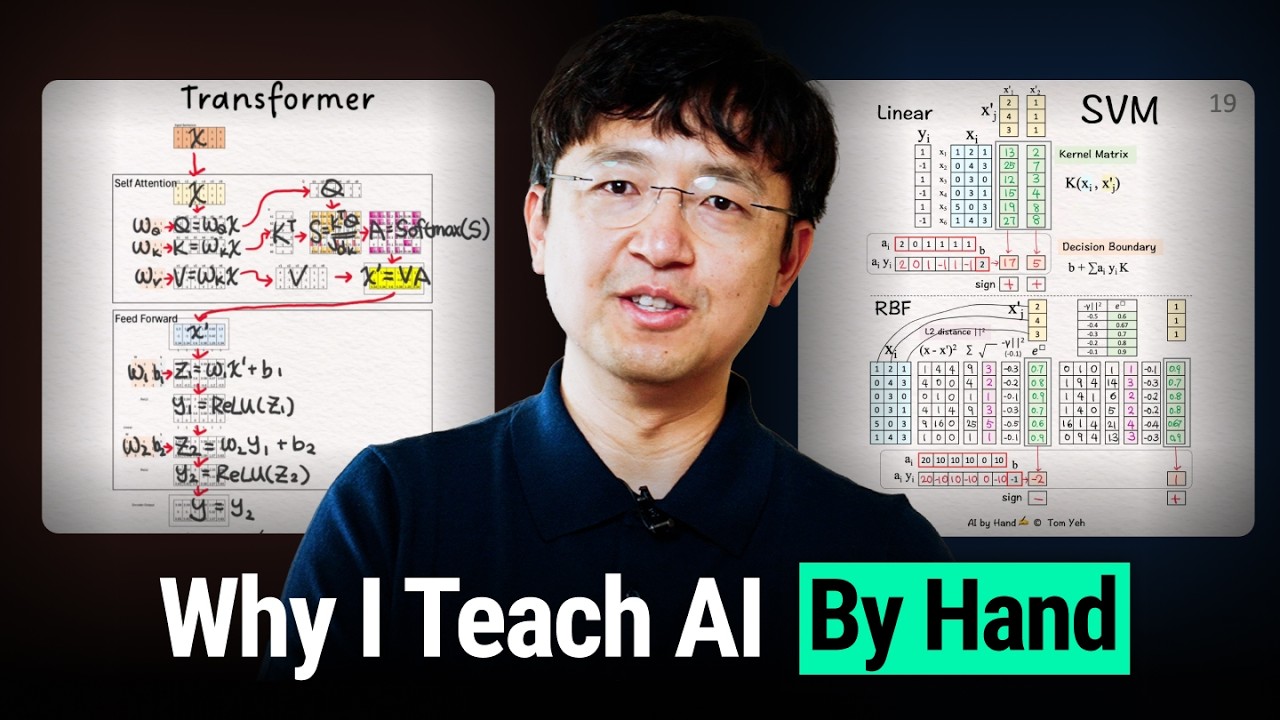
Tom Yeh, a computer science professor at the University of Colorado Boulder and founder of the education initiative AI by Hand, argues that in the AI era the most valuable form of learning is slow, foundational, and done by hand — not chasing the latest tool but internalizing core ideas that never become obsolete.
He started AI by Hand to demystify AI by writing out all the math by hand, sharing his own learning journey as a professor who came late to deep learning.
The initiative resonated globally because people connect with the act of working through difficult material slowly and manually.
Why “by hand” matters
Yeh discovered the power of hand-writing when he taught an entire semester of C++ on a blackboard instead of using slides or live coding.
Writing by hand forces both teacher and student to move at a humanly possible speed.
Students copying notes by hand keeps them focused — their hands are off their keyboards and phones.
The physical act of writing creates a deeper connection to the material than passively watching or copying digital content.
Foundation over tools
Yeh uses the metaphor of Gyeongbokgung Palace in South Korea: the original palace burned down in the 1500s, but because its foundation was built on solid rock, it was rebuilt in the 1800s on the same base.
Technology trends change constantly — DeepSeek was hot, now it’s less so; something else will replace today’s popular tools.
But foundational concepts like matrix multiplication have remained relevant across decades: computer graphics, big data, machine learning, AI, and likely quantum computing all rely on it.
If you focus only on surface-level tools, you’re constantly rebuilding. If you invest in foundations, you can rebuild any skill on top of them.
What learning actually means
Having an answer is not the same as knowing something. Degrees and certificates can be bought; ownership of knowledge cannot.
You value knowledge in proportion to the time and effort you invested in acquiring it.
Yeh’s own example: he fell behind on deep learning but caught up because he had already developed the skill of patiently breaking down hard topics by writing them out — a transferable learning skill, not a tool-specific one.
He encourages people to think about skills they built growing up — piano, chess, soccer — as evidence that they can acquire difficult things. That identity as a learner is what persists, not familiarity with any single tool.
What really differentiates people
Yeh has shifted what he values in students: not whether they remember the transformer equations a year later, but whether they were once willing to sit in a library for hours and work through something hard.
The willingness to open the black box, to attempt something challenging, is what sets people apart.
Someone who has gone through the struggle of learning foundations implies effort and resilience. Someone who never has implies a lack of willingness to invest in hard learning.
Next time a new challenge arrives, that prior experience becomes evidence: “I did it before, I can do it again.”
Cheating, AI, and the real problem
Yeh spent years fighting cheating platforms like Chegg — tracking IP addresses, setting traps — and was briefly relieved when AI disrupted Chegg’s business.
But cheating didn’t stop. The symptom changed; the disease didn’t.
The root cause is a society-level incentive system that doesn’t reward real learning — students cheat because the system compels them to optimize for credentials rather than understanding.
AI is just the latest tool exploited by a broken incentive structure. When AI is gone, people will find other ways to cheat.
Hiring and the limits of AI
When hiring, Yeh argues you should focus on fundamentals: work ethic, problem-solving ability, teamwork, communication.
A strong problem solver will automatically learn whatever AI tool is relevant — you don’t need to mandate it.
A natural team player will automatically adopt AI to facilitate collaboration.
If someone lacks those qualities, AI won’t fix them. AI cannot change people; only people can change how they use AI.
Forcing AI adoption on the wrong person misses the point. Hire for character and capability, and AI adoption follows naturally.