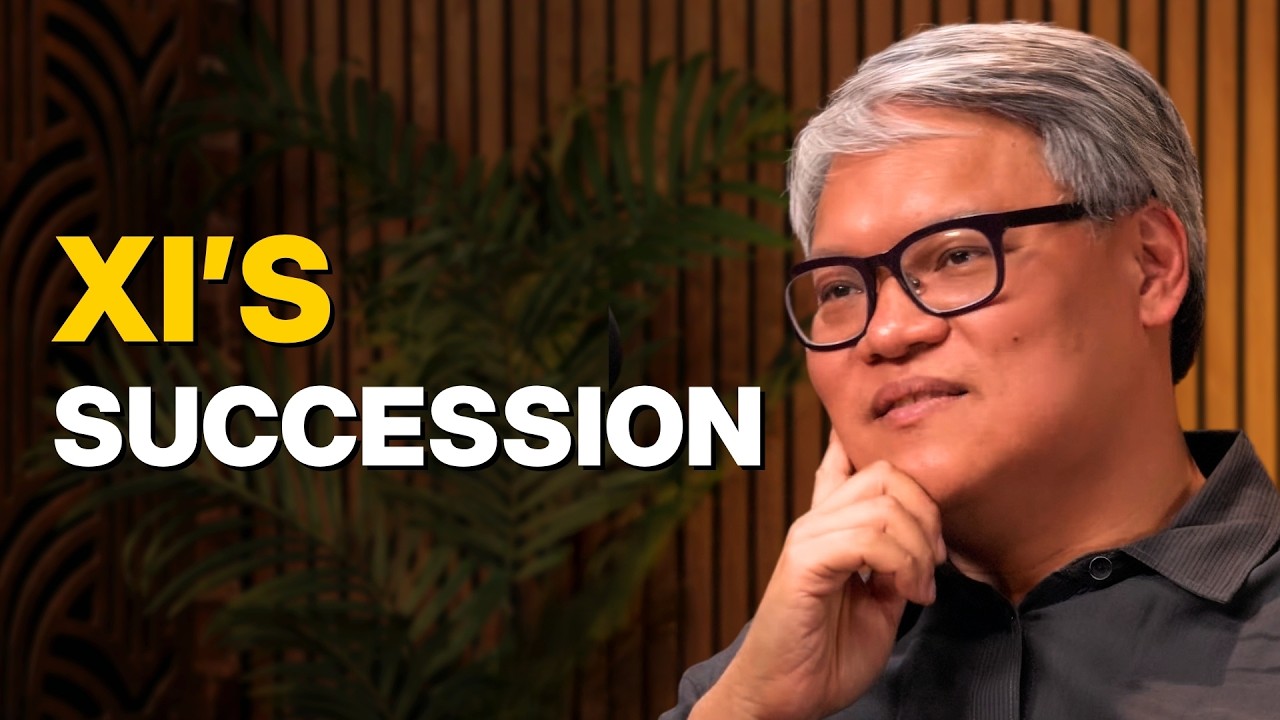
Victor Shih, director of the 21st Century China Center at UC San Diego, discusses Chinese elite politics, fiscal policy, AI governance, and the economy with a focus on how the Chinese Communist Party actually functions under Xi Jinping.
The conversation covers the surprising degree of fiscal decentralization in China, the inner workings of the Politburo Standing Committee, Xi’s micromanagement style, the local government debt crisis, the role of AI and how the Party plans to control it, corruption dynamics, Taiwan, succession risks, and long-term growth forecasts.
China’s fiscal system is far more centralized than spending shares suggest
On paper, 85% of government spending in China is local/provincial versus 15% national, compared to a 50/50 split in the US, which makes China look more decentralized.
But this is misleading: the central government collects nearly all tax revenue (especially the value-added tax since a 1994 reform) and reimburses provinces conditionally, so fiscal autonomy has been falling for decades.
Localities briefly gained more autonomy from 2000–2020 through land sales during the real estate boom, but the central government effectively killed the land market in 2022, making local governments highly dependent on Beijing again.
The 1994 tax centralization was explicitly motivated by fear of fragmentation like the Soviet Union.
The Politburo is technically meritocratic but ultimately subordinate to Xi
Many Politburo members hold impressive STEM or economics degrees from top universities like Tsinghua, and some (like former Premier Li Keqiang) genuinely understood economics.
But technical training does not necessarily translate into good governance, and many senior officials lack basic market economics knowledge because China’s education system tracks students into STEM or humanities early, with STEM students often never taking economics.
A required course called “Situation and Policy” has replaced substantive social science education with government propaganda.
The Party’s overriding instinct is self-preservation and power preservation, which repeatedly overrides expert advice and leads to suboptimal policy.
Examples include Zero-COVID lasting too long and refusing to buy superior Western mRNA vaccines to protect domestic pharmaceutical SOEs, even when experts confirmed the Western vaccines were better.
The cost—slower growth, excess deaths—is accepted if the alternative means losing control (e.g., over banks, scientific institutions, or information flows).
Xi Jinping micromanages through Leading Small Groups, concentrating all decision-making
Xi chairs numerous Leading Small Groups (LSGs) that bring together heads of relevant ministries for specific projects, meeting frequently to identify bottlenecks and drive policy.
Because Xi is the most senior-ranked person in every LSG, and all other members are lower-ranking (vice premiers, ministers, provincial governors), genuine debate is functionally impossible.
Historically, Politburo Standing Committee members had equivalent rank and could debate or even overturn the Party Secretary General’s position; that dynamic has disappeared.
Xi spends roughly 270 days per year in policy meetings and makes decisions that effectively become law for 1.4 billion people.
He receives briefing books before meetings with policy options and must decide on the spot.
He shows strong political acumen on internal Party and military control matters, but on economic and technical issues, he appears to rely heavily on advisors’ talking points.
Compared to today’s American leaders, he is probably better prepared because Chinese experts interact with top leadership constantly, though the information those experts provide can be curated or manipulated.
Ding Xuexiang is Xi’s most trusted lieutenant and the key figure for AI policy
Ding Xuexiang is one of seven members of the Politburo Standing Committee, head of the Central Science and Technology Commission, and head of the administrative office of the Central Commission on Cybersecurity (which Xi chairs).
He worked under Xi for only one year in Shanghai, but Xi trusts him absolutely—likely because Ding provided intelligence on rival Shanghai faction leaders, helping Xi break Jiang Zemin’s stronghold before taking power.
Ding later ran Xi’s personal office, controlling all information flow in and out of Xi’s desk.
On AI, Ding’s stated approach is to invest heavily but simultaneously develop “brakes”—the ability to shut everything down if AI threatens Party control.
This reflects a core Party fear: that a hostile actor (internal or external) could use AGI to undermine Party authority, for example by generating subversive content (e.g., Falun Gong material) faster than censors can control it.
The Party will designate human beings in every government agency and commercial entity using AI who can “put their foot on the brake” if necessary.
DeepSeek almost certainly has a team in its headquarters that can pull the plug on its models if ordered.
AI governance will likely remain under the cybersecurity LSG rather than a new dedicated AGI group, because the security dimension dominates the Party’s thinking.
However, the physical investment side (data centers, power, GPUs) involves other powerful bodies like the NDRC and could justify a new leading group if the scale demands it.
DeepSeek was trained to track CCP policy, making it uniquely useful for research
Victor Shih finds DeepSeek the most useful LLM for understanding Chinese government policy because it returns high-quality links to official policy documents and high-level meeting outcomes.
This is because DeepSeek was originally developed by the hedge fund High-Flyer to trade Chinese stocks, and detecting policy shifts is a major source of alpha in China’s policy-driven markets.
Other Chinese-language models (like Baidu’s) are more trained on social media and return less policy-relevant results.
The Party’s obsession with control stems from lessons of the Cultural Revolution
Many from the Cultural Revolution generation, including Xi Jinping himself, suffered under extreme Party control.
The lesson drawn by Xi and others in power was not that the Party should liberalize, but rather: “Don’t be on the losing side.”
Xi spent decades building coalitions methodically, including cultivating military relationships in Fujian in the 1980s–90s that paid off 30 years later when those contacts became generals.
Xi’s political trajectory closely mirrors Stalin’s:
Both were outwardly low-key and unthreatening early in their careers while quietly building power.
Both systematically eliminated rivals by forming coalitions against the most threatening figure, then turning on former allies.
Xi’s equivalent of Trotsky was Bo Xilai, a flamboyant high-profile rival whom Xi ensured was purged and imprisoned.
Local government debt is enormous and driven by corruption, not productive investment
Central government debt is 60–70% of GDP, but local government debt adds another 120–140% of GDP, pushing total government debt toward 200% of GDP.
The central government authorizes local borrowing but does not fund the spending, so the debt accumulates at the local level.
A recent 10 trillion RMB debt swap lowered interest rates on existing debt but did not reduce the principal—it was an accounting exercise.
The debt financed infrastructure (high-speed rail, airports, industrial parks) and industrial policy ventures (startup seeder funds, science parks).
Infrastructure investment was productive in the 1980s–90s when China lacked basic infrastructure, but has faced rapidly diminishing returns since, especially as population shrinks in many regions.
The primary driver of overbuilding is corruption, not promotion incentives:
Local officials award contracts to connected firms and receive kickbacks, which they use to bribe superiors to secure promotion.
Research by James Kung shows that officials who sell land cheaply to politically connected princelings are statistically more likely to be promoted.
This contrasts with the US, where regulations create stakeholders who benefit from delaying projects (consulting fees, environmental reviews) rather than accelerating them.
The financial system is a tool of socialist industrial policy, not profit maximization
China’s state banking system allocates capital based on Party priorities (output maximization) rather than profit maximization.
Banks will lend to companies that may never make money as long as they produce strategically important goods (semiconductors, AI, robotics).
Expert panels at the Ministry of Industry and Information Technology assess technology projects for banks, but this system is rife with corruption—dozens of officials were arrested for approving bogus semiconductor deals.
Financial repression (1% deposit rates) acts as a hidden tax on savers and channels household savings into state-directed investment.
Capital controls prevent wealthy Chinese from moving money abroad (legally limited to $20,000/year), forcing domestic investment in high-tech or bank deposits.
Eliminating financial repression would mostly benefit the top 10–20% of households who hold the vast majority of savings; the median household has little savings beyond their home.
Successful Chinese tech companies (BYD, CATL, DJI, High-Flyer, Alibaba) were primarily privately funded, not products of state industrial policy.
For every state-financed success (like Huawei), there are over a dozen failed cases wasting billions.
Victor is bearish on Chinese growth and skeptical of PPP comparisons
Without an AI-driven growth uplift, Victor forecasts China’s economy will be roughly the same size as the US (perhaps 1.2x) by 2040 in real income terms, not PPP.
He is skeptical of PPP calculations because quality differences between Chinese and American goods and services are significant and inconsistent.
China’s growth is slowing due to trade pressure, high debt preventing consumption stimulus, and diminishing returns on investment.
Even capturing most of Latin America, Africa, and the Middle East would not provide enough market size to sustain high growth; ultimately China would need to penetrate European and North American markets, which will face strong pushback.
Taiwan invasion is possible but not imminent; Xi is risk-averse
Xi has repeatedly stated that reunification is a sincere goal, but he has not acted on it in 12 years in power, suggesting he is not willing to take reckless risks.
Victor sees Xi as fundamentally conservative and risk-averse on Taiwan, not reckless.
The Ukraine war likely raised Xi’s threshold for invasion by demonstrating how quickly a confident military operation can go wrong.
China has been stockpiling oil and grain, expanding the navy, and building amphibious capabilities, which could indicate preparation for a future threshold—but that threshold is not fixed and depends on many variables.
Information flows to Xi are real but filtered:
The top leadership consults experts frequently and takes them seriously, unlike some US political contexts.
However, interest groups curate which experts Xi hears, and even when experts are correct, political considerations (protecting SOEs, maintaining Party control) can override their recommendations.
Succession after Xi is the biggest systemic risk
There is currently no designated successor, and Xi has eliminated the position of Vice President that historically served as a succession signal.
If Xi died suddenly, the immediate risk would be a financial crisis:
Capital controls work because local foreign exchange bureaucrats fear punishment from Beijing; if they believed no one was watching, they would approve massive outflows for bribes.
China’s $3 trillion in foreign exchange reserves is less than 5% of the money supply—even a 10% reallocation of assets abroad would exhaust them, forcing massive devaluation and interest rates as high as 20%.
A more gradual decline (e.g., senility over months) would trigger factional struggle:
Historically, designated successors under Stalin and Mao were killed; a better model is a trusted transitional figure who cannot become number one (like Mao’s wife Jiang Qing or potentially Xi’s wife or daughter).
But the current Politburo lacks the social capital and mutual trust that allowed relatively peaceful transitions in earlier eras (e.g., the Long March generation after Mao’s death).
Xi has deliberately prevented Politburo members from becoming too close to each other to prevent coups, which makes a post-Xi transition more likely to be brutal and disruptive.
Factions today include pro-market coastal officials (from Zhejiang, Shanghai) and statists (military-industrial SOE backgrounds), but all are beholden to Xi personally.
The military-industrial faction could be stabilizing in a transition, as they primarily want to preserve their subsidies and vested interests rather than pursue ideological goals.