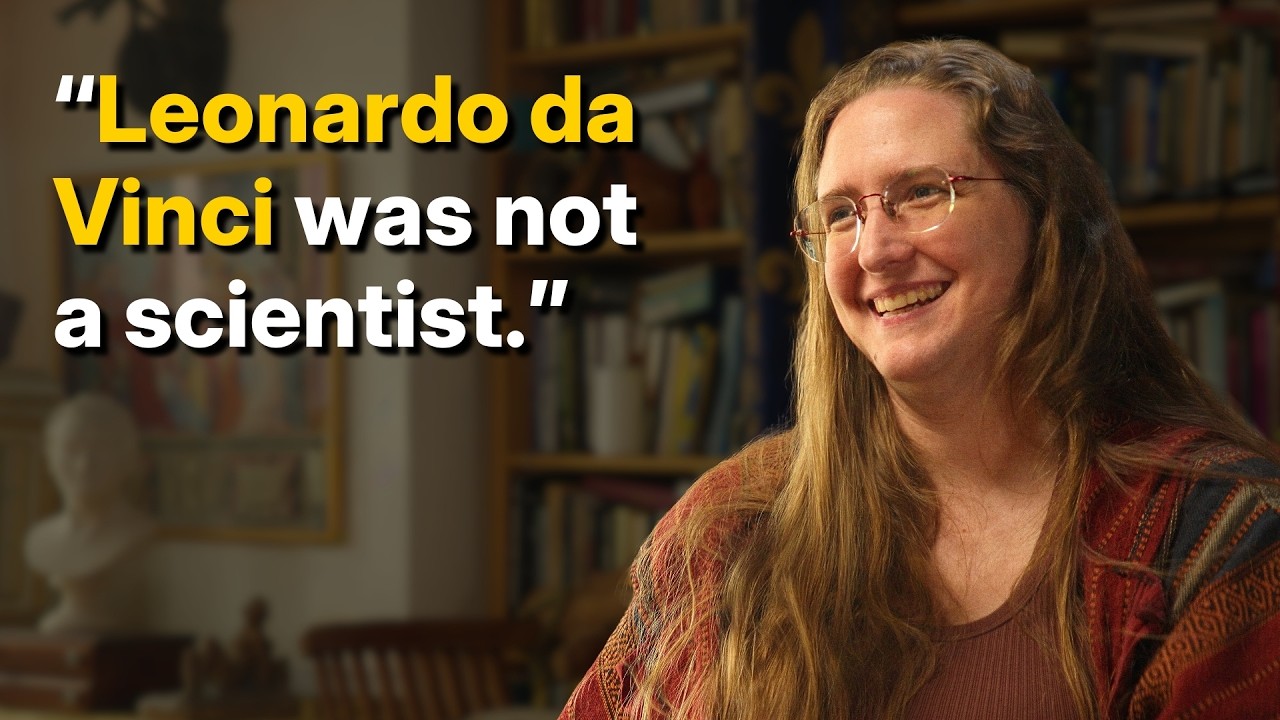
Ada Palmer, a Renaissance historian at the University of Chicago, discusses her book Inventing the Renaissance, tracing how a 14th-century project to revive Roman virtues through classical education gradually—over two centuries—transformed into the scientific revolution, with many unintended consequences along the way.
How Italian city-republics survived Rome’s collapse
When the Western Roman Empire dissolved, cities across Europe had to self-govern without centralized infrastructure, supply routes, or road security.
Larger, wealthier towns surrounded by good agricultural land could sustain themselves and became republics modeled on Rome, governed by councils of leading families.
Weaker towns often collapsed as residents migrated to the protection of local lords with bodyguards, creating feudal villages instead.
Italy had excellent farmland, so more of its cities survived as republics—Venice, Florence, Genoa, Bologna, Siena—making the region unusual in medieval Europe.
Petrarch’s project: imitate the ancients to fix broken leaders
Petrarch lived through the Black Death and constant warfare in Italy, including bandit attacks that killed close friends.
He concluded that contemporary leaders were selfish and cared more about family honor than the common good, unlike Roman figures described by Livy and Cicero.
He pointed to the Roman consul Brutus, who executed his own sons for plotting treason against the state—something no Renaissance lord would do.
His solution: recreate the educational environment that produced virtuous Romans by building libraries of ancient texts and surrounding young rulers with classical values.
This assumed education worked like osmosis—exposure to great examples would produce great leaders.
Cosimo de’ Medici and the propagandistic power of culture
The Medici were minor merchant families in Florence, looked down on by European nobility as “merchant scum.”
Cosimo invested heavily in art, architecture, Greek scholarship, and Platonic philosophy to make Florence appear as a rebirth of Rome.
When foreign ambassadors visited, they encountered lifelike bronze statues, a massive dome rivaling Roman ruins, a courtyard that felt like ancient architecture, and a ten-year-old Lorenzo de’ Medici reciting an original poem in ancient Greek about the soul.
This cultural display flipped power dynamics: suddenly noble ambassadors wanted alliances with the “merchant scum” to bring artists, architects, and Greek teachers back to their own courts.
The Medici also became papal bankers, collecting and channeling church revenues from across Christendom, taking a cut of the enormous flow of money.
Florence’s unusual republic and the Medici takeover
Unlike other Italian republics based on hereditary noble senates, Florence massacred its nobility and set up a commoner republic run by merchant guild owners.
Power was shared through sortition: nine men were randomly selected from eligible guild members, locked in a tower for two to three months, and had to reach consensus on all decisions—making it nearly tyrant-proof.
Florence couldn’t field its own armies or police (soldiers wouldn’t follow a commander without noble blood), so it hired a nobleman as podestà each year, paid him well, then banished him for life to prevent a takeover.
The Medici gradually captured this system through regulatory capture: employing a third of the city’s workforce meant that statistically, several of the nine randomly chosen councillors would always be their people.
When bad lottery results in 1430–32 led to Cosimo’s arrest, he bribed his guards (paying far less than he was worth), fled, and returned in triumph after the next lottery favored his allies.
Even after the Medici became dukes, they had to respect republican institutions because Florentines were deeply invested in them—the dukes continued wearing the republican lucco fiorentino (a toga-like red robe) and maintaining the appearance of shared power.
The Vasari Corridor—an elevated walkway connecting the old government palace to the Medici’s new palace—was built because the dukes feared assassination, a sign of their weakness.
When the duke tried to demolish part of the ancient Mannelli family tower for the corridor, the family refused, and he backed down—violating long-held property rights would have sparked rebellion.
This illustrates how even failed resistance constrains tyrants: Florence’s republic fell, but the fight meant more rights survived under the duchy than in neighboring Ferrara, where the d’Este dukes ruled with casual brutality.
Machiavelli: from Petrarchan idealism to political science
The first generation raised on Petrarch’s classical education—including Cesare and Lucrezia Borgia—grew up to wage even worse wars than before, with bigger cannons and more destruction.
Machiavelli, raised on Cicero and Livy, watched virtuous princes like Guidobaldo da Montefeltro lose everything while ruthless ones like Cesare Borgia succeeded.
He concluded that Petrarch was wrong: reading about good men doesn’t make good rulers. Instead, he proposed using history as a casebook—comparing examples of what worked and what didn’t, then imitating successful strategies.
This was an early form of political science, though it took decades to catch on.
Machiavelli worked for the Florentine republic after the Medici were temporarily expelled, but when they returned, his name was found on a resistance recruitment list and he was arrested, tortured, and exiled.
He wrote The Prince in exile and dedicated it to the Medici—not out of flattery, but because he wanted only Florence to have his manual of statecraft, believing it would help defend his homeland.
He refused to take positions at other courts (as most exiled intellectuals did) and stayed in a Tuscan hamlet, writing letters begging to be allowed to serve Florence again.
His core argument: regime changes bring civil violence, and even life under a tyrant is better than civil war, which usually ends in massacre and foreign conquest.
The long chain from classical libraries to the scientific revolution
The process from Petrarch (1300s) to Francis Bacon and Galileo (1600s) took about 200 years—as long as from Napoleon to the space race.
Key intermediate steps:
Building libraries by scouring monasteries and Constantinople for manuscripts
Developing tools that made texts accessible: translations into vernacular, footnotes, glossaries, dictionaries
The printing press (1450), which took 40 years to become economically sustainable
Rising literacy and book ownership beyond a tiny elite
When Poggio rediscovered Lucretius’s materialist poem in 1417, perhaps two dozen people in the world could read it; a hundred years later, 30,000 could read it in 30 printed editions.
Med students, law students, and readers across different countries asked new questions and tested hypotheses—leading to discoveries like the heart being a pump and early germ theory.
Francis Bacon proposed using nature itself as a casebook, the way Machiavelli used history: observe, compare, test, and share results.
Bacon’s famous insect simile: the ant merely collects knowledge; the spider spins beautiful but empty theories; the bee gathers from nature and transforms it into something sweet and useful for humankind.
The scientific method was framed as the ultimate act of charity—a gift to every human who will ever live.
Why the printing press didn’t immediately change everything
Gutenberg went bankrupt because printed books are mass-produced commodities in a world without distribution networks for mass-produced goods.
He printed 300 Bibles but could only sell 7 in his small German town (only priests were legally allowed to read the Bible).
His apprentices also went bankrupt, fled to Venice, and only there—as the Mediterranean’s hub port where ships constantly arrived and departed—did print become economically sustainable by distributing books along existing trade routes.
Book fairs (like Frankfurt) developed as distribution mechanisms: printers would trade copies with each other, then return home with diverse inventories.
Printers survived financially by printing cheap pamphlets alongside expensive books—pamphlets could be produced in days and sold immediately, while books took months.
The printing press didn’t cause one revolution but many successive ones over 150 years:
1450s: printed books
1490s: economically sustainable printing
1510s: pamphlets enabling rapid news distribution
1517: Luther’s Ninety-five Theses reached London in 17 days, enabling the Reformation
1600s: newspapers, then magazines to fact-check newspapers
This parallels the digital revolution: computers, personal computers, internet, cell phones, social media, and AI are all successive applications of one underlying technology.
Why the Industrial Revolution didn’t happen in Italy
Italy was already economically dominant through agriculture (olive oil as “Big Oil”), high-quality wool processing, and finance—so there was less pressure to industrialize.
England exported raw wool to Florence because it lacked the olive oil needed to process it into fine fabric.
Italy’s land was more valuable as farms than as mines.
Its political fragmentation into competing city-states meant no single entity could drive massive industrial transformation, and no city wanted to bear the costs of industrialization.
England’s centralized crown could pass facilitating legislation, and industrialization occurred in second-tier towns like Lancaster rather than in wealthy centers.
There’s evidence that industrial-scale looms were figured out in the 1400s but deliberately not adopted because artisans preferred producing luxuriant handmade fabrics.
The material basis of knowledge: papyrus, parchment, and paper
Rome’s bureaucracy and libraries depended on papyrus, a cheap plant-based writing surface that grew only in warm climates.
When Rome lost access to papyrus, Europe was left writing on parchment (animal skin)—as expensive as a leather jacket per page, compared to a head of lettuce for papyrus.
A handwritten medieval book cost as much as a house; a large illuminated Bible cost as much as a villa.
The great library of the University of Paris had only 600 books; sultans in the Middle East and libraries in Sub-Saharan Africa and China had thousands because they had cheap writing surfaces.
Most ancient texts were not lost at the Library of Alexandria but between 400–600 AD when papyri became brittle and fell apart.
Monks who did the copying saved Christian texts (like Saint Augustine) far more than pagan classics, biasing what survived from antiquity.
Paper reached Europe around 800 AD but was expensive (made from beaten rags) and distrusted—it took 400 years before the earliest state document was written on paper.
Gutenberg’s real cost was paper: he borrowed the equivalent of $1.5 million to buy paper upfront before he could sell a single book.
Leonardo da Vinci as saboteur of progress
Leonardo wrote all his discoveries in coded mirror writing, refusing to share even with his students.
He wanted to create unique masterpieces that future generations would marvel at, unable to replicate—exactly how he and his peers marveled at Roman ruins like the Pantheon.
Brunelleschi deliberately burned his notes and schematics after building Florence’s dome so no one else could replicate it.
These were inventors and engineers, but not scientists—they deliberately cut off progress to maintain their uniqueness.
The shift came around 1600 with Bacon’s call to publish and share, making science a collaborative enterprise aimed at benefiting all humanity.
Censorship always targets the wrong things
The Inquisition was far more worried about Jansenist treatises on the nature of the Trinity than about Voltaire, Rousseau, or the Encyclopédie.
When Rome ordered France to burn the banned Encyclopédie, French authorities ceremonially burned Jansenist treatises instead because they actually loved the Encyclopédie (the queen used it to look up how her silk pantyhose were made).
The 1545 Index of Banned Books put minor Protestant theologians’ names in all caps as “arch-heretics” while leaving Machiavelli in regular type.
Inquisitors wrote to each other that Lucretius didn’t need censoring because only learned people could read it and they “know perfectly well that the false stuff is false.”
Of hundreds of thousands of Inquisition trials, only about 100 were for atheism, 12 for science-related matters, and only Giordano Bruno was executed.
Milton’s Areopagitica—the great defense of press freedom—failed; censorship passed, and Paradise Lost was published under censor. The censors’ one demanded change was a line about astrology, not Satan’s anti-monarchical rhetoric.
Every era is wrong about what ideas are truly dangerous and wastes energy on petty concerns while missing transformative ones.
The Inquisition accidentally invented peer review
After Galileo, inquisitors saw themselves as guarantors of truth and decided they needed to verify the scientific claims in books they were sent to censor.
They built what was effectively the most extensive experimental laboratory in late 17th-century Europe, repeating experiments to check whether results were real.
This was essentially the invention of peer review—a second laboratory trying to recreate the results of the first.
Some inquisitors went home at night to write their own scientific treatises based on the experiments they had conducted during the day.
Why the New World discovery wasn’t immediately seen as world-changing
When Columbus returned, Europeans thought he had found something perhaps the size of the Canary Islands—not a continent.
Europe was simultaneously facing French invasion, Ottoman advances, and papal power struggles, making distant discoveries feel less urgent than immediate crises.
The discovery became intellectually significant over time as it challenged ancient geography and forced a paradigm shift, but in 1492 it was one of many simultaneous upheavals competing for attention.
People in every era are consumed by their immediate tumults and fail to recognize the most transformative developments happening around them.