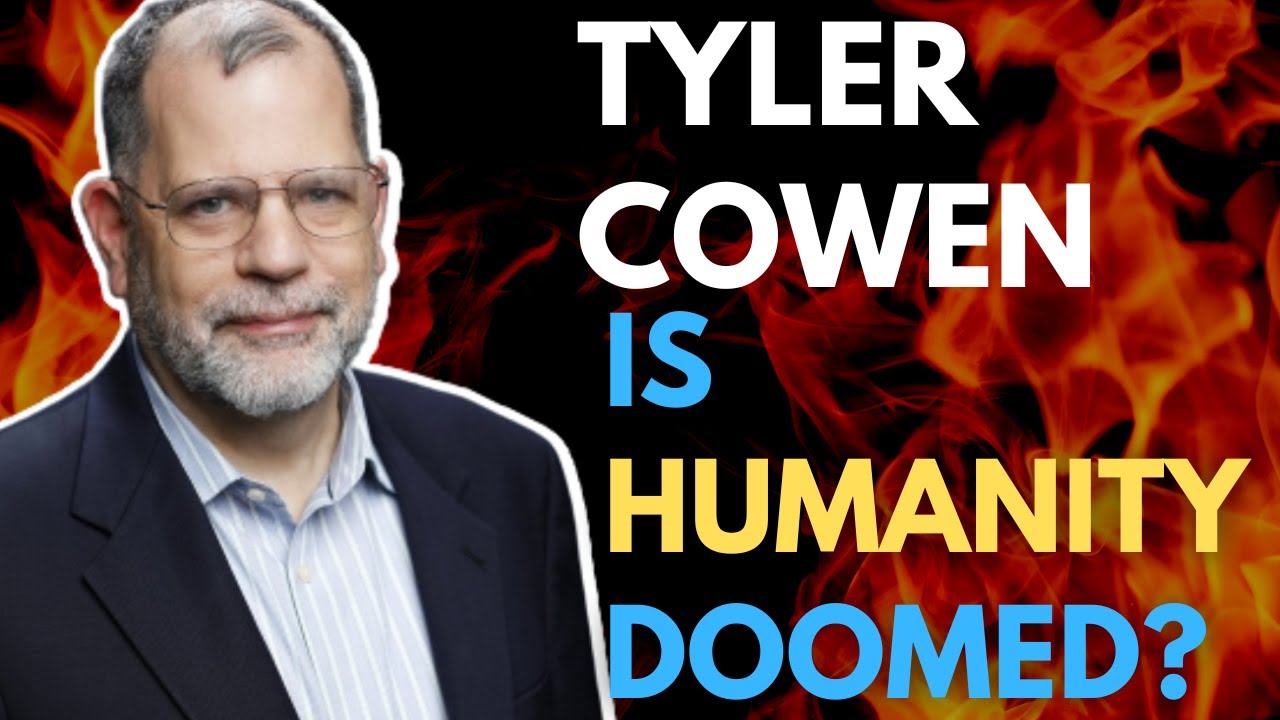
Tyler Cowen, economist at George Mason University and director of the Mercatus Center, discusses his prediction of a “Great Reset” from his 2017 book The Complacent Class, how the current crisis fits that vision, and his views on economic growth, stagnation, nuclear risk, education, talent, and the future.
He argues the Great Reset is here now, driven by institutional failure across the American regulatory state, executive branch, and Congress, even though the Fed and Supreme Court have functioned well.
He predicted that racial tensions and segregation would be an early warning signal of the reset, which he sees confirmed in recent events.
He remains optimistic about biomedical dynamism and tech innovation but uncertain about dynamism in other sectors.
Growth and the cyclical view of history
Cowen reconciles the apparent tension between Stubborn Attachments (which champions long-run economic growth) and The Complacent Class (which sees history as cyclical).
He is cyclical in the short run, expecting periods of slower and faster growth, but believes that over centuries, reasonably liberal institutions produce steadily advancing growth.
He sees cultural and institutional persistence as the reason growth can compound over very long horizons despite short-term fluctuations.
Time horizons, sustainability, and space
Cowen’s Stanford lecture argued that the case for long-run growth depends on choosing the right time horizon.
If the time horizon is too long, people become excessively risk-averse, prioritizing safety over growth.
He semi-seriously estimated that civilization has about 700–800 years remaining, largely because of the risk of weapons of mass destruction over long time spans.
He is not a “space optimist” and believes the speed of light and travel difficulties make galactic colonization unrealistic; Earth is essentially all we have.
He does not think physical space or energy are binding constraints on Earth-bound growth; human conflict and carbon emissions are more pressing, and he believes carbon will eventually be addressed.
Nuclear risk and the future of war
Cowen is skeptical of Steven Pinker’s thesis that the long-term trend away from violence will continue.
He proposes a “ratchet hypothesis”: major wars become less frequent but each one is worse than the last, and he considers another world war inevitable given enough time.
He pressed Pinker on what happens when nuclear weapons become cheap (e.g., $50,000), and found Pinker’s inability to answer the question telling.
He is not persuaded by David Deutsch’s argument that free societies will innovate faster than authoritarian threats, because the cost of destruction is far lower than the cost of building, and a single rogue actor or accident could be catastrophic.
He estimates over a 70% chance that a nuclear weapon will be detonated (in a limited, non-test capacity) in the listener’s lifetime, most likely through terrorism or accident, but considers full-scale nuclear war relatively unlikely in the near term.
Common sense morality and authoritarianism
Cowen argues that common sense morality tends to be roughly right because societies with wildly aberrant moral norms fail through group-level selection and competitive pressures.
Philosophies that radically contradict common sense morality (e.g., some of Peter Singer’s views) should be viewed with suspicion.
He is cautiously optimistic that free and prosperous societies will prevail long-term, but acknowledges that autocracy has proven more durable than expected.
China has become less democratic as it has grown wealthier, and there is no evidence that its median voter desires democracy; the naive modernization theory is unsupported by current facts.
Big business and complacency
Cowen’s book Big Business is not a contradiction of The Complacent Class but a refinement.
The decline in startup formation is heavily concentrated in retail (e.g., mom-and-pop stores), which he considers unremarkable rather than alarming.
Large firms like Google and Amazon are highly innovative and productive; the productivity problem in the US lies in education, health care, and government, not in big business or the tech sector.
He views big business as a major force against complacency, though he still wants more dynamism overall.
Online education vs. university
Cowen co-created Marginal Revolution University (MRU), an online platform with full economics courses including lectures, problem sets, and exercises.
He sees online education as a supplement, not a replacement, for in-person university—roughly the best 20% of a traditional education can be replaced by choosing freely from online offerings.
The irreplaceable value of university includes face-to-face interaction with diverse personality types, mentorship, socialization, and learning how hierarchies and institutions work.
He believes people’s need to be around other people ensures that in-person education will always remain central.
Aesthetic decline in West Virginia
Cowen visited Parkersburg, West Virginia, and observed a striking contrast between beautiful early 20th-century homes and ugly modern architecture.
Absolute wealth in Parkersburg is higher today than when the fine homes were built, yet the aesthetic quality has collapsed.
He attributes this to a loss of cultural self-confidence, sense of centrality, and civic ethos, drawing a parallel to the aesthetic degradation seen under communism in places like Prague.
Advice for young people
Cowen’s core advice: find at least one really good mentor (ideally two or three) and build a small group of close friends.
Mentors teach a few critical things and give a glimpse of what one can become; the return on good mentors is enormous.
He emphasizes that mentors influence through example more than explicit instruction—he was shaped by meeting someone who tried to read as many books as possible, even if that person never directly told him to do so.
He acknowledges that in-person, flesh-and-blood mentorship remains important even in the age of podcasts and online content.
Identifying talent
Cowen is co-authoring a book with Daniel Gross on identifying and signaling talent, due July 20, 2020.
The book is aimed at both talent searchers and those being searched for, focusing more on spotting and signaling talent than on developing it.
He strives to keep his books almost entirely fresh material, avoiding overlap with his blog, Bloomberg columns, or podcasts, as a matter of principle toward his readers.
Can adults change?
Cowen believes temperament is relatively stable from age 18 through 70 for most people, though there are exceptions (e.g., certain mental health conditions).
Skills and interests can change significantly after 18, and people who develop later may bring valuable fresh perspectives.
He had a major head start (giving talks at 19, reading voraciously as a teenager) but cautions against writing oneself off for lacking that head start.
He notes that women may change more dramatically than men later in life, partly due to the formative experience of childbearing and partly because societal barriers may delay their development, making their eventual change more radical.
Feminization, safety, and growth
Cowen argues that the feminization of society has brought significant benefits, especially in safety—the chance of an American dying in combat has been very low for decades.
He does not believe reversing feminization is either feasible or desirable, as doing so would require destructive and rights-violating measures.
Instead, he advocates building a dynamic, highly feminized society rather than trying to return to a more aggressive, risk-tolerant culture to boost growth.
Conservatives, progressives, and dynamism
Cowen notes that conservatives and figures like Ross Douthat and Peter Thiel are often the ones concerned about stagnation and lack of dynamism.
Progressives define progress differently, focusing on removing barriers for the least privileged, and believe that failing to do so will make politics toxic for everyone.
Cowen agrees with the progressive framing in principle but argues that economic growth over time raises all boats even when gains are unequally distributed, and that this insight has been lost due to impatience.
Biggest mistake in history
Cowen is reluctant to identify a single biggest mistake in human history, arguing that most of history has worked out well relative to the starting point (e.g., even poor countries like Laos are far better off than in the Stone Age).
He is skeptical of counterfactuals: preventing World War I might have led to a non-Nazi Germany acquiring nuclear weapons first, which could have been worse.
He considers Brian Caplan’s proposal of World War I as the biggest mistake to be the best available answer but remains uncertain.
Pessimistic and optimistic futures
Pessimistic scenario: The crisis drags on for years; a vaccine may come but could be low-quality or even harmful, undermining vaccine credibility; psychological scarring, unemployment, collapse of international cooperation, and closed borders persist regardless of who is president. The worst case combines war with pandemic.
Optimistic scenario: The US death rate has already fallen to a quarter or fifth of its peak, better than predicted; a moderate-quality vaccine arrives by early 2021; a V-shaped recovery follows by March; borders reopen. Most importantly, biomedical science 5–10 years from now will be significantly better because of the pandemic-driven research surge, and the world will be better prepared for the next pandemic.
Cowen considers this silver lining—a major acceleration in biomedical innovation—more than 50% probable.