-
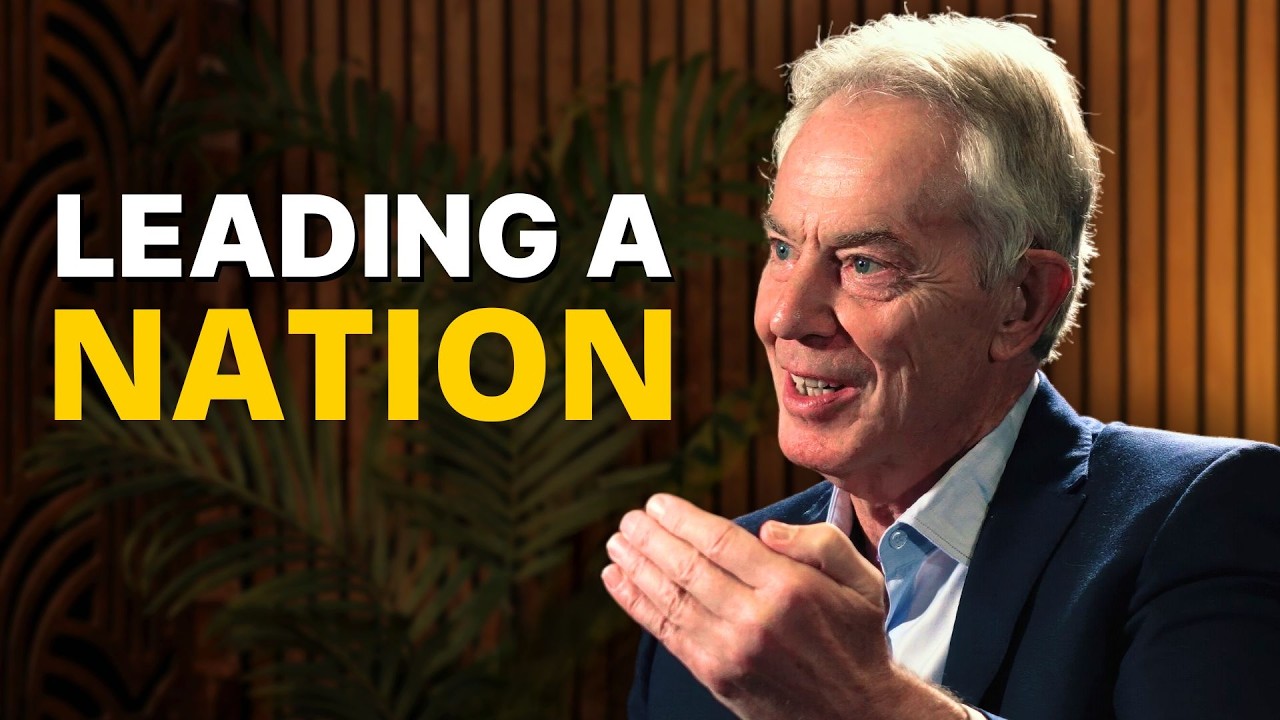
Tony Blair, UK Prime Minister from 1997 to 2007 and now head of the Tony Blair Institute (TBI), which advises roughly 40 governments on governance and reform, discusses what he has learned about political leadership, why it is uniquely difficult, and how the current AI revolution should reshape the role of government.
-
Why political leadership is uniquely hard
- Blair argues that political leadership is the only major role where someone is given enormous power with zero prior training or experience. He himself had never held a ministerial post before becoming prime Minister.
- The core difficulty is a skills transition: campaigning requires persuasion and communication; governing requires executive skills — prioritization, policy design, team-building, and implementation. Many leaders fail because they never make that shift.
- The system itself is not a conspiracy but a “conspiracy for inertia”: civil servants and institutions see elected politicians as temporary and prefer to manage the status quo. Blair says the hardest part of his early years was learning how to give clear direction to the bureaucracy and bring in outside skilled people to drive change.
- If he could return to 1997 with what he knows now, he would move people faster, give clearer direction, and be more ruthless about putting quality people in the core positions that matter — though he notes that politics, unlike business, sometimes requires keeping people who are useful for party management even if they are not the best ministers.
-
CEOs vs. politicians
- Blair believes executive skills from business do transfer to government, but they are not sufficient. A political leader must also manage a party, frame issues, and navigate political constraints that a CEO does not face.
- He reflects that in hindsight he had more leverage than he realized at the time — he could have fired underperformers or canceled unproductive meetings — but that political dynamics make this harder than in a company.
- His core lesson: “It’s all about the people.” A small number of strong, determined people who share the leader’s vision can change a country, but they must be in the right positions.
-
Why elected change-makers often fail to change much
- Blair identifies two recurring problems he sees across the leaders he advises:
- Ambitions are not policies. Leaders often articulate a general vision of change but have not done the intellectual work to translate that into specific, actionable policies. Ambitions are easy; policies are hard.
- Policy is an intellectual business. Even though politics at the surface is crude — slogans, attacks, handshaking — real policy design requires deep engagement with complex questions. Without that work, ambitions remain ambitions.
- He applies this to AI: leaders today must understand the technology revolution deeply enough to access its opportunities, mitigate its risks, and regulate it appropriately. If they do not, they will be unable to respond when a crisis occurs.
- Blair identifies two recurring problems he sees across the leaders he advises:
-
COVID, AI, and how governments handle crises
- Blair uses COVID as a case study of systemic government failure. He notes that no Western government handled it well, and the failures were correlated — suggesting a structural problem rather than individual incompetence.
- The core trade-off — how much to lock down vs. keep the economy open — was genuinely difficult, but Blair believes many governments could have avoided harsh lockdowns with better testing and faster vaccine rollout.
- A deeper problem was that governments did not know where to turn for advice. They had scientific and medical input but struggled to balance it against economic and social costs.
- He argues that COVID was technically simpler than an AI crisis would be: there was a known tool (vaccines) and a known playbook (roll them out). AI is a general-purpose technology with novel, poorly understood risks.
- His view is not that government should be bypassed, but that it must rely on the private sector for technical expertise and options while retaining the authority to make final policy decisions — because governing means choosing between competing values, and “the moment you take a decision, you divide.”
- He warns that if the health bureaucracies that failed during COVID are analogous to today’s technology and commerce departments, those may also be unprepared. The solution is not to fire everyone but to build systems that can sense the contours of a new crisis and draw on outside expertise to generate options.
- Blair uses COVID as a case study of systemic government failure. He notes that no Western government handled it well, and the failures were correlated — suggesting a structural problem rather than individual incompetence.
-
Learning from Lee Kuan Yew
- Blair says he learned from Lee Kuan Yew rather than the other way around. Lee took three deeply contested decisions in the 1960s that now seem obvious:
- Made English the common language of Singapore, despite pressure to use local languages.
- Recruited the best intellectual and managerial talent from anywhere in the world, despite resentment of foreign influence.
- Instituted zero tolerance for corruption and paid political leaders extremely well (roughly 10× the next best-paid leaders globally) to reduce the incentive for graft.
- Blair’s broader point: government should be treated as its own professional discipline, not just a branch of politics, and leaders should study what has worked and what has not.
- Blair says he learned from Lee Kuan Yew rather than the other way around. Lee took three deeply contested decisions in the 1960s that now seem obvious:
-
Whether Western leaders can still drive major change
- Blair argues they can. Unlike Singapore in the 1960s, Western leaders inherit large, established systems, but they still have significant power at the center (especially in the UK).
- He sees the technology revolution as the defining agenda: using AI to transform healthcare, education, and the functioning of government itself, and helping the private sector adopt AI to improve productivity.
- He pushes back on the idea that Western systems are too inert to experiment. Governments should be able to experiment, but systems have a bias toward caution — “a conspiracy for inertia.”
- He describes the “four Ps” of government that apply whether you are running the US or a small African country:
- Prioritize — if you try to do everything, you do nothing.
- Policy — go deep and get the right answer, often by bringing in outside experts.
- Personnel — put the right people in place.
- Performance manage — focus on implementation once a decision is made.
-
Foreign policy and intelligence
- On dealing with regimes like Iran and North Korea that are pursuing WMDs, Blair is blunt: there is no appetite in the West for regime change, sanctions have limited effect, and the problem is compounded by the alignment of China, Russia, Iran, and North Korea.
- The realistic options are to constrain such regimes and build alliances to reduce their ability to destabilize regions.
- On intelligence, Blair says Western intelligence (especially the Five Eyes) is generally extremely good and will improve further with new tools. He acknowledges that in cases like Iraq, intelligence failures were real, but argues that with hindsight one must be careful not to treat past problems as predictors of current or future ones.
- He notes that intelligence services are now heavily focused on forward-looking threats like AI and cyber, and that cyber threats represent a new category of potentially devastating risk.
-
How much leadership actually matters
- Blair argues that governance quality — of which leadership is a large part - is the key determinant of national outcomes in a world where capital and technology are mobile.
- He gives paired examples to illustrate the point:
- Poland vs. Ukraine: both emerged from the Soviet Union with similar potential, but Poland’s decision to join the EU and undertake major reforms led to success.
- Rwanda vs. Burundi: Rwanda, despite the genocide, is now one of the most respected countries in Africa.
- South Korea vs. North Korea: the largest experiment in human governance. South Korea went from having the same GDP per capita as Sierra Leone in the 1960s to being one of the top countries in the world.
- He acknowledges that institutions matter and that good leaders should build good institutions, but insists that leadership decisions — like those of Lee Kuan Yew in Singapore or Deng Xiaoping in China — are often the turning points.
- He sees the AI revolution as a moment when technology leaders and governments must work together: “We need your help in changing government and changing countries.”
-
Public vs. private sector and the “reimagined state”
- Blair rejects the idea of simply privatizing healthcare and education, because the public will still expect government to protect the public interest.
- Instead, he advocates a “reimagined state” that is more strategic: setting a framework and then allowing more diversity, competition, and innovation within it.
- The hardest challenge in the public sector is creating self-perpetuating innovation. In the private sector, failure to innovate means going out of business; in the public sector, it just means the service gets worse while the institution survives.
- He points to examples like Khan Academy and the prospect of AI tutors and AI doctors as opportunities to personalize education and healthcare, but says the challenge is reforming the system so these tools are used effectively.
-
Why leaders ignore good advice
- Blair says this usually happens for two reasons:
- Change is hard. There is a rhythm to reform: people say it is a terrible idea at first, it is painful while underway, and afterward people wish they had done more. Vested interests and system resistance can block even sensible reforms (e.g., island states that could run on solar and wind but remain dependent on heavy fuel oil).
- Government is a conspiracy of distraction. Events, crises, and scandals constantly divert leaders from their core priorities. Blair describes doing time analyses with leaders and finding that they spend as little as 4% of their time on their stated priorities.
- He argues that the single biggest problem in Western politics today is “politics first, policy second” — leaders choose a position for political reasons and then try to shape policy around it, rather than finding the right answer and then shaping the politics around it.
- He also highlights the psychological toll of modern politics: leaders are dehumanized, attacked on integrity and character, and subjected to a constant stream of noise, especially on social media. His advice is to develop a “Zen-like attitude” and have someone summarize the noise on half a page each morning rather than falling into the rabbit hole.
- Blair says this usually happens for two reasons:
-
The unipolar moment and today’s multipolar world
- Blair reflects on the 1990s and early 2000s, when the West had unusual global dominance. He says the West did try to adapt: he and President Clinton pushed to bring China into the global trading system, and the G8 included Russia with China regularly invited.
- He believes the West probably underestimated how fast India would rise and sometimes views the world too much through its own lens, assuming it could have shaped outcomes that were driven by other countries’ choices.
- He sees today’s multipolar world as inevitable and even healthy, but notes that China and Russia have become overtly hostile to Western democratic values. His view is that the West should not try to contain China — China is rightly a major power — but must retain military and technological superiority while leaving space for cooperation.
-
What success looks like across countries
- When asked which leader is most impressive, Blair declines to name individuals but says that countries that have moved from developing to developed status tend to share four features:
- Stable macroeconomic policy.
- An environment that allows business and enterprise to flourish.
- The rule of law.
- Strong education of their people.
- He adds that the AI revolution may rewrite all of these rules. The single most important thing for any leader today is to engage with the technology revolution, understand it, and bring people who understand it into government to make the key decisions that will allow societies to access opportunities and mitigate risks.
- When asked which leader is most impressive, Blair declines to name individuals but says that countries that have moved from developing to developed status tend to share four features:
-