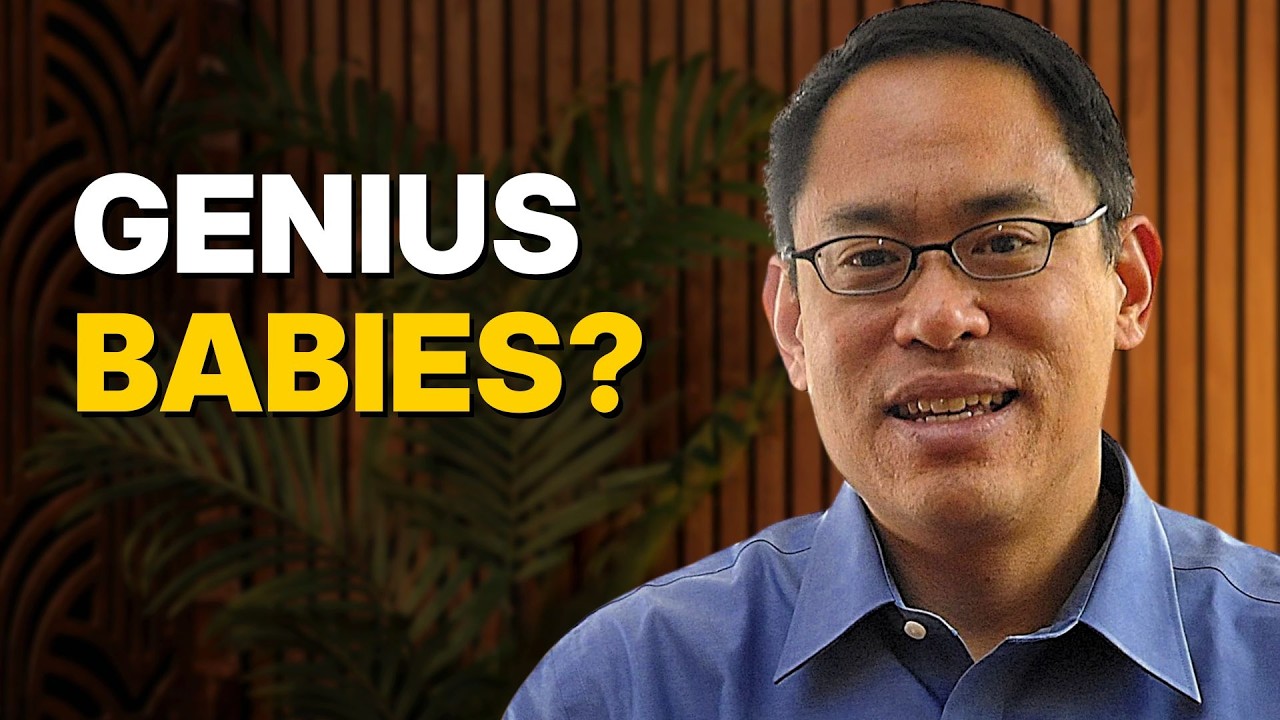
Steve Hsu is a theoretical physicist and co-founder of Genomic Prediction, a company that uses machine learning on genomic data to help IVF families select embryos with lower disease risk and, potentially, higher cognitive ability. He explains the science behind polygenic risk scores, why genetic architecture is surprisingly additive, how embryo selection could dramatically extend healthy lifespan, and why intelligence data is lagging due to political sensitivities. He also discusses the future of gene editing, the feasibility of selecting from hundreds of embryos, and the broader implications for human evolution and inequality.
Embryo selection and polygenic risk scores
Genomic Prediction works with IVF clinics worldwide to genotype embryos from small biopsies and produce reports estimating each embryo’s risk for diseases like diabetes, breast cancer, and cardiovascular disease.
The core scientific problem is predicting phenotype from genotype: given millions of single nucleotide polymorphisms (SNPs) across individuals’ genomes, machine learning identifies which variants predict traits like height, disease risk, or cognitive ability.
The models are ultimately simple and additive: each variant contributes an independent effect, and the total prediction is a weighted sum. This additive structure is not assumed but empirically validated.
Hsu’s early mathematical work (around 2012) used compressed sensing theory (L1-penalized regression) to prove how much data would be needed to “solve” traits like height. When sufficient data became available around 2017, the predictions held: a few hundred thousand genomes were enough for height, confirming the theory.
The additivity is explained by Fisher’s fundamental theorem of natural selection: additive variance dominates evolutionary response because nonlinear interaction terms get broken up by sexual reproduction. For small differences between humans, the genome behaves like thousands of independent switches.
Why evolution hasn’t optimized humans
Traits like height and cognitive ability are controlled by roughly 10,000 or more variants. To shift someone by one standard deviation, you only need to flip about 100 variants (the square root of 10,000), meaning there is enormous “variance up for grabs.”
Evolution hasn’t optimized humans because: (1) the environment has changed radically in the last 10,000 years (agriculture, modern life), so there’s no fixed optimum; (2) many diseases manifest after reproductive age, so there’s little selective pressure against them; (3) high-dimensional optimization is slow even with strong selection.
Hsu’s group showed that selecting the best embryo out of 10 could increase disability-adjusted life years by about 4 years. Extrapolating from polygenic predictors, a one-in-a-billion person on overall health would be predicted to live to about 120 years.
With gene editing (multiplexed CRISPR), it may eventually be possible to flip hundreds or thousands of variants at once, dramatically extending lifespan and reducing disease risk. Hsu is confident this will be technically feasible within 10–20 years.
Intelligence and cognitive ability
Cognitive ability is highly polygenic (likely more than 10,000 variants) and highly heritable, but progress on genomic prediction for intelligence is lagging because researchers are afraid to collect cognitive data due to political controversy.
Hsu estimates that with 250,000 to 1,000,000 genomes linked to cognitive test scores, a predictor with a standard error of about 10 IQ points could be built. Short tests like the Wonderlic (12 minutes) are sufficiently correlated with full IQ tests to be useful.
Currently, researchers use educational attainment (EA) as a proxy, but EA captures conscientiousness and conformity in addition to intelligence. Hsu’s group showed that EA predictors perform worse when predicting differences between siblings (who share family environment) than when predicting unrelated individuals, confirming that EA is contaminated by non-cognitive factors.
Using sibling comparisons and other methods, Hsu’s team can partially disentangle the “G” (general intelligence) component from the conformity/conscientiousness component, but direct cognitive data would be far better.
If different countries (e.g., China, Singapore, Estonia) build cognitive predictors using their own populations, they could gain a scientific and strategic advantage, since tagging correlations between SNPs differ across ancestry groups.
Ancestral populations and portability of predictors
Most genomic data is from European-ancestry populations. Predictors trained on Europeans lose accuracy when applied to other groups because the “tagging” correlations between nearby SNPs (linkage disequilibrium patterns) differ across populations.
It is not yet known whether the truly causal variants are the same across populations or just different tags for the same causal variants. This is an active area of research.
As non-European biobanks come online in the next 5 years, researchers will be able to identify which SNPs are consistently significant across populations, helping to pinpoint causal variants.
There is concern that this research could reveal average differences in trait-associated alleles between populations (e.g., height-associated alleles differ between Northern and Southern Europeans, likely due to selection over the last 5,000 years). If similar differences exist for behavioral or cognitive traits, it would be politically explosive. Hsu argues the science should proceed regardless.
Tradeoffs and pleiotropy
A common concern is that selecting for intelligence might increase risk for other conditions (e.g., the higher rate of nervous system disorders among Ashkenazi Jews). However, because traits are controlled by thousands of largely disjoint variants, Hsu argues there is enough “room” in the genome to avoid pleiotropic tradeoffs: if one cluster of variants increases disease risk, a skilled genetic engineer can use different variants to achieve the same cognitive gain.
Historical examples of geniuses who were also physically healthy and socially successful suggest that high intelligence does not necessarily come with severe tradeoffs.
The modularity of the genome (different traits depend on largely non-overlapping sets of variants) means that, in principle, many traits can be optimized independently.
Consumer adoption and market dynamics
Hsu disputes pessimistic forecasts about adoption of embryo selection. In Denmark, 1 of 10 babies is already born via IVF, and IVF rates are growing worldwide, especially as maternal age at first birth increases.
Once IVF is already being done, adding a polygenic risk report is nearly free (just computation on existing data), so Hsu expects near-universal uptake among IVF users.
Genomic Prediction has a first mover advantage through relationships with hundreds of clinics on six continents, though the scientific moat (best algorithms) may not be permanently defensible.
The service is hard to regulate because it’s just data: a clinic anywhere can upload genotypes to a cloud service in another country and receive a report. Hsu expects the technology to become fully cloud-based within a few years.
Some countries may ban it; others (like Denmark or Israel, where IVF is publicly funded) may offer it free as part of national healthcare. Hsu hopes for broad access to prevent grotesque inequality.
Future technologies
Induced pluripotent stem cells (iPSCs) as egg substitutes: It’s already possible to make eggs from skin cells in mice. Startups are working on this for humans. If perfected, this would remove the bottleneck of egg retrieval, allowing hundreds or thousands of embryos to be generated from a single skin cell. A young woman already produces 60–100 eggs per cycle; with iPSC technology, even more could be generated.
Iterated embryo selection: Repeatedly selecting the best embryo, growing it to stem cells, generating new embryos, and selecting again could amplify gains beyond what a single round of selection allows. Hsu considers this plausible but doesn’t know of anyone actively working on it.
Multiplex gene editing: On a similar timescale (10–20 years), CRISPR-based editing of hundreds or thousands of variants simultaneously is expected to mature. At that point, embryo selection becomes unnecessary: you simply edit the desired variants into the embryo.
Facial reconstruction from DNA: Because facial features are highly heritable and AI face-recognition algorithms map faces to hundreds of parameters, it will soon be possible to predict what an embryo will look like at various ages from its DNA alone.
Genomics in dating and reproduction
Hsu discussed with senior executives at a major dating app company the possibility of DNA-verified traits (e.g., height) on profiles. Men already lie about height on these apps; DNA verification would prevent this.
More speculatively, couples could be advised on the genetic complementarity of their genomes: if one partner has “plus” variants in regions where the other has “minus” variants, their offspring could be outliers for traits like intelligence. This was actually described in an early 23andMe patent application.
Hsu does not offer this service; Genomic Prediction currently focuses only on health-related traits.
Physics, data science, and career transitions
Physicists are well-suited to genomics because they are trained in high-dimensional optimization, noisy data analysis, and connecting mathematical models to messy experimental results. Hsu’s background in compressed sensing theory directly enabled his contributions to polygenic prediction.
Many physicists “bleed out” of academia into other fields. Bezos studied physics at Princeton but switched to computer science after realizing a classmate (Yasanta) was far more gifted. Elon Musk dropped out of a Stanford physics PhD. Hsu argues the training is valuable even if people don’t stay in physics.
Physicists are particularly good at dealing with “shitty data”—debugging experiments, identifying systematic errors, and insisting on connecting models to reality. This skill transfers well to finance, data science, and entrepreneurship.
Hsu interviewed Sam Bankman-Fried (FTX CEO) and noted his exceptional ability to explain complex ideas across different audiences—a skill strongly selected for in successful founders.
Elite education and cognitive ability
Even controlling for SAT scores, graduates of elite universities are overrepresented in top jobs. This is due to: (1) networking with ambitious, well-connected peers; (2) exposure to elite career paths and role models; (3) family connections that open doors.
Hsu studied this question intensely as an entrepreneur trying to understand why some founders raise vastly more money than others.
He argues that cognitive ability is multidimensional: verbal, spatial, mathematical, and generalist intelligence are correlated but distinct. Bezos may not have been the best theoretical physicist, but he is likely offscale in generalist intelligence, work ethic, and ability to function under pressure.
Spatial ability is particularly important for engineering and physical tasks but less so for programming. Hsu notes that shop class used to reveal stark differences in spatial ability that SAT scores miss.
China, India, and scientific output
China and India are underrepresented in Nobel prizes and top-tier research, but this is largely a lagging indicator of recent development. Hsu has watched Chinese and Korean universities transform within his lifetime from places where the best students always left for US PhDs to institutions producing world-class research.
The US benefits enormously from brain drain: top students from India (e.g., IIT toppers) and China come to US universities and stay. This is good for the US but bad for developing countries and may suppress native-born American talent in the long run.
In tech, compensation remains high despite immigration because demand is very elastic. In more traditional engineering fields, immigration may suppress wages for native-born workers.
Jiu-jitsu and cognitive amplification
Hsu practices jiu-jitsu, which he describes as “applied physics”—a rational, scientific analysis of what two humans can do to each other. It allows smaller practitioners to defeat larger ones through technique.
Analogously, cognitive ability can be amplified through tools (Google, AI, training), but there is no “dojo” for intelligence where a novice can quickly learn to outperform someone with much higher raw ability. Technologies help, but the amplification is limited compared to what jiu-jitsu offers in physical combat.