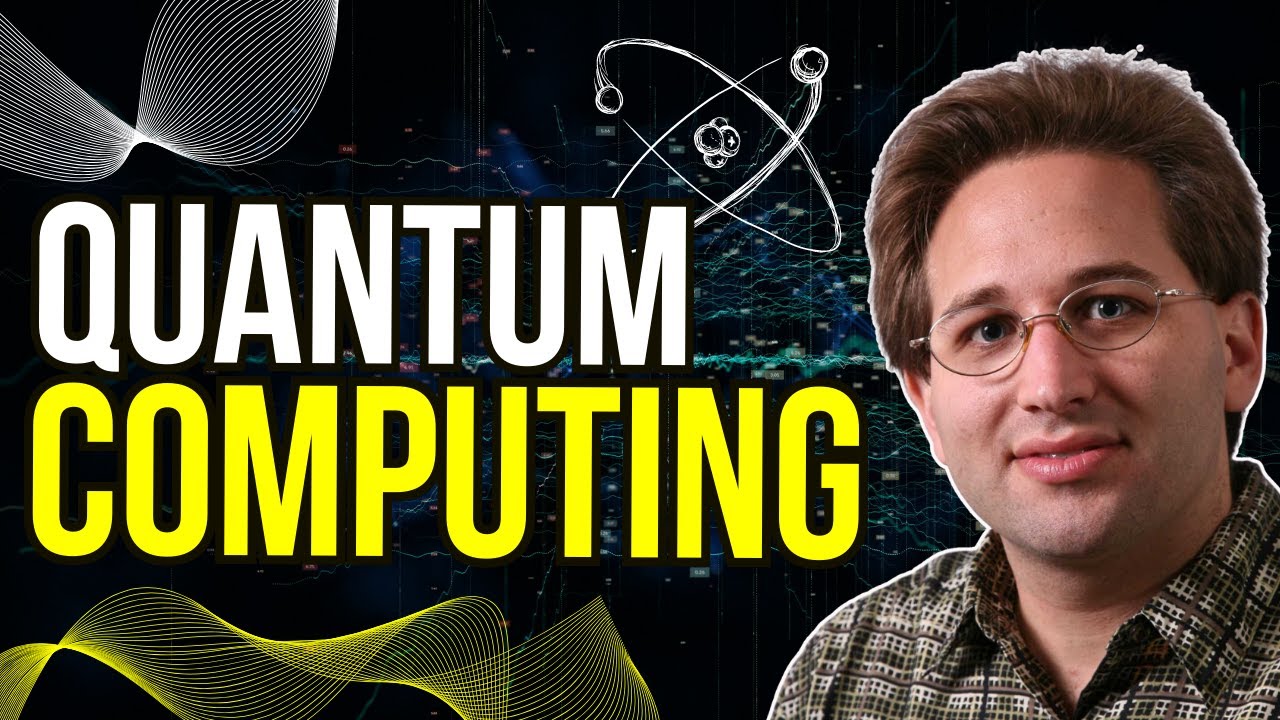
Scott Aaronson is a professor of computer science at UT Austin and director of its Quantum Information Center, known for his work in quantum computing and computational complexity. He reflects on his unconventional path through education, the nature of scientific discovery, the limits of mathematical knowledge, and the future of quantum algorithms.
Early life and education
Aaronson was academically accelerated but socially unhappy in high school, eventually leaving formal schooling early to take college courses at Clarkson University at age 15.
He was rejected from most colleges but accepted at Cornell and Carnegie Mellon; Cornell required a high school diploma, so he obtained a GED from New York State at age 15 after his mother convinced officials to make an exception.
He entered Cornell at 16 and did not feel socially out of place, as most peers either didn’t notice or didn’t care about his age.
He completed his PhD at 22, having prioritized academics over social development, which he acknowledges caused stress but allowed him to pursue his passion for theoretical computer science.
On early specialization and “miracle years”
Aaronson believes that by age 16 he already knew he wanted to study the fundamentals of computing, and that the modern concept of extended adolescence is largely a social construction.
He notes that historically, teenagers were apprentices learning trades, and that wanting to start serious intellectual work early is natural.
He is uncertain whether there is a cognitive advantage to learning complex subjects early, beyond simply accumulating more years of study, and suggests this is an open empirical question.
He discusses the phenomenon of “miracle years” (e.g., Newton at 22, Einstein in 1905), where young scientists make multiple groundbreaking contributions in a short time.
He suggests this may reflect fields being “ripe” for discovery rather than purely individual genius, and that motivation and free time may matter more than raw cognitive decline with age.
Why quantum computing took so long to develop
Quantum mechanics was discovered in 1926, but quantum computing and quantum teleportation were not conceived until the 1980s and 1990s, respectively.
Aaronson argues that early quantum physicists were focused on explaining chemistry and particle physics, while the theory of computing itself was only being born in the 1930s.
The key shift came in the 1960s with John Bell’s work on entanglement as a testable physical phenomenon, rather than a metaphysical curiosity.
Computational complexity theory, a prerequisite for understanding quantum advantage, only developed in the 1960s and 1970s.
Figures like von Neumann and Turing, who could have bridged these fields, died early or had other priorities.
The role of the many worlds interpretation and academic openness
David Deutsch credits the many worlds interpretation with inspiring his work on quantum computing, but Aaronson notes that Richard Feynman arrived at similar ideas independently through practical concerns about simulating physics.
He suggests that while some academics may have been marginalized in the past (e.g., Wiesner, Everett), modern preprint servers like arXiv have lowered barriers to sharing speculative ideas.
Today, the challenge is not suppression but sifting through an abundance of bold but often unworkable proposals.
Contributions from outside academia
Aaronson acknowledges that breakthroughs sometimes come from people on the margins of academia, such as Yitang Zhang, who worked odd jobs before making a major contribution to number theory.
He receives many claims from self-taught individuals who believe they have solved problems like P vs NP, but these usually reflect misunderstandings of the questions.
However, some hobbyists make genuine contributions; he is currently co-authoring a paper with a hobbyist named Bruce Smith who solved open problems related to the busy beaver function.
The busy beaver function
The busy beaver function, defined by Tibor Radó in 1962, assigns to each integer n the maximum number of steps a halting n-state Turing machine can run before stopping.
It grows faster than any computable function and is uncomputable in general.
Only four values are known: BB(1) = 1, BB(2) = 6, BB(3) = 21, BB(4) = 107; BB(5) is at least 47 million; BB(6) is at least 10^36,000; BB(7) is at least 10^10^10^18,000,000.
By Gödel’s incompleteness theorem, no consistent axiomatic system can prove all values of the busy beaver function.
Aaronson and student Adam Yedidia constructed an 8000-state Turing machine that halts only if ZF set theory is inconsistent, showing that BB(8000) is independent of ZF.
A hobbyist named Stefan O’Reilly later reduced this to under 800 states.
One can extend set theory with large cardinal axioms to settle more busy beaver values, but each extension has its own limits, and there is no systematic way to find consistent new axioms.
The search for new quantum algorithms
Since Shor’s and Grover’s algorithms in the 1990s, no fundamentally new quantum algorithm of comparable importance has been discovered.
Aaronson suggests these may be the “basic design motifs” of quantum algorithms, analogous to dynamic programming or greedy algorithms in classical computer science.
He argues that the lack of new fundamental algorithms may reflect a lack of new problem domains rather than a failure of imagination.
There are hints of possible new algorithms, such as for computing edit distance in DNA alignment, but none have been found yet.
Clusters of innovation
Major scientific breakthroughs often occur in clusters at institutions like Bell Labs, Cambridge, or Silicon Valley.
Aaronson attributes this to environments where ideas bounce between people, inspiring competition and collaboration.
Alternatively, such centers may simply attract individuals who would have made breakthroughs anywhere.
Complexity and economics
In 2006, it was shown that computing a Nash equilibrium is computationally hard, belonging to a complexity class where solutions are guaranteed to exist but are difficult to find.
This supports the economic intuition that even if equilibria exist, markets may not reach them due to computational limitations.
Aaronson distinguishes between lack of information (Hayek’s knowledge problem) and lack of computational power to process available information, arguing that economists have better integrated the former than the latter.
Creativity and explanation
Aaronson is skeptical of the idea of a universal “algorithm for creativity,” noting that if creativity were algorithmic, its outputs might no longer be considered creative.
He discusses David Deutsch’s concept of humans as “universal explainers,” capable of explaining anything in principle.
While he acknowledges milestones like language, writing, and computers that distinguish humans from animals, he remains agnostic about whether humans can explain everything.
He contrasts Deutsch’s optimism with the possibility that some questions (e.g., the hard problem of consciousness, why the universe exists) may be beyond explanation, even in principle.
He cautions against elevating hopeful heuristics into metaphysical principles.
Advice to young people interested in technical subjects
Aaronson encourages young people to learn as much as possible using freely available resources like arXiv and online courses.
He advises becoming the world expert on a narrow problem, which can lead to publications, collaborations, and broader expertise over time.
He emphasizes that while becoming a broad expert takes years, deep expertise on a small problem is achievable relatively quickly.