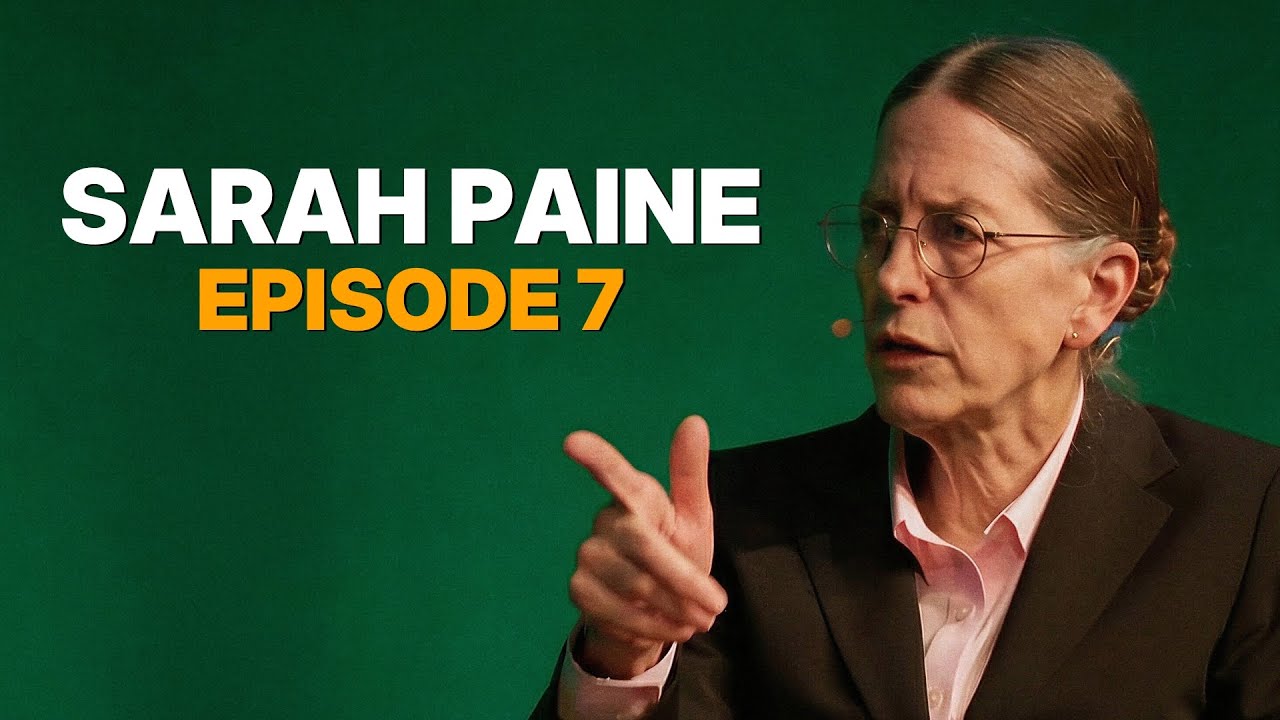
This final lecture in the Sarah Paine series examines why the Soviet Union lost the Cold War, rejecting the popular American narrative that Ronald Reagan single-handedly won it, and instead offering a layered tour of counter-arguments—external, internal, and umbrella explanations—that together form a far more complex picture of Soviet collapse.
The “Reagan did it” thesis and its limits
Many Americans credit Ronald Reagan with defeating the Soviet Union through a massive military buildup, the Strategic Defense Initiative (SDI), aggressive rhetoric (the “Evil Empire” speech, “Tear down this wall”), funding anti-communist insurgencies worldwide, and deploying missiles in Europe.
The logic: the US forced the Soviets into an arms race they couldn’t afford, bankrupting their economy.
Soviet insiders like Valentin Falin and Georgy Arbatov acknowledged that US strategy aimed to exhaust the Soviets militarily and economically, and that the Afghan war (their “Vietnam”) and the SDI pressure contributed to permanent economic crisis.
However, this explanation is incomplete on its own.
Cumulative presidential effects: Nixon through Reagan
Each US president from Nixon to Reagan opened opportunities that successors leveraged:
Nixon played the “China card,” aligning the US with China after the 1969 Sino-Soviet border war, forcing the USSR to militarize a second massive front.
Ford began dabbling in human rights diplomacy.
Carter made human rights a centerpiece of foreign policy and began the military buildup after the Soviet invasion of Afghanistan.
Reagan then operated from a position of both ideological and military strength.
Both parties agreed on core goals—free trade, democracy, containment of communism—making US foreign policy strategically consistent even as tactics varied.
The Helsinki Accords and human rights
The 1975 Helsinki Accords, initially sought by the Soviets to confirm their post-WWII borders, included human rights provisions insisted on by Western Europeans.
Dissidents across the Eastern Bloc and human rights activists in the West used these provisions to hold communist regimes accountable, contrasting communism’s promises of liberation with its reality of dictatorship.
Former CIA and Defense Secretary Robert Gates said the Helsinki conference “laid the foundations for the end of their empire.”
Carter’s human rights campaign resonated deeply within the Soviet Union, making people want a more democratic, open society.
The US submarine threat
Deterrence theory required a reliable second-strike capability; the US nuclear-powered, nuclear-armed submarine fleet threatened to destroy Soviet second-strike forces in a first strike.
Under Carter and especially Reagan, US submarines aggressively targeted Soviet home-water bastions, making Soviet military leaders panic.
Soviet Marshal Akhromeyev told his American hosts in 1987: “You know where our submarines are, but we don’t know where yours are. It’s destabilizing.”
The Soviet Union could not counter this technologically or financially, making war termination their only option.
Eastern Bloc uprisings and the domino theory in reverse
The domino theory—that one country falling to communism would bring others down—actually applied to communism itself: once democratic contagion hit one Warsaw Pact country, it spread rapidly.
Poland led the way: Solidarity’s worker movement, the credibility of the Roman Catholic Church (with a Polish Pope), and the 1988 strikes over a shrinking standard of living led to roundtable talks in 1989. The communists rigged the election rules, but Solidarity won every seat it could contest; voters rejected communist candidates by choosing “none of the above.”
East Germany followed within months: 70,000 demonstrated in Leipzig, then 1.4 million across 200+ demonstrations. When a confused official, Günter Schabowski, announced new travel regulations would take effect “immediately,” crowds gathered at the Berlin Wall and border guards opened the gates. Within a week, over half of East Germany’s population visited the West.
Gorbachev welcomed and encouraged reforms in the Eastern Bloc, not grasping that the demonstrators wanted freedom from the Soviet Union, not just political freedoms within it.
The Soviets were shocked by how unpopular they were; their own allies’ armies could not be trusted to shoot demonstrators.
Oil, Third World overextension, and the internal empire
The Soviet Union bankrolled Third World allies (Angola, South Yemen, Ethiopia, Nicaragua) while its own nationalities grew increasingly restive and wanted out of the empire.
Oil accounted for up to 55% of the Soviet budget; when oil prices collapsed in the mid-1980s, the Soviet economy was devastated.
Brezhnev had a “deep bench of non-performing allies” he could no longer afford, while simultaneously facing 76 seething ethnic rebellions by 1990.
Russia violated the cardinal rule of continental empire—“no two-front wars”—by having too many fronts to manage at once.
The failure of the Soviet economic system
Soviet growth stagnated from the mid-1970s onward, falling 1–2% behind US growth annually for the decade before Gorbachev, with enormous compounding effects.
Central planning was built on systemic lying: every subunit underreported inventories and overreported needs, so aggregated data at the top was garbage. The government had no idea what capital, labor, productivity, or consumer preferences actually were.
Misallocation was catastrophic: the Soviets rotted 20–40% of their crops, then used scarce hard currency to import grain to compensate.
Gorbachev himself told the Central Committee: “We’re encircled not by invincible armies, but by superior economies.” He often said, “Living this way any longer is impossible.”
The Soviet economy was “literally exhausted from this monstrous arms race, militarism, enemies with half the world.”
Gorbachev’s pivotal mistakes
Russians of all political persuasions agree Gorbachev’s role was pivotal, but his decisions were based on false assumptions:
History moves only forward toward communism: Eastern Europe made a U-turn straight back to capitalism.
The Soviet Union was a normal empire: It was actually an “inverted empire”—Eastern Europeans were richer and better-educated than Russians, like a donut. When the empire loosened, Russians could no longer siphon wealth from satellite populations.
He would get credit for liberating Eastern Europe: Instead, he got blame for having enserfed them.
If the Warsaw Pact disappeared, NATO would disappear too: Coercive alliances and voluntary organizations dissolve for different reasons. NATO expanded.
The US would oppose a unified Germany in NATO: Instead, Bush Sr. and Kohl fast-tracked a fully sovereign, unified Germany in NATO while Gorbachev was on vacation.
Gorbachev’s closest supporters blamed his foreign policy mistakes on his domestic policy mistakes, saying they destroyed the Soviet Union.
Vladimir Lukin: “Gorbachev was no Deng Xiaoping.” Arbatov: “The stupidity of our leaders caused the disintegration of the Soviet Union.”
Sins of omission: the Red Army didn’t shoot
Some argue the Red Army should have done what Deng Xiaoping did at Tiananmen—send tanks against demonstrators and crush the protests. Communist Party rule in China continued for decades afterward.
“Timely tank deployments” (TTD) might have changed the outcome of the Cold War.
But Gorbachev’s generation of communists, horrified by the 1968 Czechoslovakia invasion in their youth, lacked the stomach for mass violence against civilians.
Boris Yeltsin’s role
Yeltsin removed Article 6 from the Soviet Constitution (guaranteeing Communist Party monopoly on power) and then signed the Belavezha Accords with Ukraine and Belarus, formally dissolving the Soviet Union.
This opened the door for multiple parties and for Soviet nationalities to become independent—“suicide on purpose.”
German unification and the Bush-Kohl tag team
The Cold War’s endgame required the confluence of two exceptionally talented leaders: George Bush Sr. and Helmut Kohl.
Bush had one of the most impressive resumes of any president: war hero, Yale honors graduate, Texas oil millionaire, UN ambassador, US representative to the PRC, CIA director, and Reagan’s vice president for eight years.
Kohl was the longest-serving German chancellor since Bismarck, with a PhD in history and political science, 25 years as party chairman, and deep experience in state government.
Their strategy:
Kohl bought East Germany’s cooperation one tourist at a time, paying hundreds of millions of Deutschmarks for eased travel restrictions and getting Hungary to open its Austrian border (for half a billion more).
Kohl introduced a 10-point unification program and provided 100 million in food aid to the desperate Soviet Union.
Bush and Kohl decided in January 1990 to fast-track reunification before Gorbachev fell from power.
They divided tasks: Kohl reassured the Soviets and worked financial unification (getting East Germany onto the West German Deutschmark, controlling all the money); Bush managed the alliances, delaying meetings so unification could proceed as far as possible.
They ran a tag-team diplomacy Gorbachev couldn’t keep up with, given his economy’s double-digit shrinkage.
The price escalated: first hundreds of millions, then 5 billion Deutschmarks for unified Germany, then more for Germany’s right to choose its own alliances (NATO membership), then 15 billion Deutschmarks including apartment buildings for repatriated Soviet soldiers (to keep them focused on buying furniture, not running a coup).
Germany agreed to set its border with Poland—a massive concession, since Stalin had moved Poland 200 km west after WWII, taking a third of German territory and expelling 12 million Germans (2 million died).
Britain (Thatcher) and France (Mitterrand) opposed German unification because it would eclipse them economically. Bush and Kohl worked around them.
The Gulf War and Cold War termination
Saddam Hussein invaded Kuwait a month and a half before the German unification treaty, partly because Iraq owed the Soviet Union $10–13 billion and the Soviets were a broke creditor.
Gorbachev cooperated extraordinarily with Bush, sending Yevgeny Primakov on multiple missions to Baghdad—first getting Russian hostages out, then all Westerners, before the coalition bombing began.
The Soviets funneled everything through the UN (where they had a veto) and persuaded China to do the same.
Soviet red lines: no American troops in Iraq, no regime change. The ground war ended after 100 hours partly to protect Cold War termination.
Bush and Kohl were careful never to humiliate Gorbachev, knowing it could bring hardliners to power sooner. They bought Eastern Europe 20 years to integrate with the West before Putin began consolidating power.
Bush never got credit for his essential role and was not reelected. The Nobel Prize went to Gorbachev, not Bush.
Umbrella explanations: inevitable vs. all factors required
“Any of the above” (inevitable): With so many serious problems—brutally inefficient economy, objectionable system, people who didn’t want it—collapse was only a matter of time. Yuri Ryzhov: “The main reason for the collapse is the rottenness of its system.”
“All of the above” (the West barely won): Every factor—internal, ideological, economic, military—was necessary. Remove any one and the outcome might have been completely different. The West should feel fortunate.
The most complete explanation combines all factors with the confluence of Bush and Kohl’s leadership at the critical moment.
Why the Soviet Union lasted as long as it did
The more interesting question than why it collapsed is why such a dysfunctional system survived for 74 years.
Authoritarian regimes are good at maintaining coercive power: monopolizing information, paying off elites (the nomenklatura), and exploiting the asymmetry between the difficulty of construction and the ease of destruction (it takes years to educate someone, seconds to assassinate them).
The Soviet Union was special in having a GNP that reached 60% of America’s by the 1960s–70s, with high growth rates that fooled prominent economists like Paul Samuelson into predicting the Soviets would overtake the US by the 1990s.
This was partly because it was essentially a permanent war economy—mobilized for military production, with rationing and price controls that never ended.
Soviet statistics were deeply unreliable: the ruble was non-convertible, things were measured by weight (they claimed to be the greatest TV producer because they made the heaviest TVs, which spontaneously combusted), and the CIA estimated 20% of GNP went to defense when the real figure was 40–70%.
Central planning could produce heavy industry (steel, cement) but failed at anything requiring consumer feedback or innovation. They missed the plastics revolution and the computer revolution entirely.
Oil was the key: The discovery of massive Siberian oil fields in 1959 and the 1973–85 oil boom (80% of hard currency earnings) allowed the Soviets to import grain, subsidize Eastern Europe, and sustain the Red Army. When oil prices collapsed in 1985, the whole system unraveled. They saved none of the oil wealth—it was all consumed, never invested.
Why Russia collapsed worse than Eastern Europe
Eastern European satellites (Poland, Czechoslovakia, East Germany) recovered much faster because they had always been more connected to Western Europe commercially, legally, and culturally.
Poland’s leaders actively sought Western expertise on banking, legal systems, and institutions throughout society; the Bush administration provided extensive free consulting.
Russia lacked any commercial tradition: under the tsars, the economy was a riff off the Mongol Empire (taking cuts from trade, selling commodities), and under the communists, commerce was abolished entirely.
The Soviets had no tradition of markets, prices, legal systems, or entrepreneurship. American kids learn buying and selling from lemonade stands; this knowledge was absent in Russia.
When the empire collapsed, the Soviets’ strategy of distributing industrial production across the empire (plane parts built in different republics) meant newly independent states inherited fragments—a quarter of a plane with no way to get the other parts.
Why Gorbachev’s reforms made things worse
Gorbachev gave away political power before fixing economic problems—the opposite of Deng Xiaoping’s approach.
He decentralized power to quasi-firms but believed the price system and private property were immoral, so firms couldn’t intermediate using real prices. The result was corruption and backroom dealing.
There was no legal system to support market activity, and legal systems take generations to develop.
Russia’s difficult geography (flat, invaded from all directions) historically required a war economy and large standing army, channeling economics away from commerce and toward military production—unlike Britain, where a navy and merchant class created different institutional incentives.
Life in the Soviet Union in 1988–89
Sarah Paine lived in Moscow during the 1988–89 academic year and described it as “breathtakingly backwards”:
A typical supermarket had only 77 items total; the meat section smelled of rot.
Hospitals without running water; medical facilities without thread for stitches.
Consumer goods were awful—heavy TVs that caught fire, cars that were jokes.
She survived on borscht made from bones bought at the peasant market with hard currency, beets, rotten Hungarian apples, and Romanian canned tomatoes.
A family she tutored English for wanted a VCR more than anything; she bought one at the diplomatic store, and they could suddenly watch Western movies. Seeing a fugitive run past a fruit section at a Western grocery store, they gasped in disbelief.
People were optimistic that glasnost and perestroika would bring a full-up democratic country, with no understanding of the work schedules and institutional foundations required to create capitalist wealth.
They were simultaneously learning the true extent of Stalinist horrors—the scale of which shocked even those who had suspected things were bad.
The inflection point from optimism to despair came later, in the 1990s, when living standards imploded for 20 years.
The broader lesson: economy first, diplomacy second
Nothing any US president did in terms of foreign policy—the competition for Third World countries, supporting dictators to fend off communists—was as significant as the fundamental fact that liberal capitalism out-produced and out-appealed communism.
Protecting the liberal economies of Europe, Japan, Korea, Taiwan, Singapore, and Hong Kong was essential; these “economic miracles” demonstrated the model’s superiority.
The Cold War was anything but cold in the Third World—tens of millions died in proxy conflicts. Ending those conflicts allowed compounding growth to begin.
The conundrum: beating communist factions often required supporting objectionable dictators, and even when the US provided billions in aid, populations often still resented American intervention.
The Marshall Plan exemplified smart strategy: it looked generous but made a fortune for the US and Europe alike—a win-win that incentivized cooperation.
Politicians think of the next election; statesmen think of the next generation. Bush and Kohl were statesmen whose payoff came in decades, not in time for the next election.
The 60 billion Deutschmarks spent on German unification seemed enormous but was a huge bargain relative to decades of future growth from integrating a major economy.
Nuclear overkill and the tragedy of Russia
Both sides maintained massive nuclear redundancy—enough to destroy the world many times over—including absurdities like tactical nukes whose users would be within their own blast range.
The Sino-Soviet split cost the Soviets 2% of GDP just to garrison the Siberian front against China—a sum that slightly faster economic growth could have offset, underscoring that economic performance was more decisive than any diplomatic coup.
Russia’s 20th-century history is uniquely tragic: tsarism, communism, collectivization, losing over 10% of its population in WWII, Stalinism, economic collapse, and then Putin.
Russia missed the Renaissance, the Reformation, and the commercial traditions that shaped the West. Its difficult geography and ruthless neighbors selected for authoritarian militarism rather than institutional development.
Putin’s war in Ukraine will set Russia back a generation, with reparations debates to come.
The optimistic note: the first Cold War stayed cold in the industrialized world, and a thoughtful generation of Western leaders crafted a strategy for a non-nuclear landing. Those same strategies—cooperating with allies, building institutions, improving laws, thinking in decades—can navigate the second Cold War too, if we don’t throw away our good hand of cards.