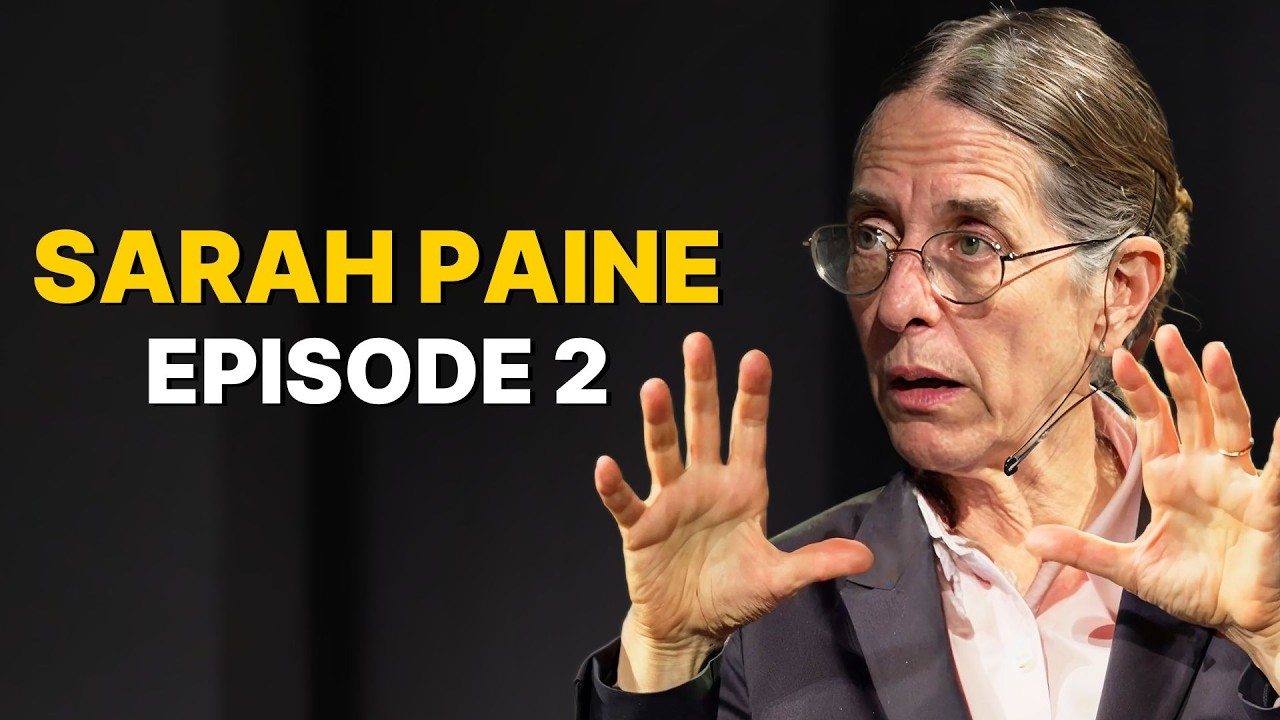
Sarah Paine argues that Japan lost World War II because of deep cultural factors that shaped its strategic behavior in ways the United States failed to anticipate. She uses Japanese strategic culture—rooted in Bushido, Buddhism, Shinto, and Confucianism—to explain why Japan fought with such ferocity, refused to surrender, neglected logistics and grand strategy, and ultimately brought about a catastrophic war it could not win. Her central method is to reject “mirror imaging” (assuming others think like Americans) and instead analyze the “other side of the tennis court” by reading what Japanese theorists read and understanding their value system on its own terms.
The problem with how Americans analyze war
Americans tend to practice what Paine calls “half-court tennis”—analyzing international affairs by focusing only on what the US did or didn’t do, ignoring the other side’s logic, values, and constraints.
This leads to strategic surprise, as in Iraq (underestimating the insurgency) and WWII (underestimating Japanese willingness to fight to the last man).
Sun Tzu and Clausewitz both emphasize net assessment—evaluating political, military, geographic, and economic factors on all sides—but Paine adds culture as an essential, often overlooked variable.
Mirror imaging—projecting your own values onto others—is especially dangerous.
The three pillars of Bushido and their strategic consequences
Paine uses Nitobe Inazo’s 1900 book Bushido: The Soul of Japan as a cultural bridge. He identified three philosophical roots of the samurai code:
Buddhism → fatalism, acceptance of death, the idea that existence is suffering and life is ephemeral (like a cherry blossom)
This produces a preoccupation with honorable death rather than achievement of policy objectives—the opposite of Clausewitz.
Yamamoto Tsunetomo’s Hagakure (early 18th century) states: “The way of the samurai is found in death.” Merit lies more in dying for one’s master than in striking down the enemy.
This explains banzai charges, kamikaze pilots, and the refusal to surrender even in hopeless positions.
Shinto → extreme reverence for the emperor as a living deity
Loyalty to the emperor (or, by extension, the group/company) supersedes everything, including family and self-preservation.
Confucianism → society organized through hierarchical social obligations, duty, and ritual rather than individual rights or equality
There is no concept of equality; even twins have a birth order.
The basic unit of society is the group, not the individual.
How these values produced bad strategy
Equating operational success with strategic success: Samurai culture focused on winning the battle at hand, not on whether the battle served the larger war aim. Japan won most battles in China but lost that war entirely.
Damage control measured in honor, not material terms: When defeat occurred, the solution was suicide (seppuku), not adaptation. Living on in shame brought disgrace to everyone associated.
Willpower over strategy: Miyamoto Musashi and others taught that desperation and sheer will could overcome any obstacle. “Learning military tactics is useless—the way of the samurai is immediacy.” This denigrated planning, logistics, and grand strategy.
No grand strategy: Grand strategy integrates all instruments of national power (diplomics, economics, military). Japanese samurai literature focused exclusively on the military instrument. There was no clear definition of what “winning” meant—how much territory to take, when to stop.
Risk insensitivity and offensive preemption: Japan began all its modern wars (First Sino-Japanese, Second Sino-Japanese, Russo-Japanese, Pacific War) with surprise attacks. When one theater stalemated, Japan opened a new one to regain the initiative—each time overextending further.
Putting enemies on death ground: Japanese brutality in China (e.g., the Rape of Nanking) was partly intended to break enemy will, but it had the opposite effect—it transformed adversaries into lethal, unyielding enemies. Paine compares this to Nazi behavior in the Soviet Union and Russian behavior in Ukraine today.
Strategic sins of omission
Neglect of logistics:
Japan never produced more than 1/13 of US steel and coal; munitions production never exceeded 10% of US levels.
Each US soldier had ~4 tons of equipment; each Japanese soldier had ~2 pounds. Japan’s main weapons were the grenade and bayonet; artillery and machine guns were obsolete.
The US had ~18 support personnel per frontline rifleman; Japan had roughly 1:1.
By winter 1942–43, critical oil shortages meant Japan could no longer deploy the fleet at will or run convoys.
Admiral Ugaki Matome’s diary entry on August 15, 1945: he attributed defeat to “the great differences in natural resources between the two countries”—a conclusion he reached too late, having spent the war believing willpower could overcome material inferiority.
Neglect of sea lines of communication:
The Japanese Navy followed Mahan’s doctrine of fleet-on-fleet engagement and treated convoy protection as a “secondary operation.”
US submarines paralyzed Japan’s merchant shipping. By war’s end, Japan had 1/9 of its transport shipping, and the empire was paralyzed.
Ugaki himself had written early in the war that it was “too bad” submarine crews had only sunk merchant ships, not warships—a disdain that proved fatal.
In-group/out-group divisions and inter-service rivalry
Japanese society is organized into nested, overlapping in-groups (province, school class, company, military branch) with finely calibrated obligations. This produces stovepiping—groups that don’t communicate or cooperate.
Within the army: The Kwantung Army in Manchuria independently invaded all of Manchuria in 1931, starting a 15-year war without authorization from Tokyo. Multiple coup attempts (some successful) occurred throughout the 1930s and even at the war’s end.
Within the navy: Pilots trained, fought, and died in the same groups. Unlike the US, there was no system of rotating survivors into training roles to pass on lessons. Post-operation “hot washes” (self-critical after-action reviews) were culturally alien.
Between army and navy:
No regular liaison meetings until 1944.
Separate war plans (army focused on Russia, navy on US/Britain) that were secret from each other and assumed the other service would cooperate.
At Guadalcanal, the army and navy lied to each other about troop numbers and supply needs; soldiers starved while the navy wanted to withdraw.
After the Doolittle Raid (April 1942), the army suddenly supported the navy’s Midway operation—not for strategic reasons but to avenge the honor of having Japanese skies bombed.
The navy concealed the loss of four carriers at Midway for months.
Even under imminent threat of invasion in 1945, there was no joint planning for home island defense.
How the war actually ended
Japan did not quit because of military defeat in the field. It took three catastrophic events in four days to shatter the political deadlock:
August 6, 1945: Atomic bomb on Hiroshima.
August 8: Soviet Union pours 1.5 million troops into Manchuria—the army’s nightmare scenario, threatening a divided Japan.
August 9: Second atomic bomb on Nagasaki (with a US bluff that more would follow daily, though no more existed).
Emperor Hirohito broke the cabinet deadlock, made an unprecedented radio broadcast ordering capitulation, and sent imperial princes to convey ceasefire orders to overseas theaters.
His samurai obeyed completely—there was no insurgency, and cooperation with the occupation was total.
The US initially misread Japan at the war’s start (the oil embargo was meant to deter but precipitated war) but correctly read it at the end: using Hirohito as the instrument of surrender and occupation.
Hirohito, fearing the extinction of his dynasty, signed whatever MacArthur put before him—including the 1947 Constitution, written in one week by MacArthur’s staff, which remains in effect today.
The grand strategic irony
The war wiped out the two barriers to communist expansion in Asia:
Chiang Kai-shek and the Nationalists: So weakened and discredited by the war that they lost the Chinese Civil War.
Japan itself: Destroyed as a regional power by the United States.
Result: A unified communist China, which led directly to the Korean War, the Vietnam War, and ongoing strategic complications. “It’s a gift that keeps on giving.”
Q&A: Brutality, diplomacy, and counterfactuals
Bushido vs. wartime brutality: Paine argues that Japanese brutality (Nanking, POW treatment) stemmed from desperation (inability to feed or house prisoners), dehumanization inherent in war, cultural differences in interpersonal interaction (e.g., not looking guards in the eye being interpreted as arrogance), and the industrial scale of modern killing—not from Bushido’s Buddhist ideals directly.
Why look at 18th-century theorists?: Paine distinguishes between underlying causes (cultural tinder) and proximate causes (the match). Culture provides the deep structure; immediate triggers are separate. She also notes that British strategic culture (island nation, balance of power, naval reliance, grand strategy) similarly explains long-term patterns.
Loyalty vs. coups: Western logic demands consistency (law of non-contradiction). In Japanese culture, group loyalties are nested and sometimes conflicting—loyalty to a subunit (like the Kwintang Army or a faction of young officers) can override loyalty to the central government without contradiction.
Unusual brutality of WWII: Industrial killing, strategic bombing, and the lesson of WWI (Germans didn’t feel defeated, enabling the stab-in-the-back myth) all drove WWII’s extreme violence. Churchill and Roosevelt demanded unconditional surrender; the Soviets sought revenge; the US chose firebombing and atomic weapons to avoid sending millions of young Americans into a ground invasion.
Could the war have been avoided?:
The Smoot-Hawley Tariff (1930) triggered global trade retaliation, devastating trade-dependent Japan and creating conditions for fascism. Paine calls this “half-court tennis”—the US didn’t consider how others would react.
By 1941, Japan had 600,000 casualties in China. Withdrawal was politically impossible—the government would fall. Hirohito feared assassination or being declared insane if he pushed peace.
Diplomatic translators sometimes exaggerated or softened messages. Some argue miscommunication caused the war, but Paine is skeptical—the structural forces were too strong.
The oil embargo: Paine notes Roosevelt’s greater fear was that Japan would attack the Soviet Union, potentially causing a Nazi victory in Europe. The embargo was partly meant to prevent that.
Paine distinguishes limited vs. unlimited objectives: If an adversary seeks not just territory but your annihilation (as Nazis did), compromise only strengthens them for the final assault. Negotiation works only when both sides have limited aims.
Counterfactuals: Paine is sympathetic to counterfactual analysis as a teaching tool (replaying decisions to explore alternatives) but cautions that by the late 1930s, the “easy solutions” were gone. The pivotal decisions had been made.
Japanese optimism about beating the US: Based on observing American isolationism (not bailing out Britain, Hawaii as a colony, minimal Asian trade). Japan expected the US to find war too costly and quit—fundamentally misunderstanding American psychology after being attacked (as on 9/11).
Rapid modernization and institutional roots: Japan westernized its institutions in one generation (Meiji era), but institutions need time to develop deep roots. The Genrō (elite Meiji leaders) couldn’t transfer their personal prestige to successors. Military rule (shogunate) had been Japan’s norm for centuries—its return in WWII was, in a sense, a reversion.
“System of irresponsibility”: Paine argues no one truly controlled the Japanese military. The Western model assigns legal authority to specific positions with courts to adjudicate overreach. Japan operated through in-group committees without clear individual accountability—making it impossible to assign fault or enforce unified command.
Why soldiers obeyed suicidal orders: Paine doesn’t fully answer this (it’s a social question, not her area of diplomatic/military history). She notes that Japanese culture discourages discussing failure (loss of face), so veterans rarely spoke of their experiences. In the West, Christian original sin creates an expectation of imperfection that makes self-criticism easier.
Unresolved questions in the field: Paine emphasizes teaching students to think in terms of arguments, counterarguments, and rebuttals. Key analytical frameworks include:
Limited vs. unlimited wars (and the danger of compromising with unlimited adversaries)
“Death ground” dynamics (putting enemies in a position where they fight to the death)
The continental vs. maritime world order struggle (territorial spheres of influence vs. rules-based international system)
Do sanctions work? Paine is honest that she doesn’t know. Sanctions inflict pain but rarely change regime behavior—authoritarian governments divert pain to civilians and use it to justify repression. She contrasts this with the successful limited war in the Gulf War (1991: get Iraq out of Kuwait, restore the government, stop) versus the failed total makeover of Iraq (2003).
Backloaded mass death: 85% of Japanese military deaths (1.8 of 2.1 million) occurred in the last 14 months of the war. Similar pattern in Germany (43% in the last year). This reflects broken transportation systems, mass starvation, and the shattered side’s inability to continue—not a rational calculation to keep fighting.
Demilitarizing Japan: Paine notes that Japan’s Self-Defense Forces (especially mine-sweeping expertise) secretly helped the US in the Korean War. Japan’s postwar economic recovery was also fueled by Korean War procurement. The generous peace (reintegration rather than punishment, as after WWI) is a key reason Japan and Germany became such effective allies.
Why the Axis didn’t coordinate: The Axis powers had completely different primary enemies and theaters (Italy→Britain, Germany→Russia, Japan→China). The Allies at least shared one intermediate objective: defeat Hitler first. The British tradition of coordinating with allies and providing serious resources (Lend-Lease, unified commands) had no Axis equivalent.
Paine’s “aha” moment: When assigned to lecture on the Pacific War, she read Bushido literature at her husband’s suggestion. Putting herself inside the Japanese value system—rather than mirror-imaging—suddenly made banzai charges, kamikaze, and refusal to surrender intelligible rather than insane.