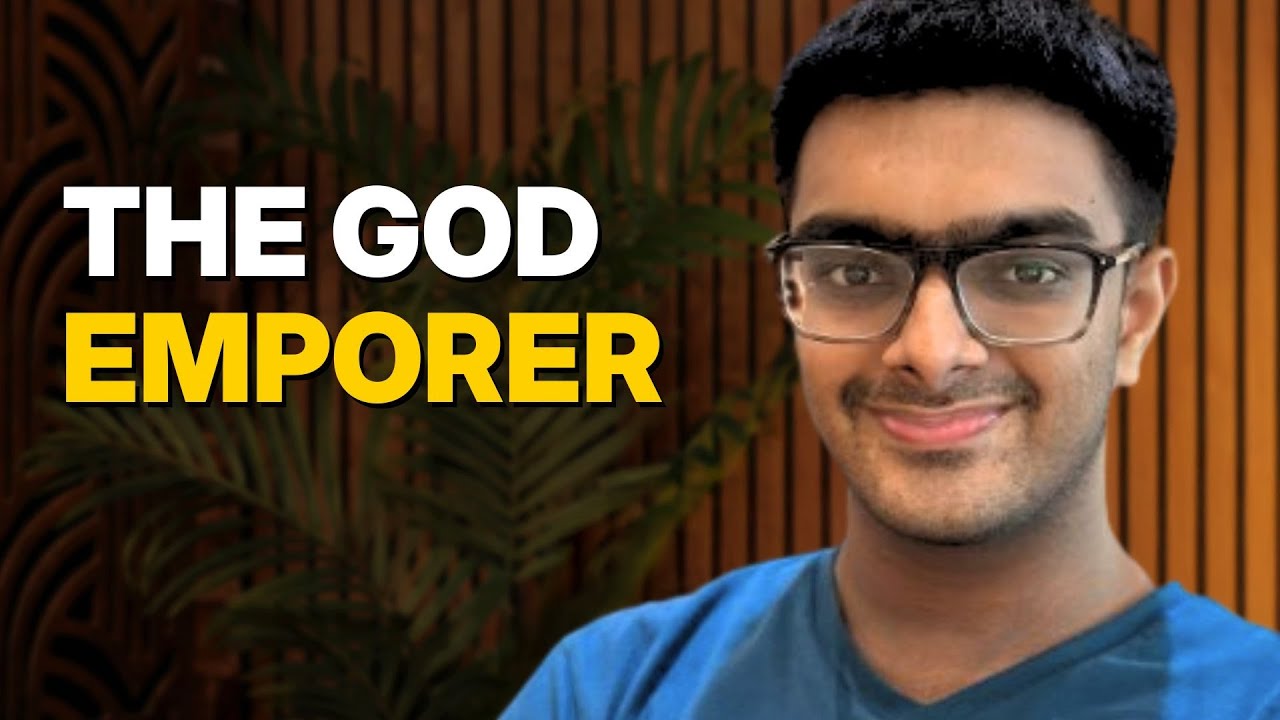
This episode features a conversation between the host and Pradyu Prasad, an 18-year-old Singapore-based blogger and podcaster (Brendon Goods), about Herbert P. Bix’s book Hirohito and the Making of Modern Japan, which argues that Emperor Hirohito was far more responsible for Japan’s wartime conduct than the conventional narrative suggests.
The conventional view holds that Hirohito was a figurehead constitutional monarch with little real power, and that he ultimately helped end the war by surrendering in 1945. Bix’s book challenges this, arguing that Hirohito had genuine authority and chose not to use it to restrain the military or prevent atrocities in China and across the Pacific.
The discussion ranges from the Meiji Restoration and Japan’s rapid industrialization, to the structural flaws in Japan’s constitutional system that enabled military autonomy, to the postwar occupation and economic recovery, and finally to broader questions about public intellectual life.
Meiji Restoration and Japan’s Rapid Industrialization
Japan’s transformation from a feudal, isolated society to an industrial and colonial power happened with extraordinary speed after 1868, driven by several key factors.
Centralization of power under the emperor replaced the fragmented Tokugawa shogunate, allowing unified national policy.
Japan was deliberately open to foreign capital, technology, and knowledge, essentially copying Western innovations through what Pradyu calls “intellectual piracy” and forced technology transfers.
The country had a less entrenched rent-seeking bureaucratic class compared to China, making reform easier to implement.
Japan’s small island geography made the threat of Western power (e.g., Commodore Perry’s ships) impossible to ignore, forcing elites to confront reality and modernize quickly.
By the 1910s and 1920s, Japan had grown wealthy enough to project power across East Asia, fighting and defeating Russia in 1905 and beginning its invasion of China in the 1930s.
Why Japanese Atrocities Were So Severe
The extreme brutality of the Japanese military in China and the Pacific is attributed to a combination of lagging cultural norms and public choice dynamics within the military.
Rapid industrialization outpaced the evolution of social norms around warfare. Japan retained traditional, brutal warrior norms but now had modern industrial weapons, creating a devastating combination.
Pradyu emphasizes public choice theory: the Japanese army and navy had institutional incentives to invent or exaggerate threats in East Asia to justify budget increases, especially after Depression-era cuts. The military essentially created problems and then demanded resources to solve them.
The 1931 Mukden Incident, in which the Japanese military staged a fake attack on its own railroad in Manchuria, is a clear example of the military acting independently and dragging the country into war without civilian or imperial approval.
Unlike Western democracies where civilian control over the military is enforced (e.g., the U.S. requirement of a gap between military service and becoming Secretary of Defense), Japan’s constitution gave the army direct, independent access to the emperor, effectively allowing the military to capture the state.
Hirohito’s Role and Responsibility
Hirohito’s personal characteristics and the structural role of the emperor are central to understanding why he failed to restrain the military.
Hirohito was mild-mannered, not politically savvy, and lacked the charisma of his grandfather Meiji. He was not equipped for the kind of factional maneuvering and public opinion management the role demanded.
The Japanese constitutional system was ad hoc and poorly defined. While in theory the emperor reigned but did not rule, in practice he had significant moral authority and could have intervened. Bix argues he chose not to.
The military consistently acted in the emperor’s name, claiming loyalty to him while pursuing its own agenda. Hirohito issued only mild condemnations when the military directly contradicted civilian government wishes, effectively enabling escalation.
Pradyu argues that Hirohito could have lessened the war’s stupidity and direction even if he could not have stopped it entirely. Japanese military strategy was fundamentally flawed: they planned for war with the Soviet Union but instead provoked China and then America, a country with vastly superior GDP and industrial capacity.
Japan’s oil supply was almost entirely dependent on the U.S. (high 90s percentage), making war with America strategically suicidal. The atrocities in China generated American public outrage (fueled by missionary reports), leading to the oil embargo that cornered Japan into attacking Pearl Harbor.
The Postwar Occupation and Japan’s Economic Recovery
The American occupation of Japan was remarkably successful compared to later occupations like Afghanistan, for several structural reasons.
Japan had a long history of stability and centralized governance. The occupation simply replaced the people at the top while leaving existing administrative structures intact.
The Japanese public was exhausted and starving. GDP per capita in 1937 was not regained until 1952. Many were relieved the war ended, and there was no significant resistance to the occupation.
Hirohito’s surrender address and cooperation with the Americans (including his famous meeting with MacArthur) gave the occupation legitimacy and continuity.
The old Japanese elite largely remained in place. There was a collective “mass hallucination” that the army had forced the war on an otherwise peaceful nation, allowing the same families and networks to retain power.
Japan was not a genuine democracy until perhaps the 1990s. The Ministry of International Trade and Industry (MITI) effectively directed industrial policy with rubber-stamp legislative approval, functioning in ways not entirely unlike Soviet planning.
The Americans attempted to break up the zaibatsu (large industrial conglomerates) but were only partially successful. They reemerged as keiretsu, financialized conglomerates that drove export-led growth.
Japan’s postwar growth was partly catch-up growth (rebuilding destroyed capital) and partly driven by effective industrial policy: the government coordinated with company executives, provided subsidies, and enforced performance benchmarks (e.g., export targets or face merger).
Modern Parallels: Russia/Ukraine and U.S./China
The episode was recorded during the 2022 Russian invasion of Ukraine, and the guests draw parallels and contrasts with Japan’s pre-WWII trajectory.
The analogy: just as the U.S. embargoed oil to Japan, pushing it toward desperate escalation, Western sanctions on Russia might push Putin toward further aggression.
Pradyu considers this analogy weak because Russia is not as captured by its military as Japan was, and Putin (a former KGB officer) understands the costs of prolonged confrontation with the West.
On a potential U.S.-China conflict, Pradyu argues the West retains enormous latent industrial capacity. While some claim the U.S. has deindustrialized, he contends that regulations and zoning are the main constraints, and these would be rapidly removed in a genuine wartime emergency.
He notes that in a short-term conflict the U.S. would dominate, and over a 12-month horizon the West’s technological superiority and capacity to rearm would overwhelm China and Russia combined.
The GDP comparison: US plus EU is roughly $31 trillion versus China plus Russia at roughly $30 trillion, but the Western total is far more productive and less burdened by corruption and ghost cities.
Reflections on Public Intellectual Life and Content Creation
The latter part of the episode shifts to a discussion of how Pradyu and the host approach blogging, podcasting, and developing as young public intellectuals.
Pradyu structures his work around deep dives into topics (reading multiple books on a subject like WWII Japan), ad hoc reading from PDFs and Twitter, and writing when he can find calm, focused time, usually on weekends.
He is applying to college, targeting computer science plus economics at the National University of Singapore, with backup plans in the UK, and is critical of British university admissions for being outdated and asking applicants to performatively narrate their life stories.
On building an audience, both guests note the unpredictability of what goes viral. A throwaway blog post on talent spotting that the host wrote casually ended up being retweeted by Alex Tabarrok and getting far far more engagement than carefully crafted pieces.
Pradyu advises finding a circle of competence, being genuinely good at one thing, and using that credibility as a foundation. He also suggests cross-subsidizing intellectual pursuits with commercially viable content (e.g., an economics newsletter on interest rates and stocks funding more esoteric historical writing).
The host is skeptical about the value of attention for its own sake, noting that popular posts do not necessarily reflect genuine expertise, and warns against the incentive to produce stupid viral content just because it gets engagement.
Pradyu plans to continue the blog and podcast through at least August 2023 and into college, partly because it is his primary way of socializing and connecting with interesting people.