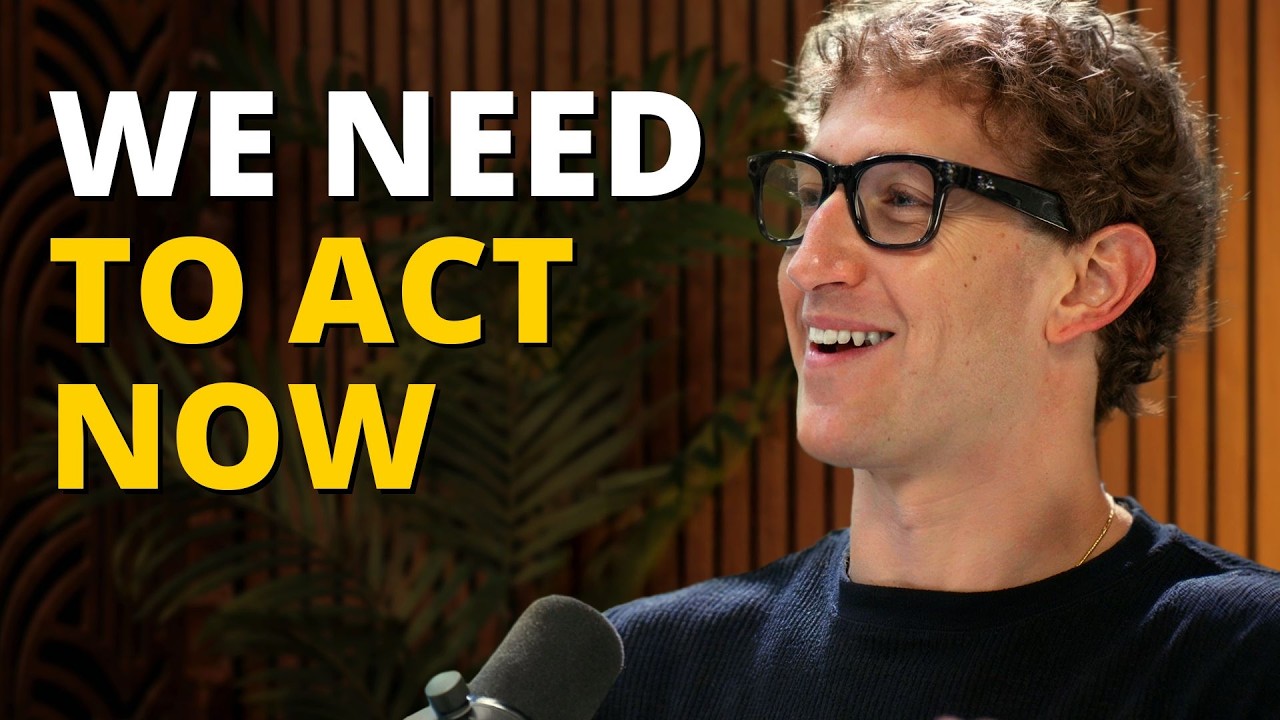
- Mark Zuckerberg discusses Meta’s latest AI developments, including the Llama 4 model family, the future of open-source AI, the path to superintelligence, and how AI will reshape Meta’s products and the broader economy.
- Llama 4 and Meta’s model strategy
- Meta has released the first two Llama 4 models — Scout and Maverick — which are mid-size, natively multimodal, highly efficient, and designed to run on a single host with low latency.
- These are optimized for Meta’s internal product needs, especially consumer-facing use cases where fast response times matter more than maximum reasoning depth.
- A smaller 8B-parameter model (“Little Llama”) is coming in the next few months, and a frontier-scale “Behemoth” model with over 2 trillion parameters is in development.
- Behemoth is so large that Meta had to build new infrastructure just to post-train it; the plan is to distill it into smaller, more usable models for developers.
- Meta AI now has nearly a billion monthly users, primarily through WhatsApp (which dominates outside the U.S.), and a standalone Meta AI app is being launched to build a first-class experience in the U.S. market.
- The app features a full-duplex voice demo that is notably natural and conversational, though not yet the default.
- Zuckerberg argues that open source is on track to become the most-used model ecosystem this year, with Llama having catalyzed the trend — but he notes that DeepSeek and other Chinese models are competitive, partly because export controls forced them to do impressive low-level optimizations on restricted chips.
- DeepSeek is text-only; Llama 4 is natively multimodal, which Zuckerberg sees as a significant advantage since every major new model is moving toward multimodality.
- Meta has released the first two Llama 4 models — Scout and Maverick — which are mid-size, natively multimodal, highly efficient, and designed to run on a single host with low latency.
- On benchmarks and what Meta optimizes for
- Zuckerberg is skeptical of standard benchmarks like Chatbot Arena, arguing they are often skewed toward narrow use cases that don’t reflect what normal people do in Meta’s products and can be easily gamed.
- Meta’s north star is user-reported value and revealed preferences within Meta AI — what people actually say they want and how they use the product.
- He sees the field splitting into different specializations: some labs focus on coding and reasoning (Anthropic, OpenAI), while Meta focuses on fast, natural, multimodal, personalized consumer experiences that fit throughout the day.
- Intelligence explosion and the path to superintelligence
- Zuckerberg agrees with the premise that automating software engineering and AI research could lead to rapid intelligence growth, and expects that within 12–18 months, most code at Meta will be written by AI (not just autocomplete, but goal-driven agents that write, test, and improve code at or above the level of a strong human engineer).
- However, he pushes back on the “fast takeoff” view, arguing that physical-world bottlenecks — building gigawatt-scale compute clusters, securing energy, permitting, supply chains — take real time and cannot be shortcut.
- He also emphasizes a co-evolution dynamic: people need time to learn how to use AI assistants effectively, and assistants need time to accumulate personal context and improve through feedback loops.
- Even in constrained environments like Meta’s ads ranking system, the bottleneck is not just generating hypotheses but having enough compute and user cohorts to test them — meaning AI-generated ideas must exceed the quality of the best human ideas before they become marginally useful.
- AI relationships, social content, and design philosophy
- Zuckerberg expects people to form meaningful relationships with AI — as therapists, friends, and companions — and argues this is rational given that the average American has fewer than three friends but desires around 15.
- He believes these relationships will fill a genuine gap in people’s lives rather than replacing in-person connections, and that society will develop the vocabulary to understand their value over time.
- He is mindful of the risk of attention-hacking in AR/VR environments (e.g., Reels scrolling in peripheral vision) and says the key design principle for Meta’s glasses is that they must “get out of the way” and be good glasses first — the AI should be available when wanted but not compete for attention.
- He envisions a future where digital and physical worlds are fully blended through holographic overlays, enabling seamless sharing of 3D content and interactions, but acknowledges that norms around digital-physical clutter will need to be worked out.
- Zuckerberg expects people to form meaningful relationships with AI — as therapists, friends, and companions — and argues this is rational given that the average American has fewer than three friends but desires around 15.
- Open-source licensing and model standards
- Meta’s Llama license requires companies with over 700 million users to negotiate with Meta before using the model, and requires derivative models to be prefixed with “Llama.”
- Zuckerberg defends this as reasonable given the billions invested in training, and notes that no major company has refused to use Llama because of the license — criticism has come mainly from open-source purists.
- He worries that if Meta stops pushing open source, many other companies would revert to closed models (pointing to Android’s gradual closure as a cautionary example), and argues it’s important that American models like Llama set the standard because models encode values and ways of thinking.
- He gives an example: an early French version of Llama “sounded like an American who learned French” rather than a native French speaker.
- He raises security concerns about distilling models from other countries, especially for coding, where a model could embed vulnerabilities exploitable by foreign governments.
- His proposed solution: limit distillation to verifiable domains (math, code), use security filters like Llama Guard and Code Shield, and conduct extensive red teaming.
- Meta’s Llama license requires companies with over 700 million users to negotiate with Meta before using the model, and requires derivative models to be prefixed with “Llama.”
- Monetization and business models
- Zuckerberg expects a diversity of business models: free ad-supported consumer AI (Meta’s default), premium services for heavy compute users, and high-priced enterprise tools (e.g., software engineering agents that companies would pay thousands or tens of thousands of dollars for).
- He sees ads as well-suited for free services with large advertiser liquidity, but acknowledges that some AI applications are too expensive to offer for free and will require subscription or usage-based pricing.
- The CEO’s role and AI governance
- Zuckerberg’s highest-leverage activities include recruiting top talent, coordinating cross-team integration (e.g., embedding Meta AI into WhatsApp and Instagram), making infrastructure and capital allocation decisions (e.g., whether to build gigawatt clusters amid economic uncertainty), and serving as the final arbiter on product quality and when to ship.
- On politics and AI governance, he frames Meta’s engagement with the Trump administration as a natural effort to have a productive relationship with whoever runs the government, particularly on enabling energy and data center buildout.
- He reflects that in the past he deferred too much to media and government on content moderation decisions, and has learned that Meta must own its decisions while listening to feedback.
- 100x productivity and the future of work
- Zuckerberg expects AI to unlock massive creativity, shifting human effort further away from basic needs toward cultural, social, and entertainment pursuits — making the world “funnier, weirder, and quirkier.”
- He argues that AI will likely increase total employment rather than reduce it, using customer support as an example: if AI handles 90% of issues, the cost drops enough to make offering support viable for Meta’s 3.5 billion users, which could mean hiring more human agents to handle the remaining 10%.
- Personal style
- Zuckerberg does not rely on a single advisor but draws on a broad network of people at Meta, on its board, and across the industry, reflecting his belief that the world is too dynamic for any one person to have all the answers.
- Llama 4 and Meta’s model strategy
Mark Zuckerberg — AI will write most Meta code in 18 months
Dwarkesh Podcast • • 1h15 → 5 min • #89