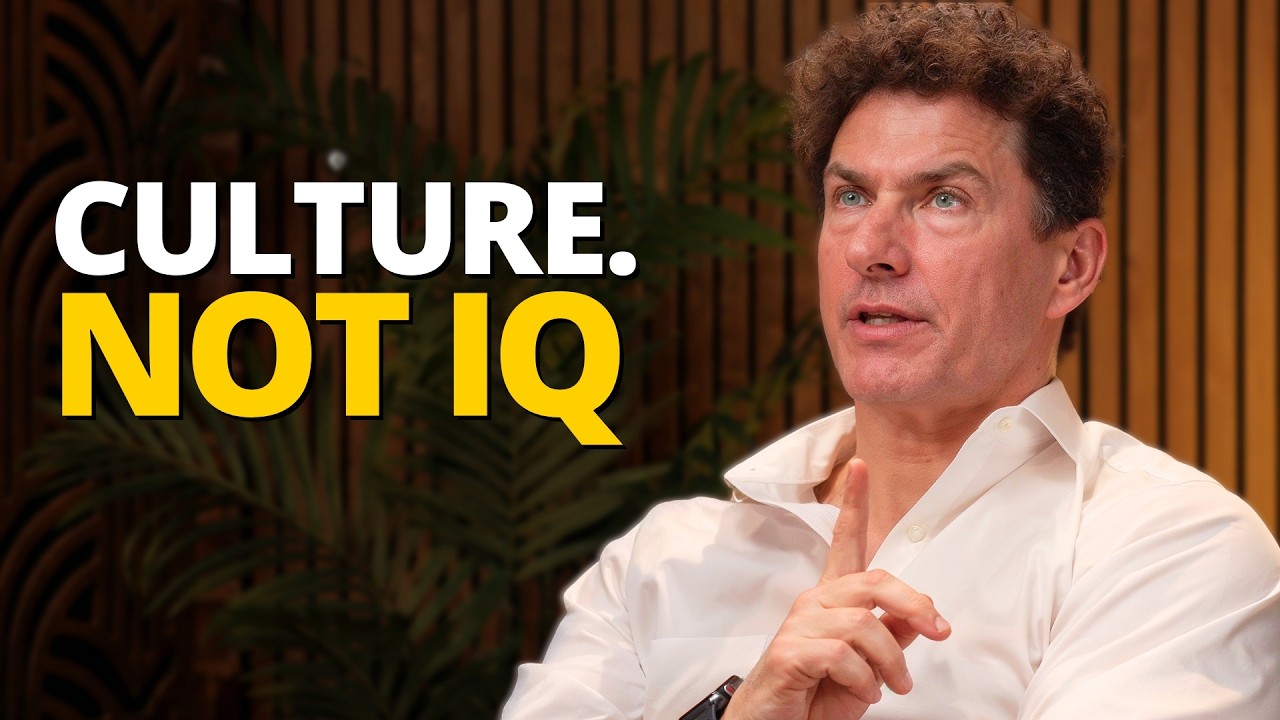
Joseph Henrich, a professor of human evolutionary biology at Harvard and author of The Secret of Our Success and The Weirdest People in the World, explains that human dominance over smarter species with larger brains—like Neanderthals and Denisovans—came not from raw intelligence but from cultural evolution: the ability to accumulate, transmit, and build upon knowledge across generations through social learning.
Around 70,000 years ago, a small population in the Near East expanded across Eurasia, eventually replacing or absorbing other hominin species. Genetic evidence from David Reich’s lab shows this expansion was likely violent, but there’s no clear genetic mutation explaining their success—suggesting cultural, not biological, advantages.
This group likely had a “package” of innovations—not just tools like bows and arrows, but social institutions that enabled interconnection, knowledge exchange, and coordination across large populations. Technologies alone aren’t enough; they must be embedded in supportive social structures.
Human history is marked by repeated expansions (e.g., Bantu, Austronesian, Inuit), where groups with superior cultural packages outcompeted others—even those with better individual technology—because fragmented populations lose knowledge over time due to isolation and language divergence.
How cultural evolution works
Cultural evolution faces a “startup problem”: social learning is only valuable if there’s already useful culture to learn, but culture can’t accumulate without social learning. Our ancestors crossed this threshold thanks to three factors:
Increasing environmental variability during the Plio-Pleistocene, which made genetic adaptation too slow and individual learning insufficient.
Living in large groups on the savanna (due to predator pressure), increasing the odds that someone in the group had useful knowledge.
Having hands (like other apes) enabled tool use, giving a substrate for cultural transmission.
Once started, cultural evolution operates like natural selection: small advantages (e.g., better food processing, spice use reducing pathogens) compound over centuries. Groups that adopt successful practices grow, spread, and replace others—even if no one understands why the practices work.
Example: Bitter cassava requires a complex 10-step detoxification process. Populations that developed it thrived; when cassava was brought to Africa without the knowledge, people got sick. Success came from copying healthier families, not understanding chemistry.
This leads to “epistemic hell”: people follow customs (often encoded as religious taboos) without causal understanding, because deviation risks death. Innovation is rare and risky—once something works, changing it usually makes it worse.
Why brain size is declining
Human brains have shrunk over the past 10,000 years, suggesting we’re getting less intelligent individually—but more effective collectively.
As societies grow and specialize, cognitive labor is distributed. Like ants with specialized castes, we no longer need every individual to know everything—we offload knowledge into culture, institutions, and specialists.
IQ is not a fixed, universal trait: it measures cognitive abilities suited to modern institutional life (e.g., abstract reasoning, working memory). These weren’t always adaptive—e.g., pastoralists benefit more from spatial navigation than digit recall.
Education raises IQ significantly; the Flynn effect (rising IQ scores over the 20th century) reflects better environmental conditions and schooling, not genetic change.
In fast-changing environments (like today), older generations’ knowledge becomes less valuable. Prestige shifts toward younger innovators (e.g., 20-something tech founders), contradicting ancestral norms of deferring to elders.
Will AGI have superhuman cultural learning?
AI could dramatically accelerate cultural evolution by overcoming biological limits:
Perfect memory and instant copying eliminate knowledge loss.
Billions of AI agents could form a massive, interconnected “collective brain,” sharing insights instantly.
They could explore vast spaces of cultural and technological variants with high-fidelity replication.
But key ingredients of human innovation may be hard to replicate:
Errors and “improper copying” generate novelty—too much fidelity may stifle creativity.
Shocks (wars, pandemics, economic crises) inject new information and force adaptation; a too-homogeneous AI system might stagnate.
Henrich is skeptical of a single “superintelligence” transforming the world. Instead, he expects AI to augment human collective problem-solving—if we maintain diversity, competition, and mechanisms for renewal.
Why the Industrial Revolution happened in Europe
Henrich’s central thesis in The Weirdest People in the World: the Catholic Church’s marriage and family policies (6th–10th centuries) dismantled Europe’s intensive kinship systems, creating the psychological and institutional foundations for modernity.
The Church banned polygyny, cousin marriage (up to sixth cousins), and inheritance by lineage, replacing them with nuclear families, testamentary inheritance, and spiritual kinship.
This freed individuals from clan obligations, enabling mobility, urbanization, and voluntary associations (guilds, monasteries, universities).
Cities grew, occupations diversified, and trust in strangers increased—key for impersonal markets, contract law, and innovation.
Europe’s “collective brain” became uniquely interconnected:
Latin served as a lingua franca for intellectuals.
Monastic networks (e.g., Cistercians) spread knowledge across regions.
Intermarriage between former tribes dissolved ethnic boundaries, creating a shared Christian identity.
China, despite its larger population and early innovations (gunpowder, printing), remained locked in kin-based clans and castes, limiting mobility and cognitive diversity. India’s caste system similarly restricted occupational switching and innovation.
Other theories (e.g., high wages after the Black Death, genetic selection for patience) are compatible but incomplete—they don’t explain the psychological variation (individualism, analytic thinking, impersonal trust) that enabled Europe’s institutional evolution.
Loss of cultural variance in the modern world
Globalization is eroding cultural diversity: languages disappear, and WEIRD (Western, Educated, Industrialized, Rich, Democratic) norms dominate.
This is dangerous because cultural evolution depends on variation. Useful variants (e.g., pronatalist religions, alternative governance models) may be lost before they’re needed.
Example: Japan adopted WEIRD institutions but blended them with local norms (e.g., mediation over litigation), creating a novel hybrid.
Declining fertility worldwide threatens the size of the collective brain. Only closed groups (e.g., Amish, Haredi Jews) resist the “anti-fertility meme,” but they require isolation to maintain high birth rates.
Henrich predicts pronatalist religions or ideologies will eventually spread via cultural evolution—just as Christianity and Mormonism grew by encouraging large families.
Without external pressures (e.g., war, competition), institutions decay. Democracy and markets provide some renewal, but bureaucracies still corrode internally. Henrich suggests “domesticating competition”—e.g., sunset clauses for government departments—to force periodic reinvention.
Is individual genius real?
Apparent geniuses like Einstein were products of their collective brain:
Einstein’s Olympia Academy read all the key ideas behind relativity before he synthesized them.
His job as a patent clerk exposed him to synchronization problems crucial to special relativity.
General relativity was nearly discovered simultaneously by others—the ideas were “in the air.”
Individual differences matter, but they’re often overstated. What looks like genius is usually the right person in the right network at the right time, with access to the right ideas.
Science itself is a culturally evolved epistemology: standards of evidence, peer review, and funding structures shape what counts as knowledge. Today’s scientific monoculture (e.g., NIH dominance) may hinder innovation—more polycentric, diverse approaches would help.
Final thoughts
Humans succeeded not by being the smartest, but by being the best cultural learners. Our “collective brain”—not individual IQ—drives progress.
AI could supercharge this process, but only if we preserve mechanisms for diversity, error, and renewal.
The future may favor new cognitive abilities (e.g., AI collaboration, creative problem-solving) over traditional IQ. As Henrich notes: “The minds that lead us into the new world might not be the ones with the highest IQ.”