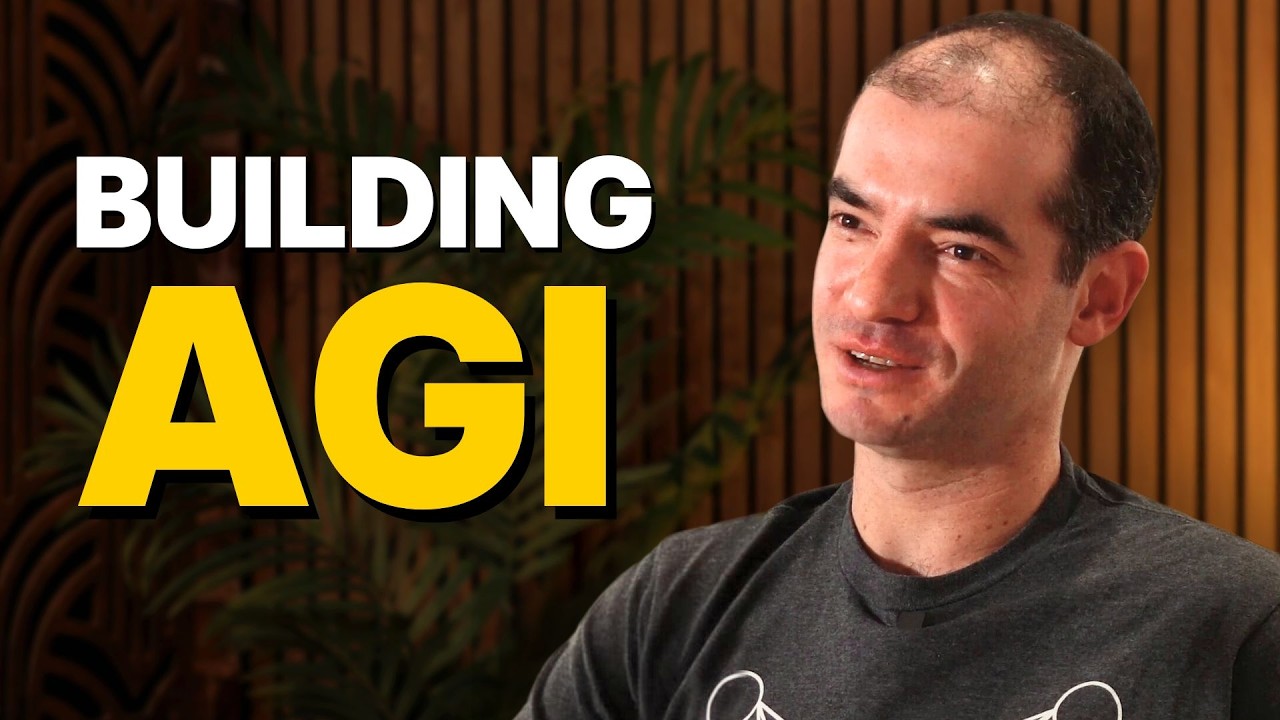
- Ilya Sutskever, Co-founder and Chief Scientist of OpenAI, discusses the trajectory toward AGI, the limits and potential of current AI paradigms, alignment challenges, and the future of intelligence. He argues that next-token prediction may be more powerful than it appears, that reliability is the key bottleneck for economic impact, and that while deep learning will go very far, AGI will likely require integrating multiple research threads. He also reflects on hardware constraints, data limitations, the role of academia, and what a post-AGI world might look like.
The Path to AGI
-
AGI is not imminent but progress is accelerating
- Sutskever avoids giving a precise timeline but suggests we are in a multi-year window where AI produces increasing economic value before reaching AGI.
- He compares current AI to early self-driving cars: it looks like it can do everything, but reliability remains a major unsolved problem.
- If AI underperforms economically by 2030, he attributes it to reliability issues—users still having to double-check outputs—rather than a lack of capability.
-
Next-token prediction may surpass human-level intelligence
- On the surface, next-token prediction seems limited to imitation, but Sutskever argues it can go further.
- To predict tokens well, a model must understand the underlying reality that produced them—including human thoughts, motivations, and behaviors.
- A sufficiently powerful model could extrapolate how a hypothetical person with superior insight would act, even if no such person exists in the training data.
- This suggests next-token prediction could, in principle, exceed human performance rather than merely matching it.
-
Reinforcement learning is already mostly AI-generated
- In Reinforcement Learning from Human Feedback (RLHF), humans train the reward function, but the actual training data during RL is generated by the AI itself.
- Sutskever envisions a future where human teachers collaborate with AI—humans do 1% of the work, AI does 99%—to teach the next generation of models.
- Fully removing humans from the loop (à la AlphaGo) is possible but not ideal; human oversight remains important.
Data, Models, and Research Frontiers
-
Data is not yet exhausted, but quality matters more than quantity
- There is still plenty of text data to train on, but the most valuable tokens are those that discuss smarter, more interesting topics.
- Multimodal training (images, audio, etc.) is a fruitful direction but not strictly necessary yet.
- Sutskever does not disclose where OpenAI has not yet scraped, but implies every organization has untapped sources.
-
Algorithmic improvements still have room to contribute
- He is uncertain how much gain comes from algorithmic advances alone but believes there is meaningful headroom beyond scaling.
-
Robotics is now viable but requires extreme commitment
- OpenAI exited robotics because there was no path to sufficient data at the time.
- Now, with better models, it is possible—but only if a company commits to building tens of thousands of robots and collecting data iteratively.
- Robotics remains fundamentally harder than software due to physical and logistical constraints.
-
Hardware is not the bottleneck
- Sutskever dismisses concerns about current hardware limitations, stating that GPUs and TPUs are architecturally similar and that cost per flop is what matters.
- He acknowledges that a disruption in Taiwan (e.g., a tsunami) would be a significant setback, but fabs elsewhere could eventually compensate.
Alignment and Safety
-
A single mathematical definition of alignment is unlikely
- Instead, alignment will be assessed through multiple lenses: behavioral testing, adversarial stress tests, and internal neural net interpretability.
- The more capable the model, the higher the confidence required before release.
-
Alignment must outpace capability growth
- Sutskever emphasizes that the degree of alignment must increase faster than model capability to maintain safety.
- Current interpretability methods are rudimentary; future success may involve using small, well-understood neural nets to audit larger, opaque ones.
-
Academic researchers can contribute meaningfully to alignment
- While companies lead in capability research, academia has a significant role to play in alignment.
- Sutskever encourages academic researchers to pursue alignment questions, as they are both important and tractable.
Economic and Strategic Considerations
-
Inference cost will not be prohibitive if value is high enough
- As models grow, inference becomes more expensive, but if the output is valuable enough (e.g., legal advice worth $400/hour), cost is not a barrier.
- Price discrimination already exists: customers choose different model sizes based on their needs and budgets.
-
Commoditization is a risk, but innovation prevents it
- There is downward pressure on model prices, but companies can stay ahead by improving reliability, trustworthiness, and specialization.
- Research directions will likely follow a convergence-divergence-convergence pattern: short-term convergence, divergence as companies explore long-term bets, then convergence again when breakthroughs emerge.
-
OpenAI’s revenue projections are grounded in real data
- The $1 billion revenue projection for 2024 is based on observed growth from the API, DALL-E, and ChatGPT.
- Sutskever acknowledges that extrapolations are uncertain but insists they are informed by actual usage trends.
The Post-AGI World
-
AGI will not lead to a static utopia
- Sutskever rejects the idea that AGI will allow us to design a fixed future; change is inevitable.
- He hopes for a future where humans remain free to make their own choices, with AGI serving as a safety net rather than a ruler.
-
Humans may merge with AI
- Some people may choose to become “part AI” to expand their cognitive abilities and solve harder problems.
- Sutskever finds this prospect personally tempting.
-
Meaning after AGI is an open question
- He suggests AI could help people become more enlightened, akin to having access to the best meditation teacher in history.
- But he acknowledges that finding purpose in a world transformed by AGI will be challenging.
Reflections on Progress and the Future
-
Deep learning’s rise was nearly inevitable
- Sutskever argues that the convergence of data, GPUs, and transformers was not a coincidence but the result of intertwined technological progress.
- Even without key figures like himself or Geoffrey Hinton, the deep learning revolution would have happened, perhaps delayed by only a year or two.
-
Breakthroughs may not feel like breakthroughs in hindsight
- Many advances involve recognizing that something had desirable properties all along, rather than inventing something entirely new.
- The Transformer was a rare exception—a genuinely non-obvious insight.
-
Inspiration from the brain should be handled carefully
- Sutskever advocates for being inspired by human intelligence but warns against latching onto non-essential features.
- The neural network itself was a fruitful abstraction from the brain; the key is to focus on the right basics.
-
Perseverance is necessary but not sufficient
- When asked why he remains at the forefront of AI research, Sutskever attributes it to relentless effort combined with the right perspective.
- He acknowledges that many factors must align to make fundamental discoveries.