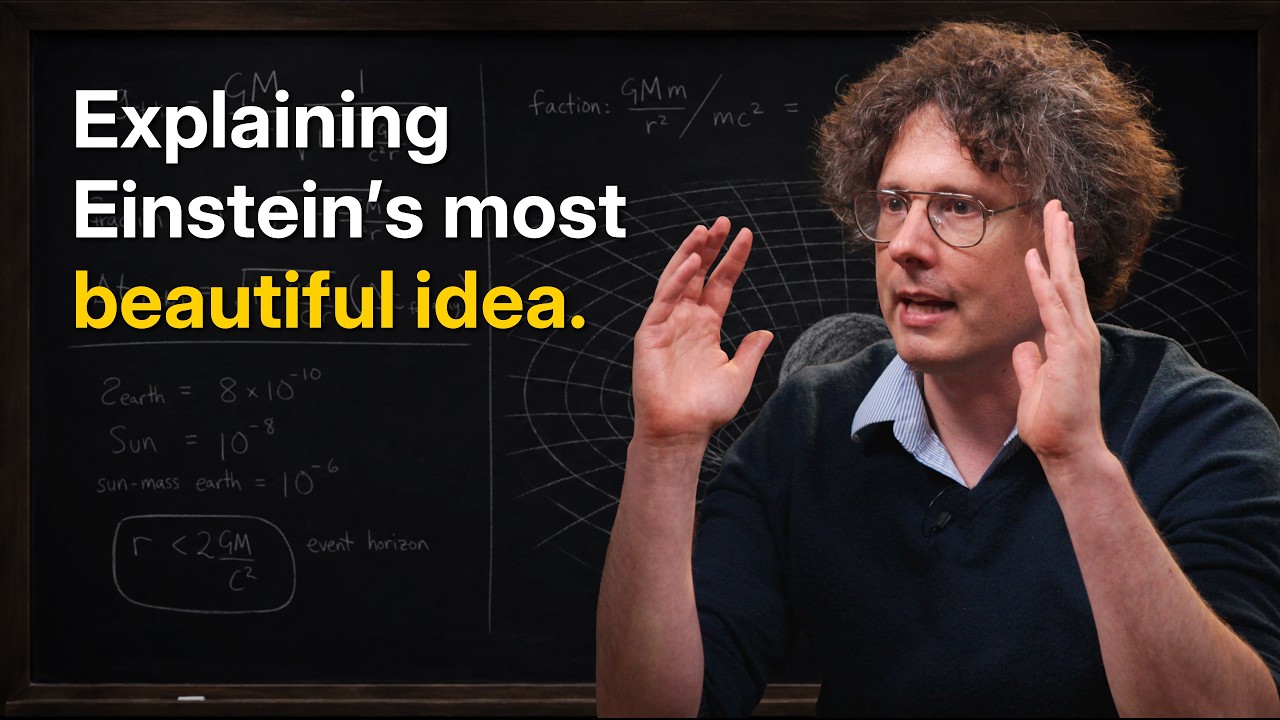
This episode features physicist Adam Brown explaining general relativity from first principles, tracing Einstein’s path from the equivalence principle to the field equations, then exploring black holes as consequences of curved spacetime, their properties as ultimate energy extractors, what crossing an event horizon would feel like, the experimental evidence that confirmed black holes exist, and reflections on whether AI could replicate Einstein’s theory-building approach.
The equivalence principle: Einstein’s central clue
Einstein’s breakthrough came from noticing a coincidence in Newtonian physics: the inertial mass that resists acceleration (in F=ma) is exactly equal to the gravitational mass that determines gravitational attraction (in F=GMm/r²), unlike in electromagnetism where charge and mass are unrelated.
This equality, confirmed to one part in 10¹⁵, means all objects fall at the same rate in a vacuum — the feather and brick hit the ground simultaneously because greater gravitational force on the brick is exactly canceled by its greater inertia.
Einstein recognized this as the equivalence principle: gravity behaves like an inertial (fictitious) force, such as centrifugal force, where the “charge” under the force is always the inertial mass because the force arises from the tendency of mass to move in straight lines.
If gravity is an inertial force, then free-falling objects (like astronauts or thrown chalk) are moving along straight lines, while objects at rest on Earth (like a person in a chair) are accelerating — requiring a radical redefinition of what “straight line” means in spacetime.
Gravity as curved spacetime, not a force
The bucket-and-water demonstration illustrates two perspectives: from outside, water stays in because it doesn’t have time to fall out; from the rotating frame, a centrifugal force pins it to the bottom — an inertial force whose “charge” is inertial mass, exactly like gravity.
Einstein’s insight: just as a flat map distorts straight lines on a curved Earth (San Francisco to London appears curved on a flat map but is straight on a globe), pretending spacetime is flat makes free-fall paths look curved and stationary paths look straight.
Matter tells spacetime how to curve; curved spacetime tells matter how to move along geodesics (straight lines in curved geometry).
The field equations: G_μν = (8πG/c⁴) T_μν — the left side (Einstein tensor) describes spacetime curvature, the right side (stress-energy tensor) describes all forms of mass and energy.
Unlike Newton’s instant action-at-a-distance, this respects the speed-of-light limit: changes in curvature propagate at c.
Black holes from the Schwarzschild solution
Schwarzschild, a Prussian artillery officer in WWI, found an exact solution to Einstein’s equations within months of their publication — describing spacetime around a point mass, now understood as a black hole.
Einstein himself was confused about the event horizon for decades, thinking objects might bounce off it.
A Newtonian precursor: Michell and Laplace (18th century) calculated that if escape velocity equals c, light cannot escape, giving radius r = 2GM/c² — coincidentally the correct Schwarzschild radius for the wrong reasons.
A more compelling argument: lowering a mass m toward a central mass M on a pulley extracts energy E = GMm/r. The fraction of rest energy extracted is GM/(rc²). For Earth this is ~7×10⁻¹⁰; for the Sun ~2×10⁻⁶. As r decreases, this fraction approaches 1 — suggesting a limit where you could extract more than mc², which is impossible.
General relativity resolves this by making gravity stronger than Newtonian at short distances, not weaker. The force becomes infinite at the event horizon (r = 2GM/c²), preventing further lowering and forming a black hole.
Black holes as ultimate power plants
Three key formulas from the Schwarzschild metric for a static observer at radius r:
Gravitational acceleration: g = (GM/r²) / √(1 - 2GM/rc²) — diverges at the event horizon, making it impossible to hover at or below it.
Gravitational time dilation: dτ = dt √(1 - 2GM/rc²) — clocks run slower deeper in the potential. Confirmed by Pound-Rebka (1959) and essential for GPS corrections.
Energy of a mass at radius r as measured from infinity: E = mc² √(1 - 2GM/rc²) — mass-energy is redshifted climbing out of the potential.
Lowering a brick to just above the event horizon extracts exactly 100% of its rest mass energy (mc²), resolving the Newtonian paradox. Chemical rockets extract ~10⁻¹⁰, nuclear ~10⁻³ to 10⁻²; gravity can extract ~1.
Quantum mechanically (Hawking radiation), black holes eventually evaporate, radiating energy mostly as photons/gravitons/neutrinos, not baryons — suggesting quantum gravity violates global symmetries like baryon number.
What falling into a black hole feels like
External observer: sees the infaller slow down, redshift, and fade to black, never crossing the event horizon — the final photon is infinitely redshifted.
Infaller’s perspective: crosses the event horizon uneventfully (for large black holes). Proper time to singularity is finite. Tidal forces at horizon scale as 1/M² — for a solar-mass black hole they’re lethal; for a galactic-mass black hole, negligible.
The event horizon is teleological: not locally detectable, but a global statement that once crossed, the singularity is inevitable. For a sufficiently large black hole, you could live out your life inside before hitting the singularity.
Orbital angular momentum helps escape far away (centrifugal force), but within r = 3GM/c² it becomes counterproductive because kinetic energy also gravitates, adding to the inward pull.
Three lines of evidence that black holes are real
Theoretical: Penrose (and Hawking-Penrose) singularity theorems proved black hole formation is generic in GR, not a fine-tuned artifact.
Stellar orbits: Decades of tracking stars orbiting Sagittarius A* (4 million solar masses) at the galactic center reveal an invisible, extremely compact, massive object — stars pass within ~100 AU without collision.
Gravitational waves: LIGO (2015) detected spacetime vibrations from merging black holes (first event: two ~30 solar mass black holes, 1.6 billion light-years away). Thousands of mergers now observed across multiple detectors.
Event Horizon Telescope: Radio interferometry imaged the shadow of M87* and Sgr A*, showing emission from accreting matter.
Historical confirmation: the 1919 eclipse expedition
Newtonian gravity predicts light bending (treating light as particles at speed c), but GR predicts exactly twice the deflection.
Einstein’s early equivalence-principle calculation gave the Newtonian value; he corrected it to the full GR value during WWI.
Eddington’s 1919 British expedition to Principe and Sobral measured stellar positions during a total solar eclipse, confirming the GR prediction — a German theory confirmed by a British expedition post-WWI, launching Einstein to global fame.
Other confirmations: Mercury’s perihelion precession (known anomaly, explained exactly by GR), gravitational redshift, Shapiro delay, binary pulsar orbital decay, frame-dragging (Gravity Probe B).
AI and the future of theoretical physics
GR emerged from minimal empirical input: finite speed of light (special relativity) + equivalence principle (empirical equality of inertial/gravitational mass). Einstein pursued a singular vision for a decade.
This is atypical; most physics requires tight experiment-theory loops. String theory attempted the “Einstein approach” (mathematical consistency + known limits) but faces a landscape of consistent solutions without experimental guidance.
AI could explore theory space in parallel (many “Einsteins”), but success depends on whether consistent theories are few (navigable by consistency/aesthetics) or many (requiring experiment to select).
Optimism about AI explainability: LLMs may not just produce inscrutable proofs but also find human-comprehensible pathways (e.g., Erdős problem, unit distance conjecture disproof). They have infinite patience for low-probability paths humans avoid due to bias.