-
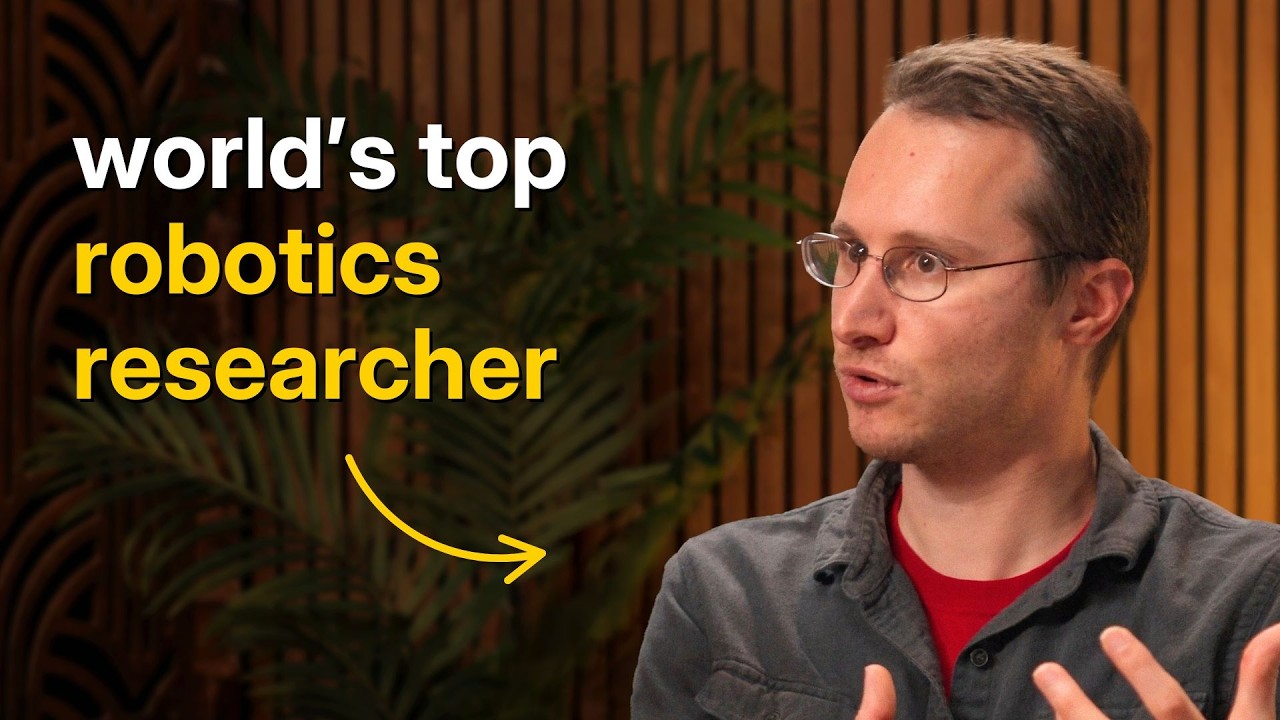
Sergey Levine, co-founder of Physical Intelligence and UC Berkeley professor, discusses the timeline and challenges for deploying fully autonomous robots at scale.
- Physical Intelligence is building robotic foundation models: general-purpose AI systems that can control any robot to perform any task, analogous to how LLMs handle language.
- The company is one year into development and has demonstrated basic dexterous tasks (folding laundry, cleaning kitchens, making coffee), but these are early proofs-of-concept, not the end goal.
- The real goal is a robot that receives a high-level prompt (e.g., “run my house for six months”) and autonomously handles diverse tasks, learns continuously, recovers from mistakes, and exercises common sense.
-
Timeline to widespread deployment
- The key milestone is when the “flywheel” starts: robots deployed in the real world collect experience, improve from it, and become more capable over time.
- Sergey estimates this flywheel could begin within 1–2 years for narrowly scoped tasks.
- For a fully autonomous housekeeper-level system, his median estimate is ~5 years (single-digit years), though he acknowledges uncertainty.
- Economic impact will likely mirror LLMs: initial productivity gains come from human-robot collaboration (e.g., a worker directing a robot via language), not full replacement.
- In 5 years, robots may handle a meaningful fraction of physical labor, but scope limitations will persist—similar to how LLMs augment software engineers rather than replacing them entirely.
-
Why robotics will scale faster than self-driving cars
- Unlike 2009-era autonomous driving, today’s systems benefit from robust perception models (VLMs, LLMs) that generalize far better.
- Robotic manipulation allows safe failure and correction: a robot can drop a dish, pick it up, and learn—unlike a car crash, which is catastrophic.
- Common sense reasoning (e.g., understanding “slippery floor” implies caution) is now possible via LLMs/VLMs, enabling safer exploration and learning.
- These factors allow starting with limited scope and expanding gradually, avoiding the “brick wall” faced by early self-driving efforts.
-
How vision-language-action models work
- Physical Intelligence’s π0 model is a vision-language model (VLM) augmented with an action expert (decoder) for motor control.
- It processes camera images and language commands, performs internal chain-of-thought reasoning (e.g., “to clean the kitchen, pick up the sponge”), then outputs continuous actions via flow matching/diffusion (not discrete tokens).
- Structurally, it’s a mixture-of-experts transformer, using pre-trained LLMs (e.g., Google’s open-source Gemma) as a foundation.
- This reflects a broader trend: prior knowledge from LLMs/VLMs is critical for robotics, enabling object recognition, spatial understanding, and task planning.
- Physical Intelligence’s π0 model is a vision-language model (VLM) augmented with an action expert (decoder) for motor control.
-
Why video data alone isn’t enough
- Video prediction models struggle because raw pixels lack the semantic abstraction of text; predicting every detail (e.g., water molecules vs. pedestrians) is computationally intractable.
- However, embodied robots have purpose: their perception is focused by goals, filtering irrelevant data (like humans’ “tunnel vision”).
- Foundation models trained on real-world interaction can better leverage auxiliary data (e.g., YouTube videos) because they know what to look for.
- Emergent capabilities arise from compositional generalization: e.g., a robot trained to fold shirts accidentally picks up two, figures out how to handle it, and generalizes this to new scenarios (e.g., righting a fallen bag).
-
Efficiency trade-offs and the path to human-like performance
- Current models face a trilemma: balancing inference speed (~100ms), context length (~1 second), and model size (~2B parameters)—all far below human capabilities (trillions of synapses, hours of context, millisecond reactions).
- Moravec’s paradox explains why short context suffices for dexterous tasks: well-practiced physical skills are “baked in” and require less active memory than cognitive tasks.
- Solutions include:
- Better representations: compressing temporal redundancy in sensory streams, using multimodal context (spatial, semantic, symbolic).
- Parallel processing: mimicking the brain’s parallelism (perception + planning + memory simultaneously), possibly via transformer variants.
- Off-board inference: running heavy computation in the cloud, with robots operating reactively when connectivity is poor.
-
Learning from simulation vs. real-world data
- Simulation alone fails because models lack goal-directed focus—unlike human pilots who know they’ll be tested on real planes.
- Meta-learning (training on multiple tasks to improve downstream performance) is promising but requires a strong foundation from real-world data first.
- Synthetic data (e.g., from learned world models) will help, but real-world experience remains essential for injecting ground-truth physics knowledge.
- Long-term, advanced AIs may simulate complex scenarios (e.g., building a Dyson sphere), but only after mastering real-world dynamics.
-
Hardware bottlenecks and cost trends
- Robot arm costs have plummeted: from $400,000 (PR2, 2014) to $30,000 (Berkeley lab) to ~$3,000 today—with potential for further drops to hundreds of dollars.
- Key drivers: economies of scale, better manufacturing, and AI compensating for hardware imprecision (via visual feedback).
- Current bottlenecks are reliability and cost, not raw capability—AI isn’t yet pushing hardware limits.
- There is no “Nvidia of robotics” yet; the field favors heterogeneous, task-specific designs over universal humanoid forms.
-
Geopolitical implications: Does China win by default?
- China dominates manufacturing of robot components, solar panels, batteries, and other critical hardware.
- If the bottleneck shifts to physical deployment (e.g., building data centers, solar farms), China’s manufacturing base could give it a decisive advantage.
- However, automation multiplies productivity: countries with advanced AI can offset labor shortages and reduce reliance on foreign manufacturing.
- Sergey advocates for a balanced ecosystem: investing in both AI software and domestic hardware innovation to avoid strategic dependency.
- The end state should be full automation in a wealthy society, with education as the key buffer against disruption—teaching flexibility, not just facts.
Fully autonomous robots are much closer than you think – Sergey Levine
Dwarkesh Podcast • • 1h28 → 4 min • #101