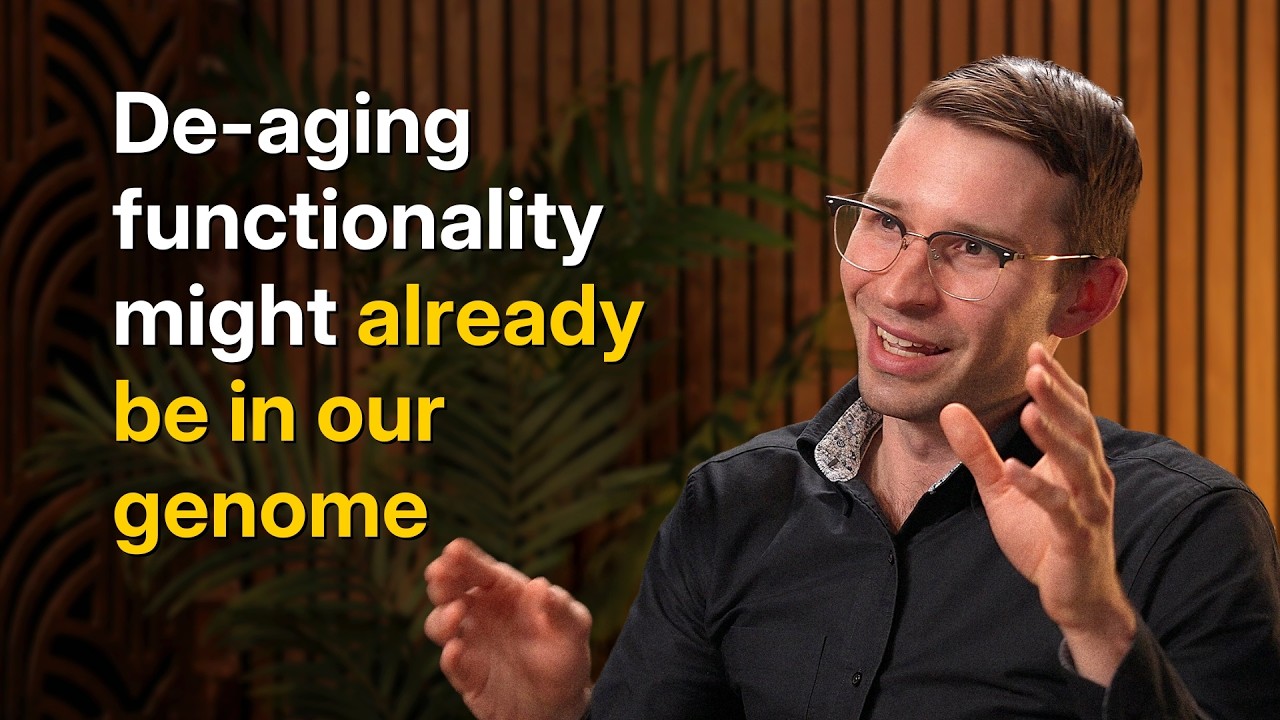
- Jacob Kimmel, president and co-founder of NewLimit, explains why evolution did not optimize humans for longevity, and how his company is pursuing epigenetic reprogramming—using transcription factors to reset aged cells to younger states—as a path to treating aging itself rather than individual diseases.
Three reasons evolution didn’t optimize for longevity
-
High baseline hazard rate limited selective pressure for longevity
- During most of human and primate evolution, the daily probability of death from all causes (infection, predation, accidents, etc.) was extremely high, so very few individuals survived long enough for aging to be a major limiting factor.
- Because so few reached advanced ages, there was little evolutionary “gradient signal” favoring alleles that extend lifespan, even if those alleles could help individuals have more children or care for grandchildren.
- This also constrains the evolution of traits like intelligence: fluid intelligence likely peaked around age 25–30 because that was the age of maximal representation in ancestral populations, not because older cognition is inherently less valuable.
-
Kin selection may actively disfavor longevity
- From a selfish-gene perspective, an organism that lives longer but becomes less fit over time consumes more calories than it contributes relative to younger, fitter individuals.
- A genome can propagate more effectively by optimizing for turnover—replacing aged individuals with younger, maximally fecund ones—than by investing in extended maintenance of any single body.
- This acts like a “length regularizer” in machine learning: the genome is penalized for letting individuals persist past their peak reproductive and resource-contributing years.
-
Evolutionary optimization constraints limit what natural selection can achieve
- Mutation rate bounds the step size per generation; too high causes cancer, too low prevents adaptation.
- Population size limits how many variants can be tested in parallel.
- Most evolutionary pressure was directed toward infectious disease resistance rather than longevity, so even if longevity were beneficial, the “weight” on it in the genome’s multi-objective optimization was too low.
- Together, these constraints mean evolution never had the opportunity or incentive to solve the hard problem of aging—making it, in principle, easier for humans to intervene than if evolution had already exhausted the low-hanging fruit.
Why didn’t humans evolve their own antibiotics?
- Antibiotics are complex metabolites produced by bacteria and fungi in an evolutionary arms race (the Red Queen hypothesis), requiring rapid mutation rates and massive population sizes to sustain.
- Mammals cannot tolerate high mutation rates (due to cancer risk) and lack the population-scale parallel computation that microbes use to maintain such arms races.
- Even if a mammal evolved an antibiotic, pathogens would likely evolve around it quickly.
- Evidence from TRIM5alpha shows that host defense genes can be repurposed or lost when new threats emerge: primates once had protection against HIV-like viruses but lost it when a more dangerous endogenous retrovirus forced a genetic trade-off—and the original defense was never re-evolved after that virus went extinct.
- Gene duplication enables evolutionary innovation: by copying a gene, evolution preserves the original function in one copy while allowing the duplicate to drift and acquire new functions, providing a substrate for adaptation without lethal intermediate steps.
Aging is not monocausal—and that’s why treatments will be incremental
- Aging arises from multiple layers of molecular dysregulation, not a single root cause.
- Epigenetic reprogramming targets the epigenome—the chemical marks and transcription factor networks that tell cells which genes to use—which degrades with age, leading to loss of cellular identity and function.
- The goal is to remodel the epigenome back to a younger state, restoring cells’ ability to perform their roles (e.g., liver cells metabolizing toxins, T cells fighting pathogens).
- Because aging is multifactorial, the first therapies will likely add healthy years without eliminating all decline—mirroring why evolution never “solved” aging in one step.
Epigenetic reprogramming via transcription factors
- Transcription factors (TFs) act as orchestra conductors: they bind DNA and direct which genes are turned on or off, shaping cell identity and function.
- NewLimit screens combinations of TFs to find those that revert aged cells to younger states, measured both by gene expression (“looks like” assays) and functional performance.
- Risks include changing cell identity (e.g., turning a liver cell into something else) or causing pathologies like cancer; these are checked at the gene expression and functional levels before any in vivo testing.
- Shinya Yamanaka showed in 2007 that four TFs (Oct4, Sox2, Klf4, Myc) can reprogram adult cells into embryonic stem cells—a landmark proof of concept—but doing this in the body would cause tumors (teratomas).
Why AI models are needed: the combinatorial explosion of TF combinations
- Yamanaka’s approach worked because success was easy to detect (stem cells look different and grow rapidly) and even 0.001% efficiency was sufficient since converted cells amplify.
- Aging is harder to measure: old and young liver cells look similar under a microscope, and there’s no single gene that cleanly distinguishes them.
- Single-cell genomics now allows measurement of all mRNAs in individual cells, enabling models to discriminate young vs. aged states—but success does not self-amplify.
- With ~2000 TFs and combinations of 1–6, the search space is ~10¹⁶; exhaustive screening would require more single-cell sequencing than the entire world has done to date.
- AI models trained on sparse experimental data can predict the effects of untested TF combinations, enabling in silico search for optimal reprogramming cocktails.
Transcription factors as evolution’s modular control system
- TFs are modular and combinatorial: small changes in TF composition can produce large changes in cell fate, which is how development generates hundreds of cell types from one genome.
- This modularity arises because evolution needs small mutations to yield meaningful phenotypic changes; gene duplication provides raw material for new TFs without breaking existing functions.
- TFs function like queries in an attention mechanism: they bind specific DNA sequences (keys) and activate target genes (values), allowing efficient reprogramming of cellular output through small edits.
- This structure makes TFs attractive therapeutic targets—evolution has already built a system where pulling a few levers can reshape cell behavior.
Delivery: getting reprogramming factors into the right cells
- Two main delivery modalities exist today:
- Lipid nanoparticles (LNPs): fat bubbles that deliver RNA to cells; naturally target the liver but can be engineered with antibodies to reach other tissues.
- Viral vectors (e.g., AAVs): engineered viruses that deliver DNA to specific cell types; limited by packaging size and immune responses.
- Both have limitations: LNPs face physical barriers in reaching all tissues; viral vectors are immunogenic and cannot target every cell type.
- Jacob’s long-term bet: engineered cells (e.g., modified immune cells) will eventually serve as living delivery vehicles, patrolling the body and releasing therapeutic payloads only when and where needed—mirroring how the immune system already solves the delivery problem.
- These cells could persist for years, respond to environmental signals, and carry large genetic payloads (billions of base pairs vs. kilobases in AAVs).
- CAR-T therapy is an early example: T cells are engineered to recognize and kill cancer cells, proving that cell-based delivery can work in humans.
Near-term implications: partial reprogramming can have systemic benefits
- Even if only some tissues are reprogrammed (e.g., liver, immune system), benefits can spread systemically because organs communicate via hormones and signals.
- Young liver transplants in older recipients reduce risk of multiple diseases and improve overall survival.
- Hematopoietic stem cell (HSC) transplants have cured unrelated conditions due to systemic signaling effects.
- Ozempic’s wide-ranging benefits (cardiovascular, metabolic, possibly neurodegenerative) illustrate how targeting one cell type can have body-wide effects.
- Therefore, even tissue-specific reprogramming could add decades of healthy life without needing to reprogram every cell.
Practical considerations: payload size, dosing, and durability
- Effective TF combinations are small (1–5 factors), well within the capacity of current mRNA delivery platforms (which already deliver 20+ transcripts simultaneously).
- TF expression levels in cells are naturally low, so even modest dosing can achieve therapeutic effects.
- Epigenetic marks can be extremely stable (cell identities persist for decades; targeted edits in lab cells last through 400+ divisions over years), suggesting treatments could be infrequent—potentially monthly or less—though durability in humans remains unproven.
Synthetic and non-natural transcription factors
- The natural TF set is a strong starting point, but there’s no guarantee it’s optimal for reversing aging.
- Mutagenizing natural TFs (e.g., Super-SOX, an engineered version of SOX2) can dramatically improve reprogramming efficiency.
- Future therapies may use entirely synthetic TFs or chimeric proteins not found in nature.
- Some aging-related damage (e.g., skin sagging from degraded elastin fibers) may require programming cells into states not seen in normal development—extra-physiological states that must be engineered de novo.
Breaking Eroom’s Law with virtual cells
- Eroom’s Law: the number of new drugs approved per billion dollars invested has declined steadily since the 1950s, the inverse of Moore’s Law.
- Unlike AI, where scaling compute yields broadly capable models, biotech has lacked a general-purpose platform: each drug is bespoke, and success in one doesn’t reliably predict success in another.
- A “virtual cell”—a model trained on perturbation data (turn genes on/off, measure resulting cell states)—could enable compounding returns: each experiment improves the model, increasing the probability of discovering the next therapy.
- NewLimit builds such models using proprietary large-scale Perturb-seq data (combinatorial TF perturbations in human cells), predicting how TF combinations affect cell state.
- The model has multiple “heads”: one predicts the full transcriptome (pre-training, like imitation learning); others predict value-laden outcomes like “younger” or “more functional” (like RLHF).
- This mirrors LLM training: pre-train on broad data, then fine-tune for specific objectives.
Why Perturb-seq hasn’t yet delivered breakthroughs
- Perturb-seq (combining genetic perturbations with single-cell RNA sequencing) was first demonstrated in 2016 but required years of technical maturation:
- Cost per cell dropped from dollars to fractions of cents.
- Barcoding efficiency improved from ~50% to near-perfect, enabling reliable detection of which perturbation each cell received.
- Combinatorial perturbations (multiple genes at once) became feasible only recently; mislabeling scales as 1/2ⁿ for n perturbations.
- NewLimit now generates million-cell datasets routinely, giving them a data advantage in their niche (TF overexpression in human primary cells).
Vertical integration in a nascent field
- Unlike LLMs, where training data (internet text) is a public good, high-quality biological perturbation data is scarce and must be generated in-house.
- NewLimit vertically integrates data generation and model building because no external “Wikipedia-scale” dataset exists yet for their problem.
- Over time, as the field matures, a more modular ecosystem may emerge (foundation models for biology, with companies fine-tuning for specific applications).
Economic models for longevity medicine
- Reimbursement challenge: if a drug’s benefits accrue years later, no insurer (who sees patients churn every 3–4 years) has incentive to pay upfront.
- Pay-for-performance models—paying annually contingent on measurable health outcomes—could align incentives.
- Pre-existing condition frameworks post-ACA offer a template for portable benefits across insurers.
- Direct-to-consumer shift: as health-promoting medicines (like incretin mimetics) show tangible daily benefits, demand will grow for models like LillyDirect, bypassing traditional pharmacy/PBM intermediaries.
- Payment-over-time plans (like financing a car) could decouple cost from insurer churn.
- Healthcare spend: drugs are ~7% of US healthcare costs; most spending goes to administration and late-life care.
- ~1/3 of Medicare costs occur in the final year of life.
- Preventive medicines that avoid hospitalizations and intensive care could reduce total system costs even if drug spending increases.
- Pharmaceuticals are the only healthcare sector where technology consistently makes delivery more efficient over time (via generics).
Big pharma’s role and the biotech ecosystem
- Large pharma companies have largely externalized early-stage R&D, functioning more like venture capital firms: they partner with or acquire assets from small biotechs once they reach Phase I/II trials.
- ~70% of newly approved molecules originate in small biarma, despite most R&D dollars being spent by large firms (mostly on trials).
- Some exceptions exist (e.g., Roche/Genentech under Aviv Regev), but the dominant model is a bifurcated ecosystem: biotechs discover, pharma develops.
- NewLimit’s proprietary data and models position them to discover first-in-class reprogramming therapies, potentially partnering with pharma for late-stage development and commercialization.