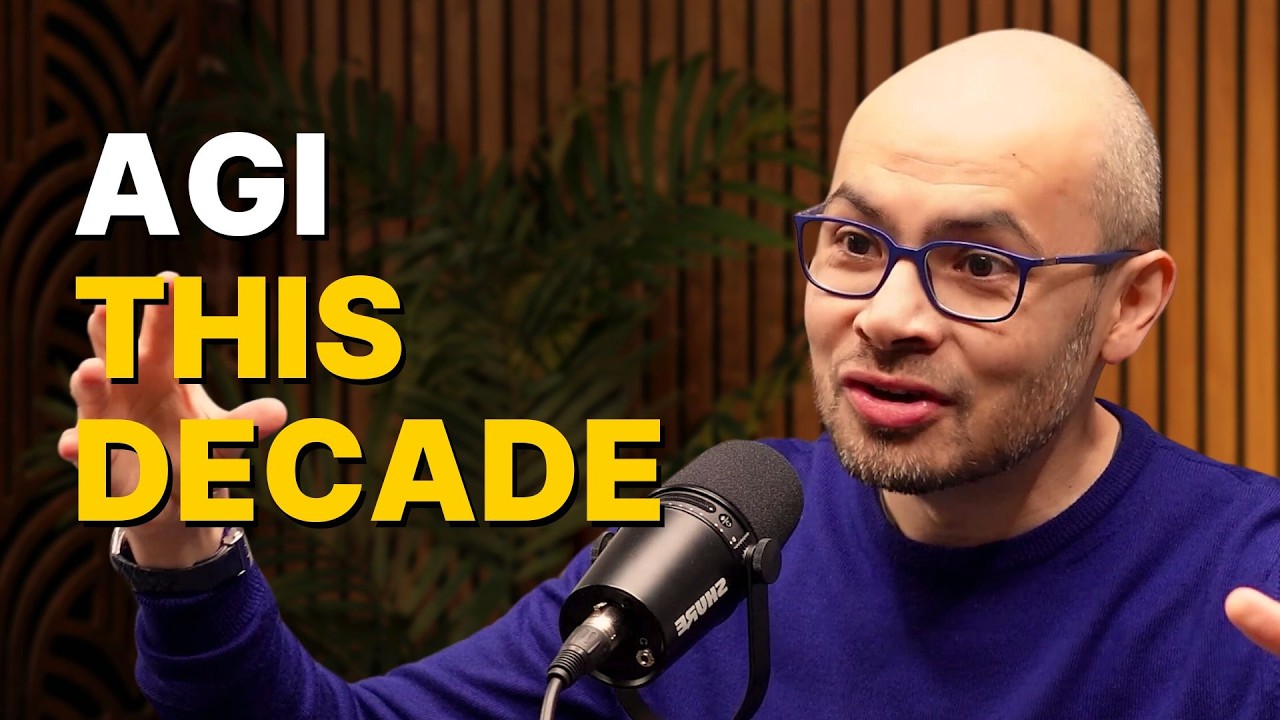
Demis Hassabis, CEO of Google DeepMind and a trained neuroscientist, discusses the nature of intelligence, the path to AGI, and the responsibilities that come with building increasingly powerful AI systems. He argues that while large language models (LLMs) have proven surprisingly effective, they are likely insufficient on their own for AGI — planning, search, and richer world models will be essential additions. He also addresses scaling, alignment, safety, governance, and the societal implications of superhuman AI.
Nature of intelligence
Intelligence likely involves both specialized brain regions and high-level common algorithmic themes that underpin general reasoning.
LLMs show asymmetric improvement in specific domains (e.g., coding improving general reasoning), which mirrors how human learners specialize despite using general learning systems.
Transfer between domains (language, code, math) is real but still limited; Demis expects more as models improve.
Neuroscience has historically inspired key AI ideas — reinforcement learning, experience replay, attention — not through one-to-one mapping but through directional clues about architecture and representation.
The brain serves as an existence proof that general intelligence is possible, which accelerates progress by making it a question of “when” rather than “if.”
Mechanistic analysis of neural network representations (“virtual brain analytics”) is still immature but a critical area for future research.
RL and planning atop LLMs
LLMs are a necessary but probably insufficient component of AGI; on top of them, planning mechanisms like AlphaZero’s tree search are needed to chain reasoning and explore possibility spaces.
Search efficiency depends on the quality of the world model: AlphaZero looks at tens of thousands of positions versus millions for brute-force systems like Deep Blue, and human grandmasters look at only a few hundred — because richer models enable more targeted search.
A key challenge for real-world RL is specifying reward functions; games are useful testbeds because winning is a clear objective.
Human genius (e.g., Einstein) likely relies on extremely accurate mental models and intuition rather than brute-force search, allowing breakthroughs with minimal exploration.
Self-play and synthetic data generation are promising for overcoming data bottlenecks, but a science of data curation — identifying gaps in distributions and filling them with targeted synthetic data — is still nascent.
Older RL ideas (DQN, deep RL on Atari) need to be recombined with modern large multimodal models; pure RL without priors is theoretically possible but far less efficient than leveraging existing web-scale knowledge.
Scaling and scaling hypothesis
The strong scaling hypothesis — that throwing enough compute and data at the problem yields intelligence — has progressed further than almost anyone expected; LLMs are “almost unreasonably effective” for what they are.
Scaling has produced emergent properties like implicit concept formation and surprising grounding from language alone, possibly aided by RLHF feedback from grounded human raters.
Demis’s current bet is that AGI requires both continued scaling and new algorithmic inventions; roughly half of DeepMind’s effort goes to each.
Grounding may actually improve as models become more multimodal (video, audio) and as RL agents learn through active interaction with realistic simulated environments.
A key alignment concern: as models exceed human capability in certain domains, human labelers may no longer be able to evaluate outputs (e.g., a million-line pull request), and RL training that optimizes for outcomes rather than next-token prediction could reduce the “guardrail” of human-like reasoning.
Alignment strategies include: better evaluations for deception and dangerous behaviors, narrow AI tools to help humans analyze general systems, hardened sandboxes for safe experimentation, and mechanistic analysis to understand internal representations.
Timelines and intelligence explosion
Demis doesn’t give specific year estimates but notes that DeepMind was founded in 2010 as a 20-year project and is “on track,” suggesting AGI-like systems within the next decade.
An intelligence explosion — where AGI accelerates further AI research — is potentially possible, especially given that current LLMs are already useful for coding and theorem proving, but depends on how society chooses to deploy early AGI systems.
Before continuing development of a model capable of such dynamics, Demis would want: robust evaluations, ideally formal proofs but at least empirical bounds on capabilities, confidence that the system isn’t deceptive, and the ability for the system to explain its reasoning to humans (analogous to a chess grandmaster explaining a move to a novice).
Red flags that would pause training include: unexpected capabilities emerging in sandbox testing, the system doing something explicitly prohibited, or evidence of deception about its behavior.
Gemini training and scaling as an art
Practical limits on scaling include: compute capacity per data center, distributed computing challenges across data centers, and hardware constraints (TPUs, GPUs).
Scaling is not mechanical — hyperparameters must be adjusted at each new scale, and intermediate data points are needed to correct optimization; extrapolating scaling laws multiple orders of magnitude is unreliable.
Core metrics like training loss can be predicted at small scale, but downstream capabilities (MMLU, math) don’t always follow linearly — there are non-linear effects and capability step functions.
Gemini 1 used roughly the same compute as GPT-4; DeepMind’s compute is also heavily used for testing new innovations at scale, not just for scaling existing models.
Demis expects Google to have the most compute of any research lab, used for both scaling and invention.
Retrospective on DeepMind’s trajectory
From the beginning, DeepMind bet on generality and learning — reinforcement learning, search, and deep learning — avoiding the handcrafted expert systems that failed in the 1990s.
Games served as efficient proving grounds with clear reward functions; AlphaGo was a pivotal moment that inspired the field to take scaling seriously.
Transformers, invented at Google Research/Brain, turbocharged progress by enabling ingestion of massive amounts of data.
Early DeepMind papers anticipated key ideas: Shane Legg’s 2009 thesis proposed compression of Wikipedia as a test of intelligence (essentially the LLM loss function), and Demis’s 2016 paper identified attention as a critical mechanism before transformers existed.
Governance of superhuman AI
AI governance must involve many stakeholders — civil society, academia, government — not just private companies; international consensus is needed on what these systems should and shouldn’t be used for.
The UK AI Safety Summit was a positive step toward international dialogue.
Demis is optimistic about AI for science (drug discovery, climate, health) through efforts like Isomorphic Labs and AlphaFold.
Current LLMs haven’t automated large parts of the economy because they still lack planning, personalization, episodic memory, and reliability; they’re only scratching the surface of what AI assistants could do.
Human memory is reconstructive, not a videotape — imagination recombines semantic components for planning; this kind of simulation is still largely missing from current AI systems.
Safety, open source, and security
DeepMind has internal safety councils and responsible scaling policies and plans to publish more on this publicly.
Security relies on Google’s corporate firewall plus additional DeepMind-specific protections; future measures may include air gaps and secure hardware.
Demis supports open science (thousands of papers, AlphaFold, transformers, GraphCast) but questions whether open-sourcing general-purpose foundational models is responsible without a clear answer for how to prevent bad actors from repurposing them.
Access to model weights is restricted on a need-to-know basis; as systems become more capable, access controls will need to tighten, balanced against the need for independent red-teaming by academic and government researchers.
DeepMind’s safety edge comes from: pioneering RLHF, self-play for automated boundary testing, experience with realistic simulations and games, and access to Google’s world-class cybersecurity and hardware expertise.
Multimodal interaction and robotics
Full multimodal models will enable contextual understanding of a user’s environment through cameras, phones, or glasses, with fluid use of video, voice, and eventually touch and robotics sensors.
Robotics remains data-poor, which pushes research toward sample efficiency, transfer learning, and sim-to-real transfer — all valuable general capabilities.
Large models are beginning to transfer to robotics: Gato treats all tokens (actions, words, pixels) uniformly, and RT-2 builds on this; multimodal training can improve performance across modalities (e.g., video understanding improving language).
Progress will likely be asymmetric: math and code will reach superhuman levels first through self-play and search, while high-level scientific creativity — asking the right questions, formulating problems — remains a human strength for now.
Domain-specific AI vs. waiting for AGI
Demis argues against waiting for AGI to solve scientific problems: domain-specific systems like AlphaFold already deliver enormous benefits, they battle-test research directions, and they provide real-world feedback on whether systems are truly scaling or just optimizing internal metrics.
Google’s billions of users provide a unique platform to ship AI advances into products that enrich daily lives at scale.
Inside Google DeepMind post-merger
The merger of DeepMind and Google Brain has been successful, producing Gemini as the first major fruit; pooling compute, engineering, and ideas has been synergistic despite the challenges of integrating two world-class organizations with long histories.
Both organizations share a commitment to responsible AI; DeepMind’s mantra is “bold and responsible.”
Demis advocates moving away from “move fast and break things” toward a cautiously optimistic, scientific approach — advancing medicine and science boldly while thoughtfully mitigating risks.
If a model were discovered to have dangerous capabilities (e.g., enabling a layperson to build a bioweapon), the response would be: detect it through red teaming and evaluation, then fix it before deployment through methods like updated guardrails, additional RLHF, or training data removal.
Psychological perspective
The progress was largely priced into Demis’s world model from the start, but the speed of public interest — driven by ChatGPT — was surprising and has created a more chaotic environment with massive VC investment and hype.
His main concern is that the field maintains a responsible, scientific approach rather than losing that in the rush; he remains a techno-optimist but emphasizes caution, humility, and the scientific method.