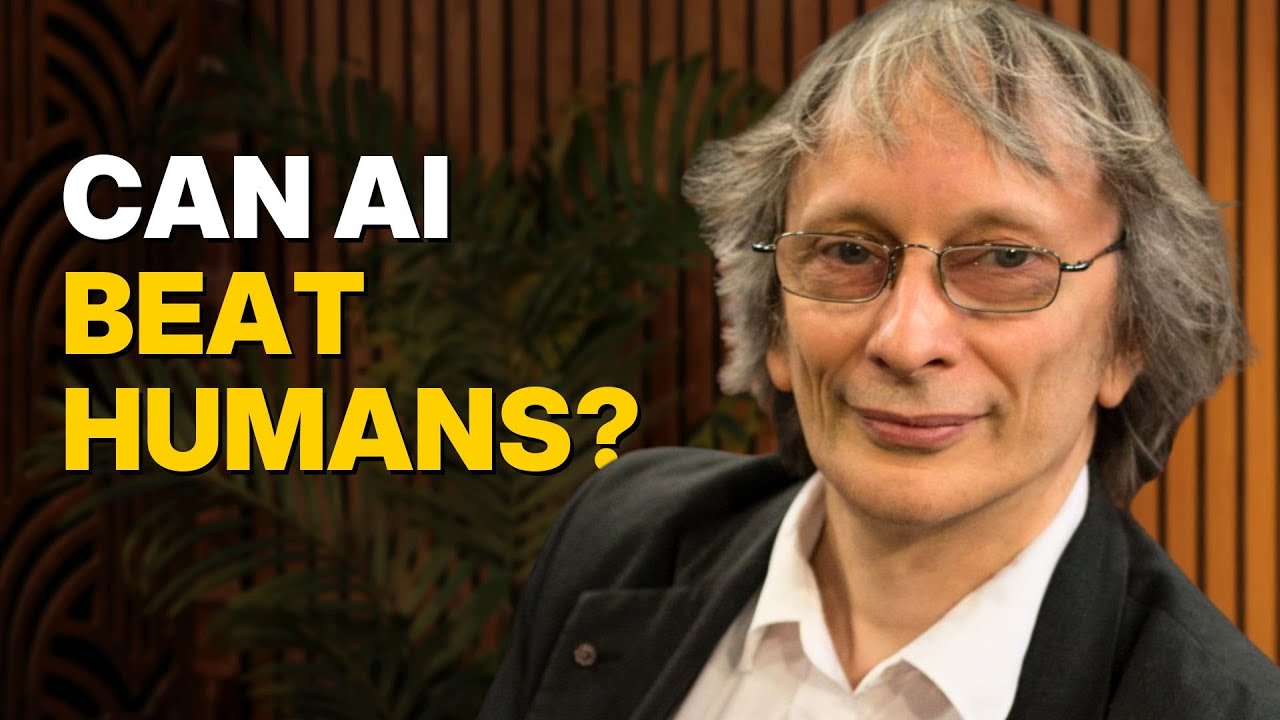
David Deutsch — physicist, pioneer of quantum computing, and author of The Fabric of Reality and The Beginning of Infinity — discusses AI, the nature of intelligence, animal cognition, the Turing principle, Popperian epistemology, gain-of-function research, civilizational risk, the “fun criterion,” and the experience machine. His core thesis throughout is that humans are universal explainers: there is no fundamental cognitive gap between humans and any other possible intelligence, whether artificial or extraterrestrial, and all apparent limitations are fixable through better hardware or software, not inherent incapacity.
Will AIs be smarter than humans?
Deutsch argues AGIs will be no more fundamentally intelligent than humans — the range of possible cognition is the same for any universal computer.
Hardware limitations (speed, memory) are the only real constraints on human cognition, and these are augmentable: if a machine thinks faster, we can use that same technology to think just as fast.
Software/explanation limitations: the worry that some concepts (e.g., qualia, mathematical insight) require specialized biological hardware is unfounded, because any such hardware is just a computer connected via neurons and chemicals — and an artificial device computing the same signals would be indistinguishable.
Therefore, any cognitive feat an AGI could achieve, a human could in principle achieve too, given the right augmentations.
Are intelligence differences between humans immutable?
Deutsch disputes that differences in human cognitive performance (e.g., literacy, IQ, job type) reflect fixed hardware limitations.
For the 21–24% of Americans at the lowest literacy level, he argues this is software, not hardware — they lack the right programs, not the right brain structure.
Learning requires being “conceptually ready” — e.g., Brett Hall wants to learn Mandarin but doesn’t want to go through the process; if circumstances forced it (as with his migrating ancestors), he could learn rapidly.
He rejects the idea that choosing less cognitively demanding jobs reflects cognitive deficiency; it reflects cultural and software choices, not hardware constraints.
Even people from pre-enlightenment cultures could understand quantum computing if they learned the full conceptual framework of the civilization — not just the language, but the culture of logic, physics, and mathematics.
On identical twins separated at birth showing ~0.8 IQ correlation: Deutsch argues this doesn’t prove a hardware explanation, because there are infinitely many uncontrolled variables; some unknown trait (perhaps unconsciously perceived by parents) could cause both the similar treatment and the similar IQ scores. He doesn’t claim to know what it is, only that the hardware inference is not compelled.
Do animals have bounded creativity?
Deutsch distinguishes between sophisticated instinctive programming and genuine creativity.
A cat opening a door by jumping on a handle looks like conjecture-and-refutation, but is better explained by an extremely sophisticated genetic program evolved for navigating novel physical environments (e.g., undergrowth) — not creativity.
Animals enact complex behaviors in new environments without creativity; the program takes sensory input and generates appropriate output, but the same program would produce the same behavior in the same circumstances — unlike creative acts.
Telling a story around a campfire is a typical creative activity — forming explanations — which animals cannot do, despite being able to perform far more physically complex tasks.
How powerful can narrow AIs be?
Deutsch is skeptical that narrow AIs (e.g., stock-trading systems) represent genuine intelligence or creativity.
A paperclip or an arbitrage machine makes money because of the human idea behind it, not because the AI is creative.
Most economic value comes from the creation of knowledge (e.g., the idea of a smartphone), which no AI less than an AGI could produce.
Chess and Go AIs succeed because those are closed, rule-bound domains; the economy is open-ended and requires creativity.
Could VR implant thoughts as well as sense data?
Deutsch says yes, but only because the model of consciousness as a “Cartesian theater” (which Sam Harris and meditators invoke when they speak of thoughts and senses as similar intrusions) is wrong.
What meditators interpret as “contentless consciousness” is actually consciousness of something — the imagined stage itself is the content.
Can you simulate the whole universe?
The Turing-Deutsch principle (any universal computer can simulate any physical process) does not imply the whole universe could be simulated in a compact, efficient computer smaller than itself.
The simulator would need more memory and time than the universe contains; simulating itself as well is logically impossible.
Even with maximally dense information encoding (e.g., quantum gravity), the rest of the universe would be equally complex, so no compression advantage is possible.
The key insight is separating computational universality (what programs can be run) from resource limitations (time and memory).
Are some interesting problems insoluble?
Deutsch’s philosophical stance is that all interesting problems are soluble, but this cannot be proven by experiment.
His argument is that claims of insolubility (e.g., “we can never simulate a brain” or “we can never explain consciousness”) are themselves bad explanations — they could be applied to anything and explain nothing.
Genuine insolubility requires a functional argument (as with Gödelian undecidability in mathematics), not mere assertion.
Even if the laws of physics contained undecidable functions, we could still understand their properties — our predictive ability would be limited, but not our explanatory ability.
Does America fail Popper’s criterion?
Popper’s criterion (from epistemology) applied to politics means: policies should be proposed as conjectures, tested, and the proponents evaluated on results.
The American system of distributed powers and checks and balances dissipates responsibility — nobody is ever to blame, because Congress, courts, and the president can all block each other.
The British system is better at focusing blame on the government, though it too has flaws (e.g., the Brexit constitutional crisis with parliament, courts, and government blaming each other).
The American founding fathers were trying to implement the British constitution without a king, which forced them into a system with inherent flaws — the president has legislative legitimacy the king never had, requiring checks and balances that diffuse accountability.
Does finite matter limit “the beginning of infinity”?
If the universe contains only a finite amount of matter in our light cone, there would be finite limits on computation, energy, and economic value.
Deutsch responds that this is a speculative cosmological theory that changes every decade; we don’t know the asymptotic structure of the universe or what happens below the Planck scale.
Even if such limits exist, they would be imposed by cosmological initial conditions, not by inherent hardware limitations on knowledge creation — and it would still be up to us what ideas to fill those finite bits with.
His worldview is unaffected: if we are eventually “chopped off,” everything up to that point can still have been worthwhile.
The Great Stagnation
Against the claim that declining research productivity and economic growth over the past 50 years shows we’ve “picked the low-hanging fruit,” Deutsch offers a sociological explanation.
Academic culture has stultified in many sectors — e.g., theoretical physics stagnated from the 1920s onward, delaying quantum computers by decades.
These are parochial effects of specific mistakes, not evidence of fundamental limits; they can be undone.
Unlimited horizons don’t guarantee progress — we could start declining tomorrow — but current declines are not evidence of an empty orchard.
Changes in epistemic status: Popperianism vs. Bayesianism
Deutsch rejects the Bayesian framing (e.g., “credence in many-worlds increases after a confirming experiment”) in favor of a Popperian one.
A successful experiment (e.g., an AGI on a quantum computer reporting superposition across many worlds) doesn’t just raise a number — it expands the repertoire of arguments available to refute alternative explanations and methodological misconceptions (e.g., empiricist objections to quantum theory).
The epistemic gain is in the power and reach of criticism, not in a probability update.
Open-ended science vs. gain-of-function research
Deutsch’s commitment to open-ended scientific progress does not mean all research should proceed without constraint.
For gain-of-function research, it may be reasonable to first research how to make laboratories more secure, then proceed — just as you’d research making hoses more impermeable before running dangerous reagents through them.
He is suspicious of blanket bans, because the appropriate safety criteria depend on the specific research; a uniform standard may be inappropriate.
The key Popperian question is: which knowledge do we need to discover first?
Contra Tyler Cowen on civilizational lifespan
Tyler Cowen argues civilization has only ~700 years left because destructive technologies become cheaper faster than protective ones, and near-misses (Cold War accidents) show how close we’ve come.
Deutsch responds that civilization has been getting safer throughout history — plagues that killed a third of humanity, the genetic bottleneck 70,000 years ago, extinction-level asteroids that would have ended Homo — whereas now an asteroid would just mean higher taxation.
He denies we currently have the technology to end civilization entirely; even deliberate hell would cause vast suffering but leave survivors who would resolve never to repeat it.
Against Bostrom’s “jar with one black ball” metaphor (eventually you draw the black ball and it’s over): every problem solved reduces the number of future existential risks, rather than leaving the odds constant.
The fun criterion
The fun criterion is Deutsch’s proposed standard for evaluating modes of life and knowledge creation — it is not an emotion but a state where different kinds of knowledge (explicit, inexplicit, conscious, unconscious) are in harmony.
The everyday association of “fun” with frivolity is a bad theory about whether fun-seeking is good or bad.
The key property: fun cannot be compulsorily enacted — you can’t mechanically determine whether something is fun; it requires letting content decide rather than dogma.
Example: exercise involves pain, but can be fun if you develop a theory for why it should be; a dogmatic “no pain, no gain” theory that excludes the criticism “maybe this isn’t fun” opens the door to suffering and stasis — inability to reach a better theory.
It differs from Aristotle’s eudaimonia or well-being only in being more precisely specified (though still not fully); at a deeper level, it’s about not shielding any kind of knowledge from criticism or replacement.
Does AGI through evolution require suffering?
Deutsch’s thought experiment: simulating the actual evolution of humans from pre-human ancestors would be the greatest crime in history.
The hardware for creativity likely evolved first for transmitting memes; early beings would have used genuine creativity but “blindly” — without good effect — and would have suffered from resource scarcity.
There would be no clear moment where suffering “begins to matter” — they were already suffering while blindly transmitting memes, because they were already using genuine creativity.
Would David enter the Experience Machine?
Deutsch would not enter Nozick’s experience machine (a perfect VR world where you forget you’re in simulation).
Erasing his memory of the real world is unacceptable.
The virtual world’s laws of physics couldn’t be the true ones (since we don’t know them yet), so he’d be solving a finite, designed puzzle rather than discovering reality.
Meanwhile, the real world could go wrong and his simulation would eventually run out of power.
Advice for young people
Deutsch tries not to give advice because the advice-giver/advice-receiver relationship is one of authority, which he considers immoral.
He can offer arguments, not prescriptions — e.g., he argues it’s dangerous to subordinate short-term goals to long-term goals, because if the long-term goal is wrong, you won’t discover the error until it’s too late.
He expects his own arguments to be criticized and improved — as happened in this very conversation.