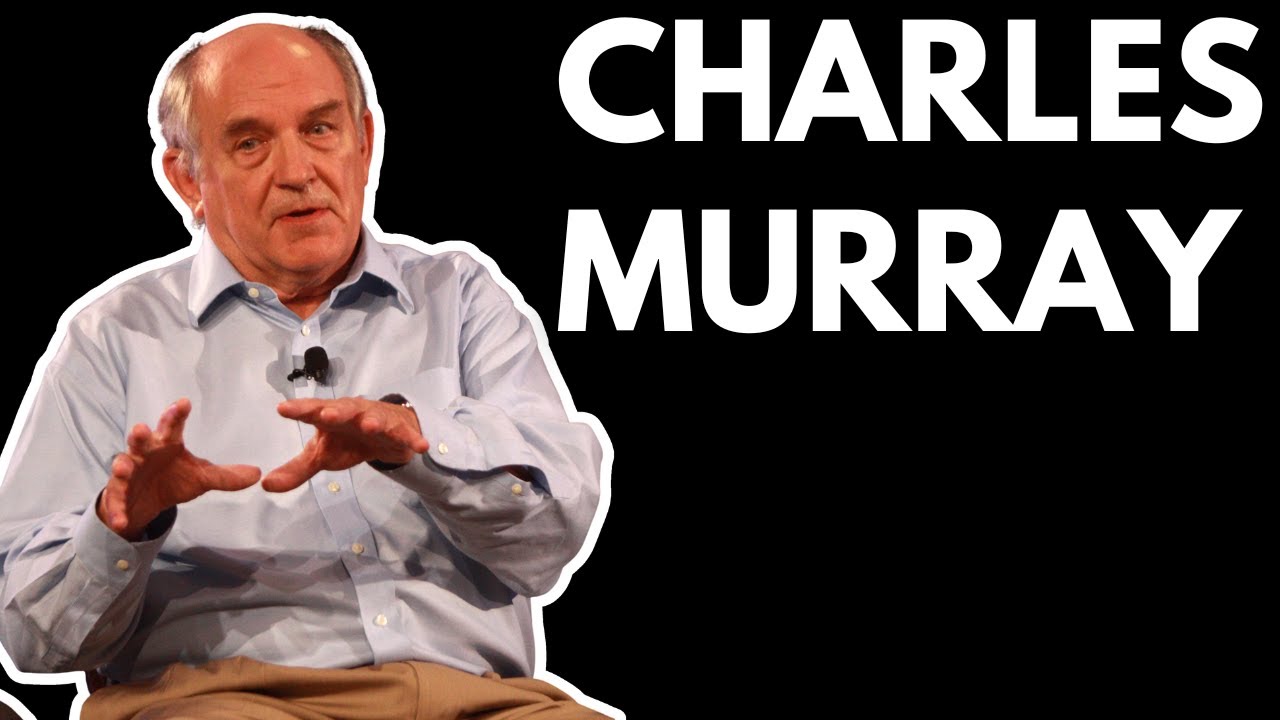
Charles Murray discusses his books Human Accomplishment, By the People, and The Curmudgeon’s Guide to Getting Ahead, exploring what drives excellence, how liberty enables it, and how individuals can thrive within flawed systems.
Writing Human Accomplishment
Murray was inspired by Daniel Boorstin’s The Discoverers, which he felt failed to present a panoramic view of human achievement—so he spent five years creating his own.
He used historiometrics: counting how many pages reference figures in authoritative histories to quantify their significance across arts and sciences.
This required compiling inventories from ~16–18 domains (e.g., Western literature, Indian philosophy, Chinese art), often through painstaking manual work (e.g., 17 ten-hour days indexing Dictionary of Scientific Biography).
Writing was non-linear: he followed curiosity, carving away what didn’t fit his vision—like a sculptor revealing form from stone.
The Lotka Curve and “Miraculous Years”
Great accomplishment follows a Lotka curve: extremely left-skewed—many achieve little, few dominate (e.g., golfers with 1 win vs. those with 20).
Inputs (talent, effort) may be normally distributed, but outputs are not.
“Miraculous years” (e.g., Einstein’s 1905, Newton’s 1665–66) cluster in peak cognitive periods—often 20s for math/science, 40s for social sciences where judgment matters.
These bursts involve cross-pollination between projects and occur when creators are at full mental power.
Habits of the Greats
Personality varies wildly among geniuses (Beethoven the egomaniac vs. Bach the family man), but hard work is universal.
Even Mozart, famed for effortless genius, worked fanatically hard.
The myth of playful genius (e.g., Feynman) obscures relentless labor; curiosity alone isn’t enough.
Murray laments modern emphasis on “balanced life” in one’s 20s—a time meant for intense exploration and focus.
Focus vs. Exploration in Your 20s
Murray advises against rushing into grad school or professional tracks straight from college—it keeps you in a comfort zone.
Instead, he recommends either military service or living abroad in a culturally alien place (e.g., rural Thailand, Bangladesh) to gain perspective.
Only after discovering your passion should you go “flat out” pursuing it—ideally working 60–80 hours/week like top scientists.
Living in Thailand
Murray served in the Peace Corps in Lampang, Thailand—the only foreigner in the province.
Initial culture shock was severe: exhaustion from decoding unfamiliar social cues, dislike of local food.
Within months, he adapted; by three years, he felt “cocky” and fully at home.
This experience taught him resilience and revealed his love for pattern analysis in data—a key insight for his later work.
Causes of Golden Ages
True golden ages of accomplishment are rare in peacetime; war often correlates with cultural vitality (e.g., expansionist societies).
Wealth alone doesn’t cause flourishing—Florence’s Renaissance required more than money.
Key factors include:
Human capital: Great mentors (Socrates → Plato → Aristotle) and foundational innovations (oil paint, perspective).
Purpose and autonomy: Western Christianity (especially post-Aquinas) framed understanding creation as pleasing God—motivating inquiry.
Contrast with East Asia: China’s stability emphasized family duty over individualism; Islamic theology sometimes discouraged natural philosophy as blasphemous.
Christianity, Enlightenment, and Decline
Early Christianity focused on the afterlife (hermits, monasteries), but Aquinas reframed earthly achievement as divine service.
The “Dark Ages” weren’t purely Christian—they followed Rome’s collapse, losing infrastructure and institutions.
The Enlightenment didn’t rescue Europe from Christianity; much accomplishment preceded it (e.g., Renaissance art, scientific method).
Murray critiques Steve Pinker’s overemphasis on the Enlightenment as the driver of progress.
Institutional Sclerosis
Mancur Olson’s theory: societies accumulate inefficient regulations (“barnacles”) that benefit narrow interests (e.g., U.S. sugar subsidies).
Only total disruption (e.g., post-WWII Germany/Japan) clears the slate for renewal.
Murray sees modern U.S. as sclerotic—like Antonine Rome: pleasant but stagnant, producing derivative rather than groundbreaking work.
Decadence and Declining Accomplishment
In science, some decline is inevitable (e.g., anatomy is mature; genetics is booming).
In arts, decline stems from cultural milieu: today’s sensibility doesn’t support 19th-century-style novels or classical music in C major.
Social science is in crisis: principles like free inquiry and truth-seeking are eroding under cancel culture and ideological conformity.
Can Secular Humanism Sustain Civilization?
Murray argues secular humanism lacks the moral grounding of religion—especially Christianity’s claim that certain acts are inherently wrong.
Without transcendent authority, moral principles become fragile under social pressure.
He’s agnostic but acknowledges religion’s cultural power and warns against dismissing it intellectually.
Suggests engaging deeply with serious theological writing (e.g., Quaker thought, C.S. Lewis) to understand why smart people believe.
Liberty and Human Accomplishment
Historically, great work occurred under autocracies—but creators had de facto freedom.
The American founding was unique: constitutionally guaranteed liberty for all, not just elites.
Murray’s By the People proposes systematic civil disobedience via legal defense funds (“Madison Fund”) to challenge idiotic regulations.
Goal: make enforcement so costly that agencies back off—like highway patrol ignoring 75 mph in a 65 zone.
Why the Madison Fund Hasn’t Taken Off
The book (2014/15) was overshadowed by Trump’s rise.
Big corporations like regulation—it creates moats (e.g., JPMorgan’s CEO called Dodd-Frank a “bigger moat”).
Small professionals (dentists, doctors) would benefit most—but need a wealthy champion (e.g., Bezos) to fund it.
Many regulations lack “halo effects” (e.g., labeling beach sand as poison) and can’t survive public scrutiny.
Future of Liberty
Murray hopes rising wealth ($100k GDP/capita) will make bureaucratic poverty-fighting absurd—freeing people from regulatory burden.
Technology (body cams, public video) may reduce need for top-down oversight.
Public sector unions are destructive in big cities but benign locally—highlighting urban/rural divides.
He’s pessimistic short-term but believes ideas can resurface when political winds shift.
Advice to Young People
In Curmudgeon’s Guide, Murray emphasizes: just do it—reliability is rare and invaluable.
Employers crave people who “can’t stand imperfection” and won’t complain about late nights.
Getting noticed is easier than you think—if you consistently deliver.
Recommends rewatching Groundhog Day as a moral fable: transformation comes through small, repeated acts of virtue—not grand gestures.
Final Reflection
Murray closes Human Accomplishment with a parable: medieval masons carved hidden gargoyles “for the eye of God.”
This symbolizes the essence of human excellence—creating with care, even when no one sees.