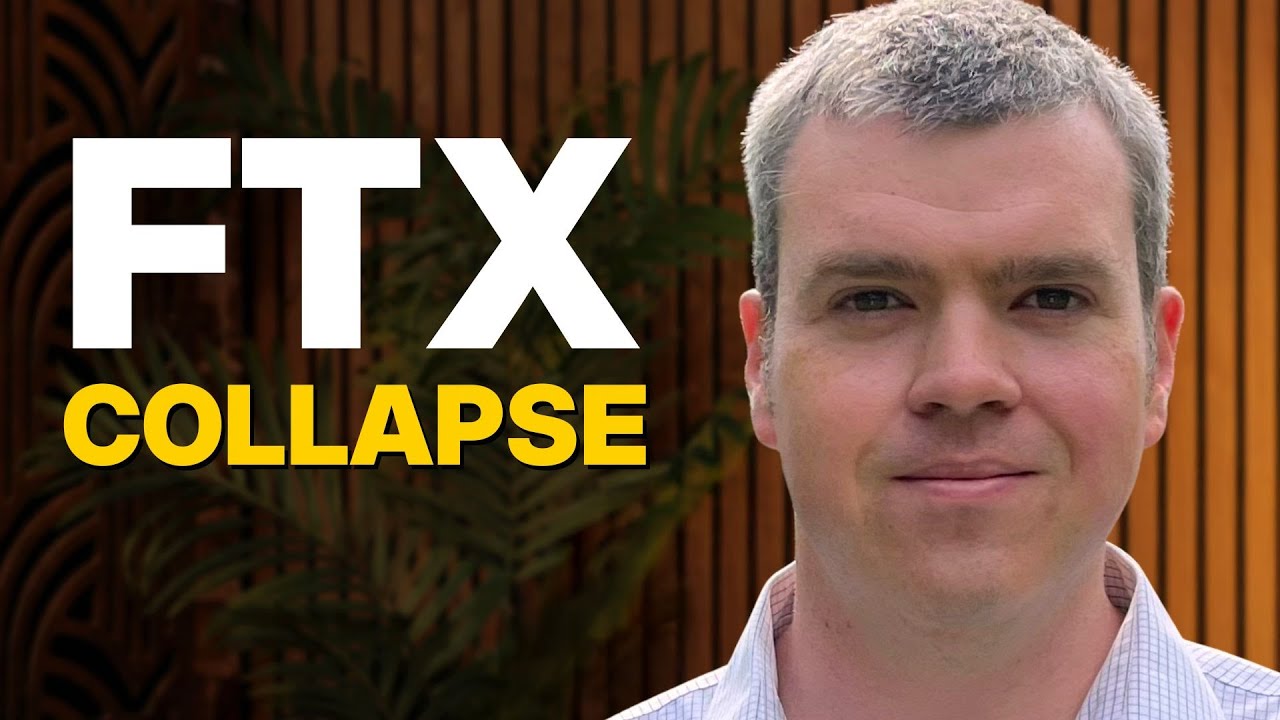
This episode is a wide-ranging conversation with Byrne Hobart (author of The Diff) about the FTX collapse, how drugs and personality archetypes shape financial bubbles and founder culture, the problem of identifying talent without over-indexing on parental pressure, what makes great biographers and political operators, the dangers of philosophical fanaticism in Effective Altruism, how to distinguish visionary bets from ego-driven overreach, and the difficulty of hedging an AI portfolio against a Taiwan invasion.
The FTX Collapse: Fraud vs. Incompetence
Much about FTX may never be known because decisions were made through auto-deleting encrypted chat and there was virtually no accounting.
Multiple narratives fit the facts, and the chosen narrative determines the proposed solution:
Pure fraud story: Alameda was a Ponzi scheme; FTX was created to funnel new cash into it. If this is the story, the problem is very hard to solve because fraud is inherently deceptive.
Incompetence story: Alameda was a real trading firm, but FTX had terrible internal accounting, causing the combined entity to lose track of which funds belonged to customers. If this is the story, the solution is straightforward: require real auditors and consistent proof-of-reserves.
Hobart suspects the truth is in the middle: extreme risk tolerance, extremely poor accounting, and fraud at some point—likely late, as a desperate scramble after discovering customer funds were gone.
Fraud requires good accounting: Perpetrators must maintain both real books and fake books that tie out. FTX’s operational slip-ups (e.g., accidentally burning USDC by sending it to a non-existent address) suggest they lacked the sophistication for deliberate, structured accounting fraud like MF Global, which carefully timed wire transfers to exploit overnight liquidity rules.
How SBF Faked Being a Genius
SBF cultivated an eccentric genius persona (e.g., refusing to cut his hair to “look kind of crazy”), much like people mimic Steve Jobs’ abrasiveness without his vision.
His background at Jane Street explains the competence gap:
Jane Street silos trading from operations. Traders focus on identifying pricing discrepancies while operations teams invisibly handle liquidity, creditworthiness, and contingency planning.
SBF explicitly noted that at Jane Street, pressing “buy” handled all intermediaries automatically, but at FTX, just getting a bank account was hard—suggesting commingling of funds stemmed partly from operational inability to separate them.
When operations work perfectly, traders never interact with them and forget they exist—like a homeowner who never thinks about plumbing until something goes wrong.
Drugs and Financial Bubbles
The impact of novel stimulants on financial markets is underrated:
Caffeine: Historically linked to financial centers (e.g., Lloyd’s of London started as a coffee shop); increases extroversion and willingness to do deals.
Cocaine (short-acting stimulant): Drove the 1980s hostile takeover boom. “Cokehead morality” viewed social obligations and fair pricing as wasteful; the move was to lever up, fire everyone, and distribute surplus to shareholders.
Adderall (long-acting stimulant): Drove the mid-2000s structured products boom. Made tolerable the incredibly boring, fine-grained work of distinguishing between nearly identical MBS tranches yielding 5.7% vs. 5.75%.
Emsam (SBF’s drug): A Parkinson’s treatment with evidence from small studies linking it to compulsive gambling. FTX had a company doctor, which may have served as plausible deniability—doctors have confidentiality norms that dealers do not.
Founder Physiognomy and Dress
The hyper-informal founder archetype (t-shirt and shorts) has become priced-in (“beta”) rather than a signal of alpha.
The signal is cyclical: the suit once signaled conformity and MBA peak-timing, but in Silicon Valley, a suit now signals either non-conformity or willingness to attend to boring details.
Hyper-informality can signal either:
A cynical attempt to game the system by mimicking Zuckerberg, or
Genuine, calibrated hyper-focus on the product to the exclusion of all else—which is good in unregulated domains but dangerous in regulated ones (e.g., medical devices).
Identifying Talent Without Over-Indexing on Parents
The younger you scout for talent, the more you over-index on parental involvement rather than innate ability. A child doing multiplication early may just have pushy parents, not unusual talent.
The closest metric to parental-involvement-independent talent is something either totally illegible to the parent’s status understanding or actively low-status.
The trap: identifying 95th-percentile talent with 99th-percentile aggressive parents, yielding 99th-percentile performance until the kid leaves home and never does the activity again.
True prodigies (Mozart, the Polgar sisters) are identifiable because talent overwhelms parental pushing. For most domains, there is too much room for parents to push.
Some early exposure (e.g., an uncle who owns a business) puts a career on a “life script,” providing momentum. LBJ’s dad was a politician (the script), but also went broke (the anti-script), giving LBJ both a model and a correction.
LBJ Figures and Caro Biographers Today
LBJ archetypes today are likely found in sales, corporate development, or network-driven roles where they build a “levered balance sheet of favors.” This skill requires adjacency to large, slowing institutions whose power can be siphoned and redirected.
Aging institutions create opportunity: when the old guard retires or is discredited, ambitious young entrants harvest a decade of missed low-hanging fruit at once. Wars cause this reset by destroying social capital and discrediting old leadership.
Caro archetypes are rarer. Caro’s method—moving to where his subjects lived, befriending sources, waiting until someone got Alzheimer’s to confirm a bribe—mirrors LBJ’s relentless networking. People with this skill set usually have ambitions beyond typing.
Caro’s work demonstrates that you cannot justify a million-word project in advance. You build motivation incrementally: as you read more, you gain convexity (skimming the known, absorbing the new), which sustains the project 500 words at a time.
Caro’s tone shifts over a decade of writing; he debates his subjects and himself (e.g., admiring Coke Stevenson’s character but opposing his politics; loathing LBJ’s methods but admiring his accomplishments), leaving the reader with an unresolved question of whether the ends justify the means.
Great Founders and Visionary vs. Overreach
It is nearly impossible to distinguish in advance between a visionary making the best bet of their life and an ego-driven leader overreaching after consecutive wins.
Alexander the Great can be read as either born to win or as someone who backed into corners and desperately fought out of them until burnout.
A key signal is whether there is a defined end state (reconquest has natural limits; conquest does not).
Elon Musk’s Twitter takeover: Could be a concrete plan to cut headcount and increase free cash flow, or just fun. The shift from bureaucratic to monarchical legitimacy is notable: under a single owner, there is a specific person to blame and yell at, rather than a faceless system. High-status people exploit this by deliberately misreading jokes as serious statements to express righteous anger.
Thumos and the “First Men” of History
Fukuyama’s “last men” (comfort-seeking, no desire for recognition) may still harbor latent thumos. Even Hobbits rise to adventure when circumstances demand it.
Post-war Japan illustrates the spectrum: the country ran a “war economy in peacetime” (centralized control, suppressed consumption, heavy industry) to achieve catch-up growth. Material austerity (bank employees working in the only room warm enough, heated by the stew pot) is inconceivable to modern Americans, and that intensity of thumos cannot be easily replicated.
Japan’s post-war recovery was a strategic realignment, not a break: the goal (economic self-sufficiency) stayed the same; only the means shifted from imperial conquest to operating under the US military umbrella.
Effective Altruism and Philosophical Fanaticism
Other belief systems segregate their most fanatical believers (e.g., monks) so they don’t damage the wider world. EA has no such safety valve.
Risk-neutral utilitarianism, combined with lucrative skills (shape-rotating, symbol manipulation) and the exchange of money for power, increases the correlation between power and craziness.
The monastic design pattern: You do not want the most fanatical people in charge. Smart people should be advisors, not executives. The decision-maker should be smart enough to understand the advisor and identify flaws, but not so intellectually engaged that they extrapolate first principles to dangerous extremes.
Historical precedent: the Founding Fathers were wordsmiths who debated in pamphlets, but Washington—the executive—did not contribute to that literary corpus. Thomas Paine as president would have been disastrous.
There is an optimal amount and place for fanaticism: fanatics should be on the front lines taking risks, not deciding where the front lines are.
Thinkers vs. Analyzers in Investing
The greatest investors synthesize high-level worldview with micro-level observation; leaning toward the worldview.
Pure quants (data-mining without theory) blow up when the pattern disappears.
Pure theorists blow up on timing: they can identify something as unsustainable years before it breaks (e.g., the subprime insight “a borrower with no down payment is a renter with upside” was published in 2001; shorting housing then would have lost 400% before the crash).
The winning approach combines the high-level thesis (“this is unsustainable”) with a low-level theory of what ratifies the wrong belief and what specific breakdown will force perception to collide with reality.
More money was made after the dot-com crash by people who recognized the internet was still a good technology and bought the overshooting correction than by those who simply shorted the bubble from first principles.
Hedging AI Against a Taiwan Invasion
Being long AI while hedging a Taiwan invasion is extremely difficult.
The next-best fab alternative is Korea, but Korean fabs don’t produce the same chips.
The sad domestic answer is Intel and TSMC’s Arizona operations.
In a worst-case scenario, the US might execute a kind of “Operation Paperclip” to extract TSMC’s best engineers to Arizona.
Some geopolitical inflections are permanent (e.g., copper mining emissions peaked during the Roman Empire and didn’t return for a millennium). For sufficiently bad outcomes, there is no meaningful hedge—like trying to hedge a meteor strike in the minutes before impact.