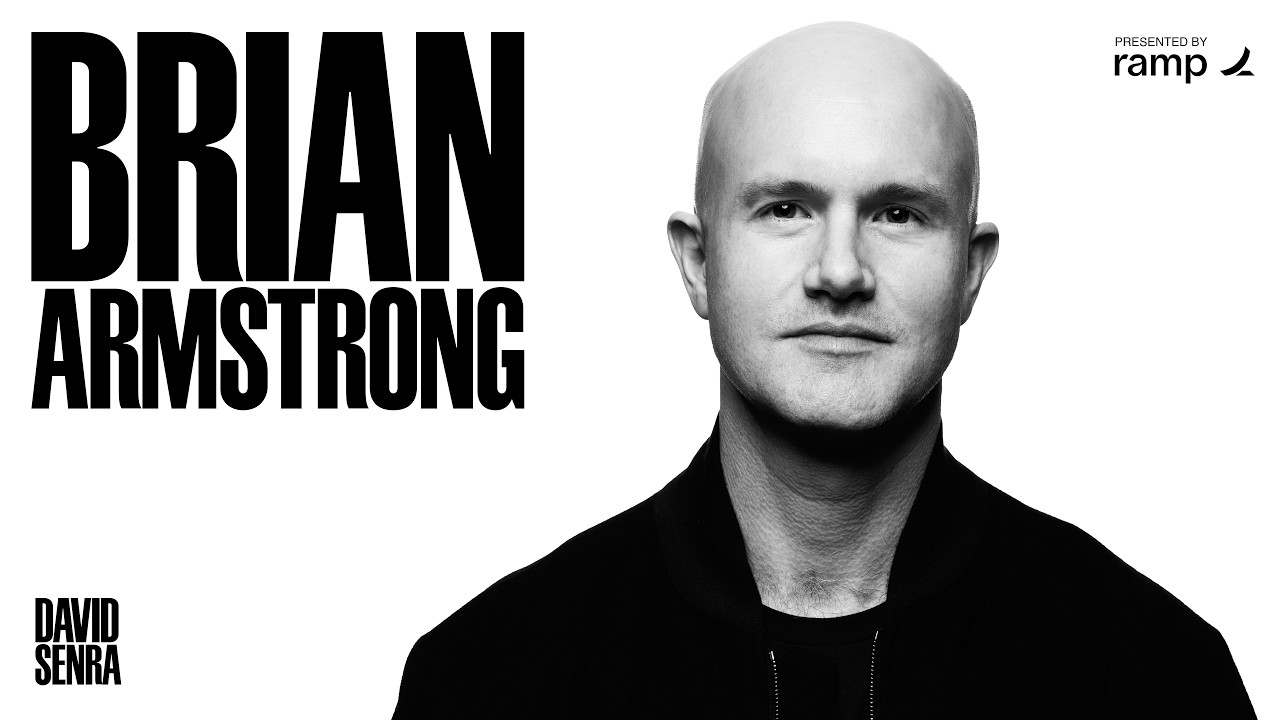
Brian Armstrong, CEO of Coinbase, discusses how he uses repetition and self-talk to rewire his mindset, how he has restructured his work around AI agents, and why he believes crypto and AI together will create a massive agentic economy that dwarfes today’s human-only economy.
Reprogramming mindset through repetition
Armstrong uses daily written repetition to install new beliefs and behaviors, treating the brain like a neural network where repetition updates weights.
In his 20s he wrote “I want to start a billion-dollar tech company” daily despite having no track record; within years of moving to Silicon Valley he founded Coinbase.
As a conflict-averse early CEO, he wrote “I love conflict” repeatedly to reframe hard conversations as valuable progress; he now feels energized rather than stressed by necessary confrontations.
He distinguishes fulfillment (deep satisfaction from meaningful work and civilizational progress) from happiness (fleeting highs), and optimizes for impact over comfort.
He describes his inner state as “divinely discontent” — perpetually seeing flaws in the product — but channels it as motivational fuel rather than negative self-talk.
Leadership style and emotional expression
Armstrong believes leaders should be “embarrassingly passionate” about their work; emotion signals seriousness and rallies teams.
He moved from suppressing anger in product reviews to expressing it directly: “This isn’t good enough. Change it by tomorrow.”
Teams often thank him afterward, saying they sensed the problem but needed the leader to name it.
He compares this to founders like Enzo Ferrari and Steve Jobs who described products like lovers, and to the “Founders in the Gym” podcast style of transferring entrepreneurial energy to listeners.
AI agent workflow at Coinbase
Armstrong now runs a personal “chief of staff” agent overseeing 7–8 lead agents, each managing 3–5 sub-agents that write code, test, chase reviews, and coordinate with human teammates.
Lead agents own areas like onboarding optimization, app quality, or agentic finance; they analyze data, propose priorities, and await his approval before executing.
Agents operate at roughly L5–L6 engineer level (mid-to-senior), work 24/7, spin up infinite copies, and return decisions via a prioritized inbox UI with keyboard shortcuts and voice dictation.
The UI shifted from chaotic chat walls to a decision queue because cognitive overload became unmanageable.
Humans remain final decision-makers on direction and code review; the main human job becomes aligning agents by editing the “Coinbase Brain.”
Coinbase Brain — internal knowledge operating system
Every employee, team, and GitHub repo has a “brain” that nightly ingests meeting transcripts, code reviews, incident reports, AB tests, policy docs, and distills lessons.
Brains resolve contradictions (e.g., conflicting guidance from different leaders) and give agents context to one-shot tasks with less human nudging.
Fine-tuned open-weight models trained on internal data outperform frontier models on narrow tasks like compliance reporting, while being faster and cheaper.
Armstrong views the brain as codifying the company’s accumulated practices and know-how — a living operating system, not a static artifact.
Agentic economy and AI-native finance
Armstrong predicts 99.9%+ of global GDP transactions will be agent-to-agent within 10 years; the agentic economy will dwarf the human economy.
Crypto rails (stablecoins) are the real-time payment layer for this economy; credit cards provide backward compatibility.
Coinbase aims to be the most AI-enabled financial account: agents that optimize yield, manage tax efficiency, execute complex thesis-driven trades, and copy-trade top performers.
Four levels of AI financial agency: (1) execute specific orders, (2) leg into positions per portfolio rules, (3) build baskets from a world thesis, (4) surface ideas from trusted human/agent track records — effectively a private banker in every pocket.
He wants Coinbase to lean into AI finance with strict permissions and customer control, mirroring its “most trusted crypto brand” positioning.
Fintech vs. TradFi and switching inertia
All fintechs combined capture ~4% of global financial services revenue; the real opportunity is taking share from traditional finance (96%).
Switching is slow because people fear change, stop learning new tools with age, and stick with incumbents until a dramatically better alternative appears (like LLMs vs. Google search).
AI agents that unlock financial benefits — higher yield, tax savings, thesis-driven investing — will be the switching trigger.
Legacy players may block full agentic access, creating an opening for Coinbase.
Product quality obsession
Armstrong personally drives app quality via a “retail app quality” lead agent that scrapes support transcripts, error logs, and his own X post soliciting user feedback.
The agent summarized top issues (unclear holds, slow startup, dead-end buttons, opaque errors) and spun up five sub-agents to fix them; several fixes are near release.
Improvement ideas flow both ways: Armstrong pushes agents on known pain points; agents surface data-driven opportunities he missed.
Humanoid robots as the next step function
Current AI is purely digital (knowledge work); humanoid robots that move physical matter — run labs, build factories, mine — will unlock the next productivity leap.
At New Limit (his biotech startup), they wait for robots to master “barista-level” dexterity before deploying in wet labs.
Once robots can operate in the physical world, the labor force expands from 8 billion humans to trillions of agents.
Build vs. buy AI tooling
Coinbase debates externalizing internal AI tools (like the prioritized inbox) but finds generalizing for other companies 10–50x harder due to security, billing, and customization demands.
Coding harnesses will likely become open-source infrastructure; value capture shifts to proprietary data, workflows, and integrations.
Coinbase Developer Platform (blockchain infrastructure, custody, staking) is already externalized and growing like “AWS for crypto”; seven of the world’s largest banks build on it.
Internal agentic tools remain proprietary for now; focus stays on making Coinbase products more efficient rather than launching new SaaS lines.
Golden age of building
Armstrong describes the current moment as a “golden age of productivity and innovation” — the most energizing period of his career.
AI lets him operate at vastly higher leverage; he worries only that excitement keeps him awake.