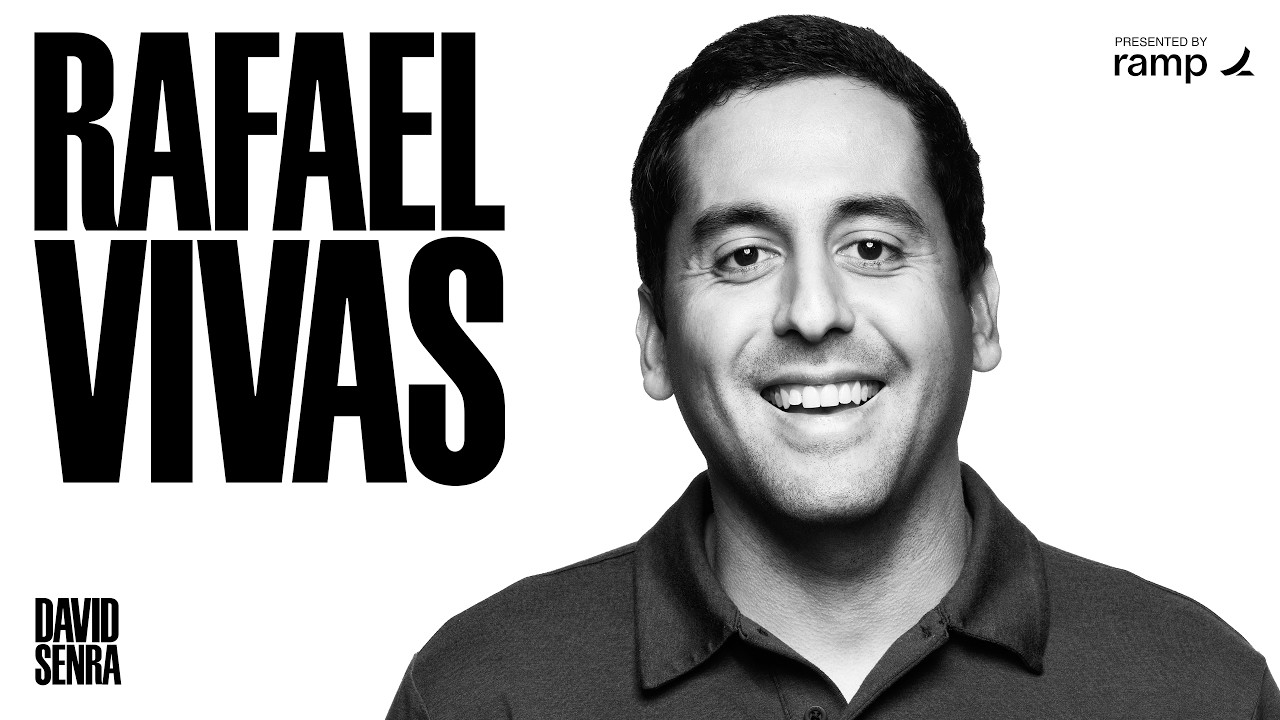
Rafael Vivas, a high school dropout who was kicked out of his house at 16 and later lived in the AppLovin office, became a multi-billionaire co-founder of one of the world’s largest mobile advertising platforms. This episode traces his journey from teenage performance marketer to building a durable, founder-led company that competes with giants like Google and Meta through relentless operational excellence, technical superiority, and a culture that rejects delegation in favor of hands-on ownership.
Origin story: dropout, kicked out, and the early obsession with performance marketing
Vivas grew up in a family of four brothers with divorced parents; he was always online, building websites and running game servers by middle school.
At 14, his oldest brother brought him in as an intern at his performance marketing company, where Vivas saw people making $20–30K per day in profit — far more than his teachers’ salaries — and realized school offered no comparable upside.
He stopped attending classes, worked 24/7, and at 16 his father told him to move out if he thought he was a “hotshot”; Vivas moved in with a friend and employed the friend’s son as an intern.
He gravitated to internet advertising because, like video games, it was pure meritocracy: “who brought back the food” — value delivered was the only metric that mattered.
Vivas rejected the linear career path (analyst → manager → senior manager) in favor of identifying the highest-leverage activity he could execute and doing it immediately, without waiting for permission.
Meeting Adam Foroughi and the founding of AppLovin
Vivas knew of Adam Foroughi (12 years older, “a walking calculator”) from a leaderboard at his brother’s company; they connected over AIM when Vivas was 15, and grew close around 17–18.
At 17, after a key advertising platform banned Vivas’s team for being too competitive, he went to his brother declaring he would “bury these guys” and start his own ad platform (Appenda); his brother gave him engineers instead of letting him leave.
Adam, then building consumer apps and buying traffic from Vivas, decided to build a competing mobile ad platform — AppLovin — and recruited Vivas to join.
Vivas negotiated to live inside the Palo Alto office as a condition of joining; Adam and engineer Furqan built bunk beds from IKEA. Vivas saw it as a “Vietnam War” mentality: out-hustle everyone because they had no VC funding, a goofy name, and a 5’8” chubby kid doing sales.
The business was pre-revenue, an “animal house” of engineers searching for product-market fit; Adam had previously run Social Hour (a Facebook ad network) and saw the PC-to-mobile shift early.
Culture: anti-delegation, hands-on, detail-obsessed, and purpose-driven
AppLovin’s culture is defined by extreme performance focus: leaders do the work (set up campaigns, upload ads, write creative) rather than delegate; Vivas calls delegation a trap that creates busywork on non-needle-moving tasks.
They lead with bad news internally — constantly identifying what sucks and fixing it one by one — rather than celebrating wins.
The company is immune to stock volatility (stock dropped >90% from $28B to ~$3.8B market cap while revenue grew); Vivas and Adam ignore short-term price because “if we do the right things, the stock takes care of itself.”
Frugality stems from ROI thinking, not penny-pinching: Adam flew JetBlue/Southwest because the return on a premium flight wasn’t there; they spend money like it’s their own.
Headcount is kept minimal deliberately: “do twice as much with half the people” forces focus; there are few management layers, the CTO pushes code, and smart hires are given maximum ownership and automated where possible.
Vivas compares the approach to Jensen Huang’s “torture them into greatness” — Adam pushed Vivas relentlessly, exploiting insecurities to drive performance; Vivas now internalizes that pressure and pushes himself.
Competitive strategy: tech-first, guaranteed results, and relentless customer obsession
While well-funded competitors (backed by Benchmark, Sequoia) had hundreds of salespeople and premium publishers, their algorithms were manual; AppLovin invested early in rules-based optimization and regression learning, often monetizing at 2x competitors’ rates.
Vivas’s sales pitch: “I guarantee you more money than you’re making elsewhere” — sometimes put in writing; publishers thought it was too good to be true.
Customer expansion is obsessive: Vivas personally harasses CEOs for an extra $5K/day spend because “if you can’t do the small things right, how can you do the big things right?”; persistence combined with delivering value (e.g., 2 years of optimization ideas to one founder) wins deals.
They treat themselves as an extension of the advertiser’s team, not a vendor; customers love and hate them for being “arrogant” but competent and opinionated about what drives profit.
The games detour, burnout, sabbatical, and return
Frustrated by dependence on a single partner (Cheetah Mobile) that constantly broke agreements, Vivas pushed to build a games publishing business (Lion Studios) — “a lion is the only animal that can kill a cheetah” — leveraging AppLovin’s distribution.
Lion Studios grew to $250M+ revenue profitably in 2 years, driving 20+ games to #1 and 3B+ downloads, but partners viewed them as competitors; the hit-driven, global, 24/7 nature burned Vivas out by ~28.
He stepped away for a planned 6-month transition (completed in 3), moved to Miami during COVID, met his wife, started a family — but found retirement “depressing” and low-quality work (e.g., a dating show) meaningless without purpose and people he deeply cared about.
AppLovin went public; stock dropped immediately. At the NYSE bell-ringing, Adam said he’d heard Vivas might return; Vivas said “I’m in” and has been back ever since, drawn by the unfinished mission.
The legendary stock buyback and durable business ambition
With stock at ~$3.8B market cap but ~$1B+ cash flow, Adam levered up and aggressively bought back shares; if it kept falling, they planned to take it private like Michael Dell.
Vivas wasn’t stressed: his lifestyle costs ~$15/month (WoW subscription, cheap clothes, same friends); no lifestyle creep meant no cash-flow anxiety.
Goal: build a company that outlives them, delivering hundreds of billions in value to the economy by helping businesses grow profitably — hiring, investing, stimulating consumption.
Vivas: “We’re still early. Nine out of 100 people know AppLovin. My journey ends when everyone on the street knows the brand.”
Mentorship, family roots, and the chip on the shoulder
Mark Rosner (CRO, ex-Zedge CEO) mentored Vivas on detail obsession: redlined NDAs, caught a 1% error in a deal signed from a hospital bedside, demanded perfection — “Do you want to be Michael Jordan or Tiger Woods?” — then said “good job” after Vivas renegotiated.
Best advice (from his brother): “Stay in the game when it hurts and you want to quit — that’s when you’re growing.”
Father was a Colombian immigrant whose dad died at 15, forcing him to support siblings; became a doctor for money, not passion; raised Vivas in a nice neighborhood but as the “poorest kid among rich kids” — five pants, five shirts a year; complaints met with “go work for it.”
Vivas’s drive: “no way I move back to my parents’ house”; high school dropout = unhirable on paper; failure wasn’t an option — “get rich or die trying.”
Current focus: telling the founder story and scaling the platform
Vivas wants AppLovin’s external brand to reflect its ruthless internal culture: showcase the founders they’ve helped grow from small businesses to massive companies, proving the platform’s edge is in thousands of compounding details.
“People back people, not companies” — more founder visibility (like Elon, Jobs) builds trust and adoption.
AppLovin connects advertisers to 1B+ mobile gamers; full-screen video ads average 35-second watch time; launch in minutes, scale to $100K+/day spend.
Vivas spends time on highest-leverage deals: bringing thousands of advertisers onto the platform, expanding existing customers, staying in the weeds to make them care.