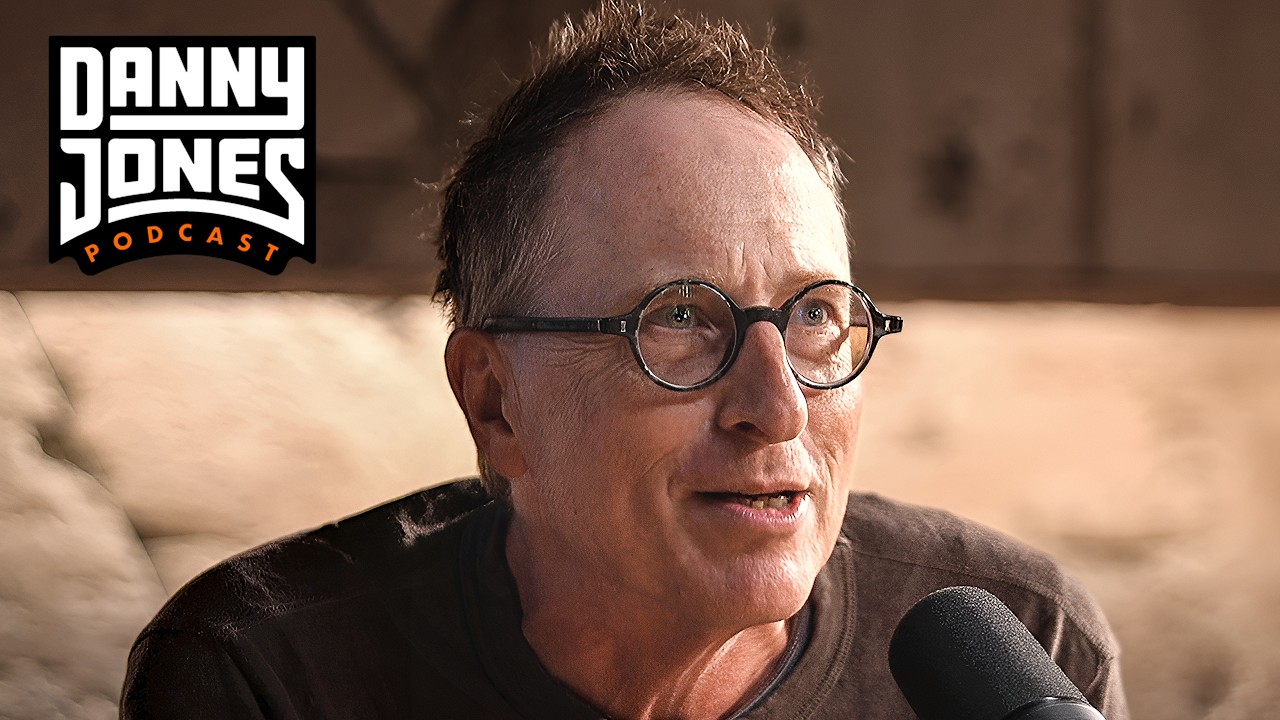
Jon Ronson is a British investigative journalist and author known for immersive, first-person narratives that explore extremist groups, conspiracy theories, and the hidden mechanics of power; this episode surveys his career from his early work with Islamic extremists and the Ku Klux Klan through his infiltration of Bohemian Grove with Alex Jones, his study of psychopathy in corridors of power, his visits to secret military psychic programs, and his latest book The Castle, which examines a mysterious Connecticut castle owner and the broader crisis of male purpose in a digitized, algorithm-driven world.
The Castle & the crisis of male purpose
Ronson’s new book The Castle opens with his son and three friends lured to a massive, newly built Gothic castle in rural Connecticut by a man in his early 60s they met on Tinder; the owner claimed to be filming a reality show called “101 Princesses” and asked the women to put on princess outfits from a basement costume room next to a pole-dancing club and hot-tub botanical garden.
The owner, the great-grandson of a Gilded Age steel tycoon, later sent Ronson menacing texts invoking two “murderers on staff” named Carlos and Brandon and claimed to have FBI investigators and the world’s largest law firm targeting Ronson; an FBI acquaintance did visit the castle, but no deeper intelligence connection emerged.
Ronson uses the castle owner as a lens on men retreating into fantasy bubbles—princesses, camels, circus performers—as society “feminizes” and traditional industry collapses; he connects this to the 6.7 million U.S. men who have left the labor force entirely and the conflicting cultural scripts (vulnerability vs. stoicism, doofus ads vs. manosphere influencers) that leave many men feeling like “a ball in a pinball machine.”
A parallel thread follows Greg Chism, a blue-collar Illinois man whose factory closed, who became a lawn-care YouTube star (“Freak to Geek”), then pivoted to family vlogs that the algorithm pushed into the “Bad Baby” format—him and his daughters dressed as babies in messy-food skits hitting 600 million views; YouTube assigned him an advisor who told him to delete non-Bad Baby content, then the channel was swept up in the “Elsagate” panic, raided by the FBI, and banned, leaving Greg depressed and his children briefly in protective services; he has since returned to lawn-care content.
“Them” – infiltrating Bohemian Grove with Alex Jones
After failing to penetrate the Bilderberg Group’s annual meeting in Portugal (where he was followed by a silent driver and surveilled by men in dark glasses), Ronson accepted Alex Jones’s invitation to sneak into Bohemian Grove, the all-male Republican encampment in the Monte Rio redwoods.
A local lawyer, Rick, advised them to dress preppy and “give the security guard an I-rule-the-world wave”; Ronson and Rick walked in, while a paranoid Jones and his producer Mike dove into the undergrowth—both parties succeeded.
Inside, Ronson found a posh campground with stages, piano music, and camps named “Red Eyes”; the Saturday-night “Cremation of Care” ritual featured the San Francisco Symphony, a leaf-clad “nature sprite,” robed figures speaking cod-Shakespearean lines about burning “cares” (an effigy), and ended with “When the Saints Go Marching In” and thousands of elderly men asking for help standing up.
Jones filmed secretly and claimed they witnessed a literal human sacrifice to Moloch; Ronson insists it was a harmless, if intense, pageant, and the Grove later wrote him a letter thanking him for countering Jones’s “paranoid fiction.” Notable attendees included Dick Cheney (whose name appeared on a guest list), George W. Bush, John Major, Henry Kissinger, David Rockefeller, and Peter Mandelson; Nixon famously called it “the faggiest goddamned place you could ever imagine.”
The Bilderberg Group & the “shadowy cabal” trope
Ronson’s interest in secret elites began when both Islamist extremist Omar Bakri Muhammad and a “politically correct” KKK faction independently told him a shadowy cabal ruled the world from a secret room—the Bilderberg Group.
He attended their 1999 meeting at the Caesar Park Hotel in Portugal with veteran conspiracy tracker “Big Jim Tucker”; after a slow-motion car chase and a call to the British Embassy (which warned him the dangerous followers are the ones you don’t see), he interviewed former Chancellor Denis Healey, who insisted Bilderberg was “private, not secret” and refused to share internal photos.
The group’s founding logic: post-WWII Atlanticists wanted business leaders (who “only care about money, not ideology”) to steer politicians away from future Hitlers—a “globalist” project that still meets annually.
The Psychopath Test & Broadmoor
For The Psychopath Test, Ronson learned the Hare 20-item checklist (glib charm, grandiose self-worth, lack of empathy, parasitic lifestyle, etc.) and applied it to corporate CEO “Chainsaw Al” Dunlap, who cheerfully reframed every trait as a business virtue (shallow affect = “not weighed down by nonsense emotions”; manipulative = “leadership”).
The book’s catalyst was a Scientologist (Brian from CCHR) introducing Ronson to Tony, a man who faked madness to avoid a prison sentence, overshot, and spent 12 years in Broadmoor high-security hospital; Tony wore a pinstripe suit to their meeting in the “wellness center” (calming peach walls, red panic buttons) but couldn’t convince clinicians he was sane—his file noted “thinks bees could fountain explosives” after he mentioned a New Scientist article about bomb-sniffing bees.
Ronson explores the neuroscience: psychopaths have an underactive amygdala (no fear/remorse signals), making psychopathy “perhaps the most pleasant mental disorder,” while society rewards its traits (ruthlessness, charm) in leadership, creating a feedback loop amplified by social media’s selective empathy and performative outrage.
Military psychic programs – Project Jedi, remote viewing & Uri Geller
The Men Who Stare at Goats traces the U.S. Army’s Project Jedi at Fort Bragg: Level 1 observation, Level 2 intuition, Level 3 invisibility (later adapted to “not being seen”), Level 4 stopping a goat’s heart by intention (master sergeant Guy Savelli claimed one success but suffered “sympathetic injury” to his own heart).
Ronson visited Savelli in Ohio, who showed a video of him staring a hamster off its wheel but refused to show the death moment (“my wife said you’re animal-rights activists”); he also toured Uri Geller’s Sonning mansion (onyx toilet, recovered limousine, Geller predicting the next visitor would be Jewish—Ronson).
He met remote viewers at Fort Meade (black-ops, condemned building, no coffee machine) who spent careers staring at yellow pads; Joe McMoneagle struck him as credible and humble, but the life seemed grim; Ed Dames’s remote-viewing of a “companion object” behind Hale-Bopp comet fed into the Heaven’s Gate mass suicide.
Ronson references Rupert Sheldrake’s “sense of being stared at” as a plausible evolutionary relic and recounts two personal moments where unexplained hesitation saved him and his son from traffic.
Eleanor Longden & the meaning of voices
Ronson toured with psychologist Eleanor Longden, who at 18 heard a calm third-person narration of her actions; a roommate’s horror and a doctor’s alarm turned the voice hostile, leading to a schizophrenia diagnosis, 12 warring voices, a drill-to-the-head episode, and repeated hospitalization.
A holistic therapist reframed the voices as parts of herself; she negotiated with them, earned her university’s highest-ever degree (voices supplying exam answers), and now works as a researcher while still hearing them daily—illustrating Ronson’s theme that diagnostic labels can create the pathology they describe.
Ruby Ridge, Waco & the radicalization of the right
Ronson’s first documentary, The Legend of Ruby Ridge, chronicled Randy Weaver’s family: white separatists on an Idaho mountaintop, infiltrated by ATF informants who entrapped Randy into sawing off a shotgun; when he refused to inform, a siege erupted—dog Striker shot, 14-year-old Sammy killed, Vicki Weaver shot in the head holding baby Elisheba, 16-day standoff, eventual surrender, and million-dollar settlements to the daughters.
The government’s overreach at Ruby Ridge and Waco (where Randy visited with Ronson and met Alex Jones rebuilding the Branch Davidian church) birthed the modern militia movement and radicalized Timothy McVeigh, who appeared at Waco and later bombed Oklahoma City.
Ronson’s Audible series The Debutante investigated Carol Howe, a debutante-turned-white-supremacist-turned-informant at Elohim City (Oklahoma border compound); McVeigh phoned Elohim City pre-bombing seeking Andy Strassmeir, but Ronson concluded most “wider conspiracy” threads (John Doe #2, unidentified leg) likely dissolved into coincidence, though some anomalies persist.
Oklahoma City & Elohim City
McVeigh’s confirmed contacts with Elohim City (phone call, speeding ticket nearby) and the compound’s history of harboring fugitives kept the “wider conspiracy” alive; Carol Howe claimed she saw McVeigh there, but Ronson found her account unreliable after deep reporting.
The ATF/FBI infiltration of extremist groups is total: at Aryan Nations, Ronson (Jewish) was surrounded by skins demanding his “genealogy”; a security guard’s joke about the Church of England signaled them to back off—either a decent human moment or an undercover agent protecting a journalist.
Epstein, Pizzagate & the blackmail architecture
Ronson has tracked Epstein since 2017 (walking past his Upper East Side townhouse with a NYT colleague who didn’t know his name); he argues Epstein hid in plain sight—James Patterson’s book flopped, only Julie K. Brown’s Miami Herald series broke it open.
He rejects the QAnon/Pizzagate fusion: Epstein’s network was the real story, and QAnon distracted attention from it; the “cheese pizza” code-word theory in the released emails is plausible but unproven, and the FBI “raw” files mix testimony, rumor, and fact without vetting.
The autopsy/prostate discrepancy (Epstein emails say prostate removed; autopsy says intact) and the December 2018 iMessage where Epstein speculated Trump would “bomb Iran to create a diversion” if cornered—weeks before the 2024 Iran strikes—exemplify the “anything could be true” opacity; Ronson sees Epstein as a bipartisan blackmail operation (vertical: elites vs. everyone) that neither party will fully expose.
UFC at the White House & the death of legacy media
Ronson attended UFC 250 on the South Lawn (2024) for GQ; the UFC segregated “content creators” (98% of attendees, neck tattoos, bro-hugs) from “print journalists” (Ronson, Toronto Star, a few others)—a vivid metaphor for institutional collapse.
The production was hyper-nationalist: bald eagle flyover, “great presidential moments” montage skipping Biden, culminating in Trump’s bloody-ear “fight, fight, fight” image; Dana White called it “perfect” but for Josh Hokit’s post-fight “Michelle Obama is a man” rant (Hokit’s shtick, possibly festering from a failed comedy bit at media day).
Photographer Evan Vucci (AP/Reuters, jiu-jitsu bronze medalist) shot the iconic Trump fist-pump; he was visibly annoyed when Ronson raised conspiracy questions, insisting “I was right there, somebody got killed.”
Social media, algorithms & the “false promise” of YouTube
YouTube’s algorithmic incentive structure lured Greg Chism from lawn care to “Bad Baby” exploitation, then banned him for the very content it encouraged—exposing the platform’s “hierarchy-free utopia” as a false promise that snaps back into hierarchy when controversy erupts.
Ronson self-censored on COVID/vaccine topics during the pandemic (shadow-banning as “genius” soft censorship); he now sees a slight cultural shift from culture-war polarization to class-war awareness (Luigi Mangione-type figures), which his BBC show Things Fell Apart will explore in its third season.
Recurring themes across Ronson’s work
From Them → The Men Who Stare at Goats → The Psychopath Test → So You’ve Been Publicly Shamed → The Castle: decisions by hidden elites (Bilderberg, Bohemian Grove, military psychics, corporate psychopaths, algorithm designers) trickle down and distort ordinary inner lives—anxiety, purpose, identity, belief.
The “sense of being stared at,” the hamster video, the Broadmoor bees, the castle’s moat, the UFC’s eagle—all become data points in a career spent asking: what happens when powerful people build secret worlds, and the rest of us are left to navigate the wreckage?