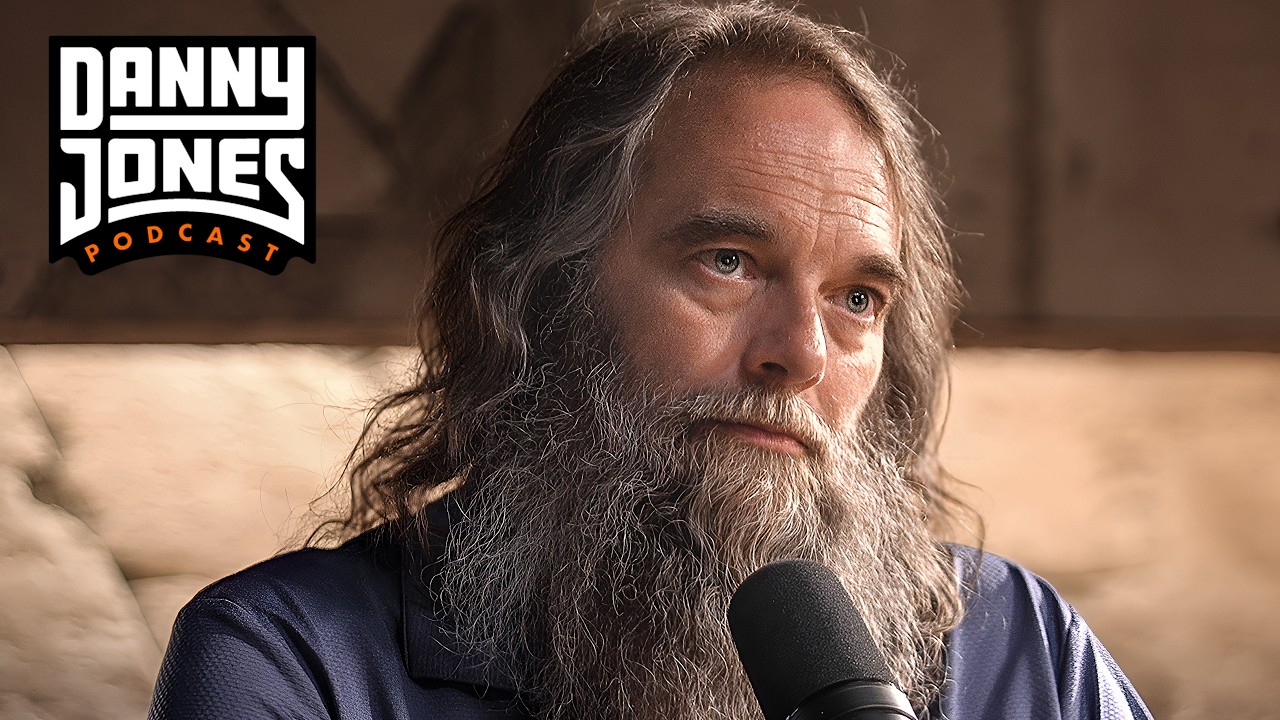
Dan Richards (The Dunking) and Dan from the podcast discuss the war between mainstream archaeology and “pseudo-archaeology,” arguing that the real problem is institutional dogma, grifters on both sides, and a media ecosystem that rewards outrage over truth. The conversation covers pyramid dating controversies, the cocaine mummies, elongated skulls, the Ark of the Covenant, brain-simulation technology, and the politics of ancient history research.
The pseudo-archaeology debate and its discontents
The hosts argue that the vicious online war between ancient archaeology skeptics and promoters misses the point — both sides contain grifters, and the real casualty is honest inquiry.
Dave Fina is singled out as someone who misrepresents opponents’ positions, gets basic facts wrong, and refuses to debate when challenged on substantive points like Bayesian modeling of pyramid radiocarbon dates.
The podcast space incentivizes outrage: attacking people gets far more views than educating them, and algorithms reward staying “on brand.”
A key distinction is drawn between honest researchers who happen to be wrong (like Carl Christian Rafn, whose racist assumptions accidentally led him to confirm Norse presence in the Americas) and people selling a “fake bill of facts.”
How science actually progresses (and doesn’t)
Good science communication means giving people threads to pull — sending them down rabbit holes — rather than calling them stupid.
Archaeology is argued to be a historical discipline, not a true science, because most of its findings cannot be replicated and it often privileges narrative over data.
The field’s origins are traced to wealthy antique collectors trying to establish provenance and value for their artifacts — commerce, not pure science.
The “cocaine mummies” (the Munich 9, tested by Lana Balabanova) are discussed: cocaine, nicotine, and hashish were found in Egyptian mummies dating to around 1000 BC, but the Egyptian Museum refused to allow retesting. Danny notes the Peruvian mummies tested had roughly three times the cocaine concentration.
The pyramid dating controversy
Radiocarbon dates for the 4th Dynasty (the age of the Great Pyramid) run about 250 years older than the written record — a discrepancy that exists only in this one period and not in earlier or later dynasties.
Egyptologists used Bayesian modeling to massage the radiocarbon data to fit the written chronology; Dan calls this “mathematical masturbation,” not science.
Dan’s own theory: Pharaoh Sneferu (builder of the Bent, Red, and Step pyramids) likely erased or absorbed an entire dynasty, claiming their monuments as his own — which would explain the carbon dating gap.
He challenges Dave Fina to debate this specific point; Fina has declined for months.
Pyramid function and the Serapeum
Dan argues the pyramids were not tombs but part of a resurrection ritual — the 12 or 16 gates of the afterlife were emulated on earth, with the king’s body moved through ceremonial stages rather than left permanently.
The Serapeum boxes at Saqqara are highlighted as evidence of extraordinary precision that modern machinists would struggle to replicate — particularly a miscut on a granite coffin lid that extends over a foot off-line, which would be inexplicable if cut slowly by copper saws.
Jeffrey Drums’ theory is discussed: the pyramids may have been chemical manufacturing facilities (extracting ammonia and other compounds for agriculture and metallurgy), with the Red Pyramid matching the mechanism of the Haber process.
The Biondi/Beyond Protocol scans and their problems
Synthetic aperture radar scans of the Great Pyramid (the “Beyond Protocol” project) claimed to find large hidden chambers, but the raw data and AI-rendered images don’t match convincingly.
A separate scan of the Egyptian underground labyrinth (by Tim Akers) reportedly found a massive metallic object — a 40-meter-long “Dippy” — in a central hall, though this is distinct from the Beyond scans.
The Egyptian authorities have not investigated the muon-scanned “void” above the Grand Gallery, likely because mystery drives tourism revenue.
The Ark of the Covenant
Dan argues the Ark was likely copied from Egyptian models (the Ark of Horus being far more impressive than the biblical version).
Moses’ glowing face after the second descent from Mount Sinai is noted as possibly indicating exposure to something radioactive — a point Graham Hancock raises in Fingerfingerprints of the Gods.
Most classical scholars do not consider Moses a historical figure; there are no contemporary non-biblical texts corroborating his existence.
Elongated skulls and institutional cover-up
Artificially modified craniums are found globally, almost exclusively along coastlines, suggesting cross-cultural contact.
The Pacific Northwest had one of the highest concentrations (Lewis and Clark documented a single grave site with 3,000 above-ground burials with elongated skulls), but this is barely taught in local universities.
John D. Rockefeller purchased four of the best Paracas skulls from Julio Tello for $3,000 (Tello’s annual salary was $300); those skulls were displayed at the Met and the Natural History Museum in New York, then “repatriated” — but the Peruvian government cannot identify them, and they may have simply been sold to someone else.
Some skulls are 96% as wide as they are tall; measurements, photographs, and drawings are unavailable for many specimens.
Dan’s theory: some groups may have been trying to emulate Neanderthals or Homo erectus; the more extreme Peruvian skulls could represent attempts to emulate something non-human.
Atlantis and Easter Island
Dan views Atlantis as the Greek cultural lens applied to a broader flood myth (just as Noah’s flood is the monotheistic version of the same story).
Easter Island is proposed as a “smoking gun”: it has an axis mundi (world navel) despite being in a remote corner of Polynesia — but if sea levels were lower, it would be centrally located in an island chain connecting the Americas to Asia.
DNA evidence confirms human contact between Easter Island and South America; the oldest habitation layer contains sweet potato (American) and ginger (Asian) — proof of contact with both continents roughly 1,000 years ago.
Plato’s account of Atlantis likely contains a kernel of truth (otherwise the allegory would have “no teeth”), but was almost certainly embellished.
The Cup of Bes and ancient pharmacology
A Ptolemaic-era vessel called the Cup of Bes was recently analyzed and found to contain residues of psychotropic plants (blue water lily, Syrian rue, harmala) along with human blood, oral/vaginal mucus, and breast milk — suggesting it was used in ritualistic consumption of psychoactive substances.
The Baghdad Battery — Dan’s alternative explanation
The Baghdad Battery (a clay pot with a copper tube and iron rod, dated to roughly 2,000 years ago) is usually interpreted as a galvanic cell.
Dan argues it was more likely used for separating gold and silver from mine runoff — a primitive form of metallurgical extraction that would have looked like magic or alchemy to its users.
Brain simulation and the future
Scientists recently mapped the complete “connectome” of a fruit fly brain (139,000 neurons, 50 million connections) and uploaded it into a physics engine — where the virtual fly began walking, cleaning itself, and responding to stimuli.
This raises simulation-theory questions: if we can create billions of simulated worlds, the odds that this one is “base reality” drop significantly.
The hosts note that government brain-simulation capabilities are likely far ahead of public science.
Closing thoughts
Dan emphasizes that he values the scientific method and has debunked many fringe claims himself (electric pyramids, encoded measurements in vases), but objects to knee-jerk dismissal of mysteries.
He argues for holding scientists to the same standards as other public figures — ego should not override evidence.
He invites Dave Fina to debate the pyramid dating issue and notes that Fina has been avoiding the challenge for months.