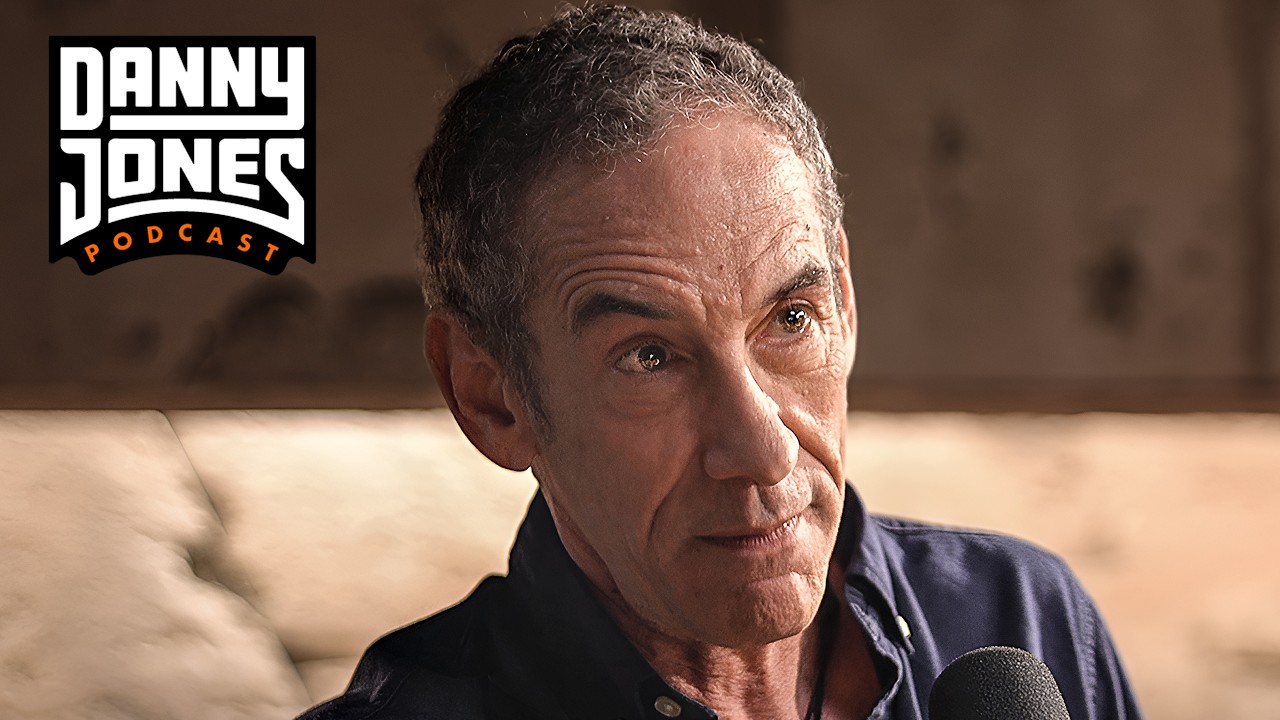
Douglas Rushkoff is a media theorist, author of 25+ books, and host of the podcast Team Human. He was accidentally invited into the inner circle of ultra-wealthy tech elites who were planning for civilizational collapse, which led him to write Survival of the Richest, a book exploring why billionaires are preparing to escape rather than fix the world.
The billionaire escape fantasy
Rushkoff was once flown out to a desert resort to give a talk to a group of hedge fund billionaires. Instead of a standard presentation, he found himself in a private session with five ultra-wealthy men asking where to build bunkers (Alaska or New Zealand) in case of “the event”—an electromagnetic pulse, climate catastrophe, pandemic, or revolution that makes the world unlivable.
They had thought through survival scenarios at the level of The Walking Dead—Navy Seals on speed dial, Bitcoin hoards—but hadn’t thought through basic questions like how you pay soldiers when currency is worthless, or how you sustain a community in isolation.
This encounter launched Rushkoff’s years-long investigation into how the wealthiest, most powerful people in the world convinced themselves that sustaining civilization is impossible and that their only rational option is to prepare for collapse and escape.
Peter Thiel’s worldview: a pyramid, not a circle
Peter Thiel exemplifies the most extreme version of this mindset. His book Zero to One argues that the goal of business and life is to become one order of magnitude above everyone else—to level up.
In his interpretation of Christianity, only a few humans will “level up” and transcend. Everyone else is essentially fuel. Mutual aid and wealth redistribution are, in his framework, satanic forces because they waste resources that should be concentrated at the top.
Thiel sees human beings as larvae living on a piece of dung. A few will sprout wings and escape—into the cloud, off the planet, or into another dimension. The rest exist only as labor and fuel for those who get wings.
He has been hosting lectures on Satanism and the Antichrist, and is actively trying to wrap Silicon Valley’s power agenda in Christian language, even though his actual goals—preserving the ego forever, escaping death, leaving the planet—are the opposite of Christian teaching.
The long history of money, control, and the suppression of horizontal societies
Rushkoff traces the roots of this extractive mindset to the late Middle Ages, right after the Crusades opened trade routes to the rest of the world. Europe adopted marketplaces (bazaars) and began using local currencies that functioned like poker chips—issued in the morning, expired at the end of the day, worthless for hoarding.
These currencies were optimized for trading, not accumulation. People got wealthy and healthy—women in 11th–12th century England were taller than at any point until the 1980s. People worked only about three days a week because there was no point in hoarding money. The sign of wealth was leisure.
The aristocracy, threatened by the rise of a peasant middle class, invented two tools to stop it:
Chartered monopolies (corporations): The king would grant one person the exclusive right to an entire industry. All other practitioners became employees. This is when hourly wages, the clock on the village tower, and the idea that “time is money” were invented.
Central currency: Local currencies were made illegal. Everyone had to borrow money from the central treasury at interest, which means the economy must always grow for the system to function. GDP growth is not about human welfare—it’s about servicing the interest on the money system itself.
This growth-based economy worked during colonialism (new territories, new resources, new enslaved people) but ran out of room by the 1950s. The response was to turn Americans into consumers through advertising, planned obsolescence, and storage units full of stuff nobody needs.
The internet was supposed to be the next infinite growth frontier, but human attention is finite. The system has now reached its limit: almost no one except those at the very top can create real value anymore.
How capitalism destroyed the internet
Rushkoff spent a decade blaming capitalism for killing the internet. The original internet was a creative, collective, share-everything playground. Then big tech reversed it: instead of giving people tools to realize their visions, they used tools on people to create visions for them.
This became “captology”—using technology to predict and steer human behavior. Algorithms function like demons, trained to use everything they know about you to get you to act against your self-interest.
The “scientistic” view of reality
Rushkoff also traces the problem to the origins of empirical science. Francis Bacon, selling science to the court, described it as taking “nature by the forlock, holding her down, and submitting her to our will.”
This mindset sees nature as scary, feminine, and unruly—something to be killed, taken apart, and made predictable. Anything that can’t be weighed and measured is treated as noise or nonexistent.
This “scientistic” (not scientific) reductionism carries through to the tech bros: anything that can’t be quantized isn’t real. Junk DNA is junk. The soul is noise. James Brown reaching for a note and living in the in-between space is a flaw to be autotuned out.
The in-between, the liminal, the weird—the stuff that makes you realize there’s more going on than meets the eye—is precisely what gets eliminated.
Epstein funded anti-spiritual science
At a scientist party in his late 20s, Rushkoff watched Richard Dawkins argue that humans are just computers for memes, that there’s nothing going on here, that we’re purely materialist machines. Naomi Wolf was arguing back that there must be something—a soul, a spirit. Dawkins and the other scientists laughed at her and dismissed Rushkoff as a “moralist” for defending her.
Ten years later, Rushkoff saw Dawkins and those same scientists in a photo on Jeffrey Epstein’s Lolita Express (they were going to the TED conference, not the island). He learned that Epstein had funded his literary agent and those scientists’ conferences.
The connection: Epstein funded specifically anti-spiritual, materialist scientists because their worldview justifies exploitation. If people don’t have souls, if they’re not even really conscious, if they’re just machine animals, then it’s okay to have a harem of 14-year-old girls. Nature is just something to be held down by the forelock.
This is the sociopathic marriage of the tech-bro scientist worldview with the billionaire sociopathic view of humanity.
How wealth corrupts empathy
Studies show that when you put a billionaire in an MRI machine and show them a picture of a starving baby, the empathy centers of their brain don’t light up the way yours or mine would. As people get wealthier, their empathy decreases. Wealthier people help less on the street.
This isn’t just that people with low empathy become wealthy—wealth itself erodes empathy. You have to justify your position after the fact.
That said, Rushkoff knows wealthy people who are not like this. Some must have good upbringings or strong anchors.
About 1–5% of humans have a sociopathic tendency regardless. The question is whether your society’s landscape rewards the sociopath or prevents the sociopath from gaining power.
Horizontal vs. pyramidal societies
Some indigenous and Native American cultures had safeguards against sociopathic males taking over: a male chief balanced by ten women with veto power, or the ability to simply leave and migrate away from a bad leader.
These are horizontal civilizations—optimized for leisure, sharing, and giving productivity back to everyone as more time. The late Middle Ages was one such period.
Pyramidal civilizations are optimized for accumulation and control. You climb to the top by taking. That’s the model we live in now.
Rushkoff argues the horizontal model is the more natural human state: we’re here to play and create. You work in order to have time to play.
Kessler Syndrome: the irony of being trapped on Earth
Elon Musk originally planned to get off the planet but recently dialed it back to the moon. One reason may be Kessler Syndrome: satellites in orbit crashing into each other, creating smaller and smaller particles, cascading until that entire orbital layer is a field of shrapnel moving at 20,000+ mph.
There are approximately 14,000–15,000 active satellites in orbit right now, 45,000 total human-made objects, and millions more pieces of debris. A spacecraft hit by even a centimeter-sized particle would be shredded.
The more satellites Musk and others launch, the worse the problem gets. The very technology meant to help them escape may make escape physically impossible—a metaphor for how all their walls, fences, and shielded doors make the problem worse.
The tech-surveillance-control grid
Larry Ellison (Oracle) is the big name no one talks about. Oracle was named after a CIA project. He has the highest security clearance in the US government, has the contract with the Israeli Defense Forces for intelligence analysis, and owns PeopleSoft (employment data for all big companies), medical data, and is building a DNA database of everyone in America and eventually the world.
He wants to use this data to cure cancer and predict diseases—but also to predict crime, depending on how crime is defined.
AI and predictive analysis can be used to identify whose media is most likely to sew discontent, and then quietly neutralize them—not by making martyrs (which creates a Streisand effect) but by turning a dial on their reach, shadow-banning them, or hitting them with a few tax audits.
Zuckerberg was recently revealed to have told Trump that Facebook would censor negative posts about DOGE. They did the same for Biden regarding vaccines. The behavior didn’t change—only the allegiance did.
Getting high without drugs: the original Rushkoff book
Rushkoff’s first book, written at age 24 or 25, was called Free Rides: Ways to Get High Without Drugs. The idea was that drug laws aren’t really about the drugs—they’re about the states of consciousness they provide, because once you’re in an altered state, you start questioning social agreements: Why is this money? Why do I pay rent? Why do I work for him?
All your social agreements dissolve. That’s what power fears—not the substance, but the shift in perception.
Reconnecting: ecstatic dance, Metallica, and the Elusinian Mysteries
Rushkoff attended a Metallica concert in Tampa with 60,000 people packed around a doughnut-shaped stage in the middle of a football field, with LED towers, smoke, giant beach balls, and sound vibrating through everyone. The palpable energy was intoxicating without any drugs.
He thinks this is what the Elusinian Mysteries must have been—communal altered states achieved through sensory overload, collective rhythm, and shared experience.
You can also get there through stillness: meditation, sex practiced with full presence (“passively active and actively passive”), drum circles. David Lynch wrote a book about how meditation accesses this state.
The key is learning to metabolize what’s happening in the world—all its horror and grief—rather than trying to rise above it or insulate yourself from it. Be like a mushroom: turn poop into life. Engage in the cycle of change.
The practical path forward: meet your neighbors
Rushkoff’s core advice is simple and local: meet your neighbors. If the pyramid is coming down—through climate crash, economic crash, or both—the way to soften the landing is to have resilient local networks.
He tells the story of needing a drill to hang a picture. Instead of buying one (with all the environmental and human cost of rare earth mining, disposable electronics, and waste), he could have just knocked on Bob’s door and borrowed one.
But then Bob would come over, do the job properly, smell the barbecue, get invited, bring his wife and mother-in-law, the mother-in-law would see the piano and suggest Christmas carols, and the whole block would end up at a party. Then they’d realize they don’t each need their own lawnmower. They could share two for the whole block.
Someone at a tech-bro conference objected: “But what about the lawnmower company? What about the old lady depending on its stock dividends?” Rushkoff’s response: I don’t want to live in a society where that old woman’s welfare depends on how many lawnmowers we buy. We should be taking care of her directly. She’s our neighbor.
A society where you must earn enough money in your working years to support yourself entirely alone for the rest of your life is not a society. It’s an every-man-for-himself competitive economy.
Written language and the invention of linear time
A psychologist explained to Rushkoff that the story of Adam and Eve eating from the Tree of Knowledge represents the shift from inherent/oral knowledge to trusting the written word. Written language is inherently deceptive because it enables lying and distances us from intuition.
The entire Bible can be read as an ethical manual for a society transitioning from oral to written culture—the “Axial Age.”
Writing gave us two things: history (a recorded past that becomes an origin story: “we own this land, we deserve this”) and contracts (the ability to bind people in the future: “if you do this, I will reward your descendants”).
This created linear time—past, present, future—and with it, the idea of inevitable progress toward a messianic endpoint. Before writing, spirituality was a way of being, not a goal. There was no alpha and omega, no endgame.
Now we’ve combined linear time with thermonuclear weapons. That’s the endgame.
American elites weaponizing religion
The people currently in power are using ancient texts and religion as excuses for control, but each for different reasons:
Musk: driven by a childhood obsession, trying to spread his seed as far as possible.
Thiel: gay, wants to be transformed and awakened; sees a few humans leveling up as the goal.
Ellison: a Rupert Murdoch-style power family.
Trump’s circle: organized crime using government to get money.
Genuine Christian believers: want to bring on the messianic age by getting Jews to own greater Israel, triggering the apocalypse.
JD Vance: a chameleon, everything to everyone depending on who’s paying.
Troops have been told by their generals that Trump was commanded by Christ to wage war, and that they’re fighting to bring back Christ. This violates the Catholic just-war doctrine, which says you don’t go to war unless someone is actively bullying someone else, and you never do it for religious reasons.
The Pope is being attacked by the war faction because he’s going against everything the current government is doing.
The podcast ecosystem vs. academia: two separate universes
Rushkoff had on an “academic attack dog”—someone whose job is to publicly humiliate anyone who challenges scientific consensus (ancient civilizations, Graham Hancock, etc.).
He asked the academic: “Is there anything you originally thought was fact that you changed your mind on?” The answer: “No, never. I don’t think it ever will.”
This revealed to Rushkoff that the podcast world and the academic world are essentially separate universes. The academic saw any scientist who does a podcast as a grifter (financial motive), while the podcast world exercises the “what if” muscle—imagining alternatives, even if they turn out to be wrong.
The “what if” exercise itself creates more space in the brain. Art Bell was a master of this: he’d follow a guest’s logic (“enslaved people mining gold for aliens on another planet”) not to endorse it but to explore it, keeping the space between belief and skepticism open.
Some academics do push back against the canon—like a PhD student whose dissertation committee forced him to remove all references to recreational drug use in ancient Rome because “the Romans wouldn’t have done such a thing,” despite overwhelming evidence. He got his PhD, then wrote a book about it.
Rupert Sheldrake’s censored TED Talk
Rupert Sheldrake, who proposed morphic resonance, gave a TED talk asking: “What if the laws of science themselves evolve?” Everything else changes—why not the laws of physics, on a larger timescale?
It’s the only TED talk that has ever been censored. TED erased it. Whether or not it’s true, it’s a beautiful “what if”—a meta-scientific question that doesn’t require belief in Bigfoot, just openness to the possibility that the framework itself is alive.
Retrocausality: the future affecting the past
Rushkoff is fascinated by retrocausality—the idea that events in the future affect the present and past. Experiments have shown that people who study for a test after taking it do better on the test than people who didn’t study.
Eric Wargo (a real scientist) has documented throughout history cases of people recording dreams that later came true. The Princeton Random Number Generator project also showed anomalies before major global events.
One physics theory suggests that when the Big Bang happened, time moved forward and backward simultaneously—we’re in a loop, coming back around.
Nick Land, the accelerationist philosopher, believes capitalism is a “strange attractor” in the future, pulling us toward it. The future state already exists and is rippling backward, drawing us into it.
How to survive and thrive in the unfolding landscape
Remember the Sabbath: Take one day a week (Friday night to Saturday night) completely off screens. Meet people, touch people, have sex, play games. When you return to the device, you’ll feel what it’s doing to you.
Exercise the “what if” muscle: Even if you don’t believe in aliens or ancient civilizations, spending an hour wrapping your head around it creates cognitive flexibility and opens you to the possibility that there’s more going on than the official story.
Stay connected to your “Spidey sense”: The gut feeling that something is off is what kept Rushkoff from falling into the Epstein world. The more you’re distracted by social media metrics as your gauge of right and wrong, the more you lose that ethical compass.
Engage in behaviors that engender compassion: You can’t single-handedly create a new social order, but you can be nice to people on the street, answer less email, do favors, change jobs, spend time with your kids without making them feel entitled.
Being human is a team sport: The only way out is through, and the only way through is together.