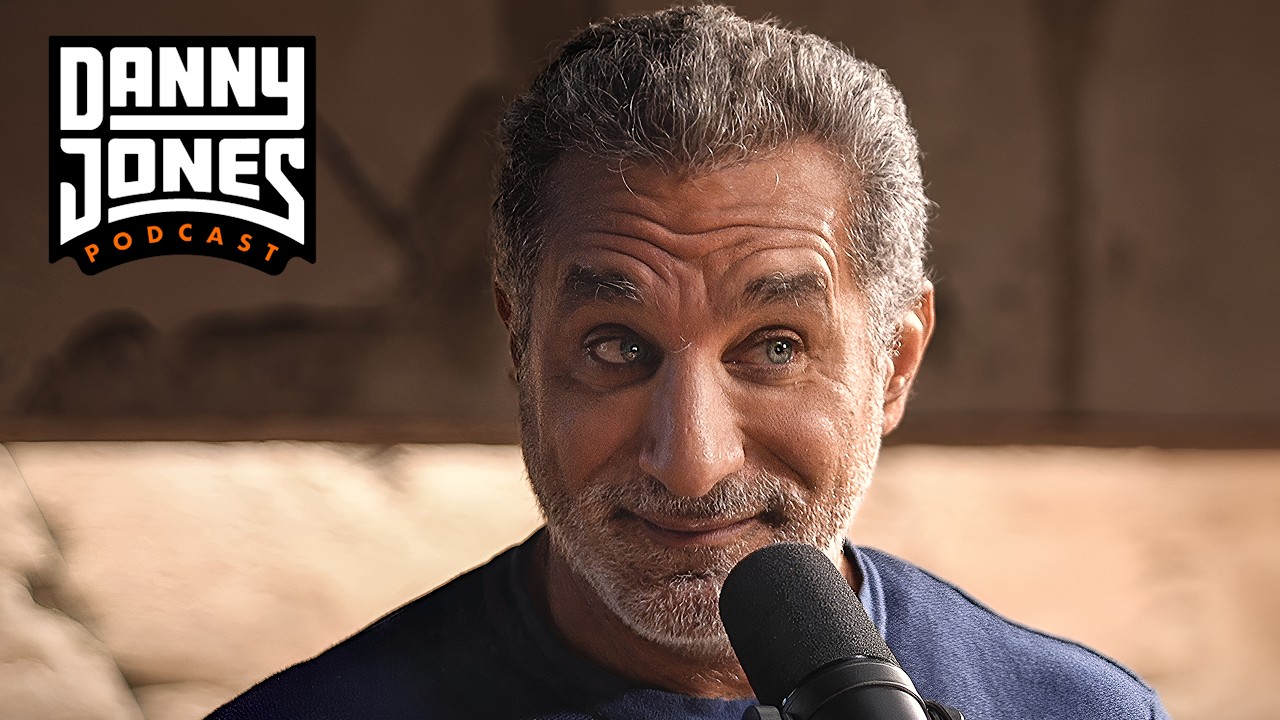
Bassem Youssef is an Egyptian comedian and former heart surgeon who became the Arab world’s most famous satirist with a TV show reaching 40 million viewers, then left Egypt under political pressure and rebuilt his career in America as a stand-up comedian. He is now one of the most prominent critics of Israeli policy and the influence of the Israel lobby on American politics, and he uses his platform to challenge what he sees as a toxic U.S.-Israel relationship funded by American taxpayers.
From heart surgeon to comedy
Youssef spent 20 years in medicine (7 studying, 13 operating) but hated every second — he pursued medicine only to meet Middle Eastern cultural expectations (doctor, engineer, or disappointment).
While in medical school in Miami in 2001, he was a salsa teacher; he returned to Egypt two days before 9/11 after running out of money.
He specialized in pediatric heart surgery, passed his US medical licensing exams, and was accepted to a fellowship in Cleveland — but in 2011, the Egyptian revolution created an opportunity for a TV show, and he chose comedy over medicine.
His show became the biggest in the Arab world with 40 million viewers per episode, but he ran afoul of both the Muslim Brotherhood and the military government, was interrogated for his jokes, had his show canceled, and eventually left Egypt in 2014.
He has not been back to Egypt in 12 years, though relations have thawed somewhat; he appeared remotely on an Egyptian TV show and may visit next year.
His wife is half-Palestinian; much of her family from Gaza has been killed or displaced to Egypt.
The U.S.-Israel relationship as a toxic dynamic
Youssef argues that the U.S. sends roughly $4.2 billion annually in direct aid to Israel, but the real cost is far higher — about $30 billion in the two years since October 7th alone, including weapons and indirect support.
He points out that non-governmental donations from American evangelical Christians to Israel exceed $4 billion, meaning poor Americans in the South are effectively funding Israel through their church donations.
He frames the relationship as a “dominatrix” dynamic: America pays, gets humiliated, and keeps coming back.
He notes that infrastructure and healthcare in the U.S. are crumbling while Israeli citizens enjoy free healthcare, free education, and affordable housing subsidized by American taxpayer money.
AIPAC and political control
AIPAC spends enormous amounts to punish critics — $15–16 million poured into a Kentucky congressional race against Thomas Massie, one of the few congressmen who openly opposes AIPAC and has introduced legislation to force it to register as a foreign lobby (something JFK tried and failed to do).
Massie is crowdfunded and still nearly winning despite being outspent massively.
Youssef notes that 37–38 U.S. states now require government contractors to sign pledges not to boycott Israel as a condition of getting state contracts.
In the Senate, pro-Israel legislation passes 99-to-1 or 100-to-zero, which he argues reveals that the two-party system is performative (“political WWE”) except on Israel, where both sides always agree.
He argues that both Republican and Democratic presidents have been compromised — he cites a book reviewed by the Times of Israel alleging that Israeli intelligence possessed the Monica Lewinsky tapes on Bill Clinton and used them to pressure him during peace talks.
The Epstein files and elite blackmail
Youssef believes the Epstein files reveal a pattern of compromised leaders across politics, tech, media, and religion — and that the files were released in a way designed to overwhelm and distract rather than enable prosecution (flooding the internet with documents, redacting key names, and waiting until the statute of limitations had expired).
He notes that the same strategy of “flooding the zone” is used with UFO disclosures and other distractions.
He argues that Trump may have been pushed into the Iran war partly because of what the Epstein files contain about him and his associates.
He sees the same blackmail-and-compromise pattern in evangelical pastors (many of whom take free trips to Israel and return to influence their congregations), Silicon Valley leaders, and politicians.
October 7th and the Hannibal Directive
Youssef highlights that Israel’s first response to the October 7th attack came 6–8 hours after it began, despite Israel being only the size of New Jersey — he argues this is evidence of a stand-down order.
Multiple IDF soldiers have testified in front of the Knesset that they were told not to report to their posts that day.
He discusses the Hannibal Directive — an IDF protocol (officially revoked in 2016 but reportedly still used) that orders forces to kill everyone, including Israeli hostages, to prevent captives from being taken. Investigations by Haaretz and UN investigators found it was used on October 7th, likely causing many Israeli civilian deaths.
He also references videos of IDF soldiers committing atrocities (wearing women’s lingerie, sodomizing detainees) and argues these were approved or allowed as part of a strategy to generate anti-Israel hatred and thus more sympathy and funding for Israel — a cycle he calls deliberate.
The strategy of sowing anti-Semitism (Pax Judaica)
Youssef discusses the theory of Pax Judaica — the idea that Israel deliberately provokes worldwide anti-Semitism to scare the Jewish diaspora into returning to Israel.
He argues that Israeli leaders openly discuss goals like “Greater Israel,” ethnic cleansing, and blowing up the Al-Aqsa Mosque to build the Third Temple — but when these are mentioned by critics, they are dismissed as conspiracy theories.
He points to a secret Israeli military base discovered in the Iraqi desert in June 2026, used to launch attacks on Iran and possibly other Arab countries, then blame Iran — a false flag strategy he says Israel has used for decades (citing the 1950–51 Baghdad bombings of synagogues by Mossad to scare Iraqi Jews into emigrating, and the Lavon Affair in Egypt).
Israel’s propaganda machine (Hasbara)
Israel has quadrupled its public relations budget to $730 million, which Youssef argues is itself proof that something is deeply wrong with Israel’s image — “the truth doesn’t need $730 million to defend itself.”
He notes that TikTok was bought by Larry Ellison (a major IDF donor) not because of China concerns but because it was the only unregulated platform where people could see what was happening in Gaza.
He argues that American media functions as “state-run media for the state of Israel” — pointing to the Las Vegas sting operation where an Israeli cybersecurity officer was caught soliciting a minor, fled to Israel the next day, and was never covered by any major American news outlet.
Surveillance, Palantir, and the tech threat
Youssef is alarmed by Palantir (founded by Peter Thiel), which has access to NHS patient data in the UK, supports ICE and the Israeli/U.S./UK militaries, and is building AI systems to integrate health records — which he sees as a rehearsal for the same in the U.S.
Palantir also partnered with Oura Ring to access biometric data on American citizens.
He notes that AI targeting in the Iran war has been catastrophically inaccurate — a girls’ school and 36 hospitals in Gaza were allegedly hit by AI error, and a park called “Police Park” in Iran was struck because the AI targeted anything with the word “police.”
Data centers supporting AI are consuming massive water resources — one campus in Georgia drained 30 million gallons unnoticed until residents complained about low water pressure.
Religious Zionism and end-times theology
Youssef explains that Christian Zionists (like John Hagee’s CUFI, which has sent $70 million to Israel) support Israel because they believe it will bring about the end times — but in the Christian version, this ends with all Jews being killed except 144,000 who convert to Christianity.
He argues that both Jewish and Christian religious fanatics are essentially seeking the destruction of the world to fulfill prophecy, and that this theology drives real policy.
He notes that Netanyahu’s wife gave him a birthday cake decorated with a noose to celebrate a new law allowing execution of Palestinians — an image he says tells you everything about the society.
He also mentions that Netanyahu reportedly brings suitcases of dirty laundry to the White House to be cleaned, which Youssef interprets as a deliberate “fuck you” to the American people.
The left-right divide is fake
Youssef argues that the partisan divide in America is manufactured — the two sides fight on every issue except Israel, where they always agree. He calls it a “vertical fight” (the people vs. the elite), not a horizontal one (left vs. right).
He was a “vote blue no matter who” voter when he got citizenship in 2019, but now sees both parties as compromised.
He supports anyone who prioritizes breaking Israel’s grip on American politics — including Thomas Massie and even Dan Bilzerian (a private citizen with a questionable lifestyle) over sitting congressmen like Randy Fine who openly calls for killing Arabs.
Free speech and its expiration date
Youssef notes that free speech online is currently wide open compared to the heavy censorship during COVID and the Biden years, but he questions how long this will last given the exponential growth in people being doxed, fired, and blacklisted for criticizing Israel.
He himself faces cancellation campaigns — a campaign to cancel his Royal Albert Hall show in London began a month before the event, despite 90% of tickets being sold.
He was named “Anti-Semite of the Month” in August 2024 by stopantisemitism.org and ranked number three on the Israeli Ministry of Diaspora’s top 10 anti-Semites list in 2025, which he treats as a badge of honor and evidence that the term has lost all meaning.
His personal faith crisis
Youssef is a Muslim but not strictly observant. He says his faith has been deeply shaken by the injustice he witnesses — particularly the argument that Jews are “God’s chosen people” while atrocities are committed in their name.
He challenges critics who attack Islam’s “unfiltered” version to also look at what is written in the Talmud, and notes that no Muslim leader has invoked religious texts to justify genocide the way Israeli leaders have (referencing the Amalek commandment to kill women, children, animals, and trees).
What’s happening now in Gaza
The killing in Gaza never stopped after the ceasefire — more than 3,000 people have been killed since.
Israel has taken 45% of Gaza and is pushing further, closing in on the remaining population.
The West Bank and Lebanon are also experiencing ongoing violence that receives little media attention.
Youssef’s wife’s Palestinian family has been decimated — half are dead, the rest fled to Egypt.
Upcoming shows
Houston (June 4–6), then a European tour (Berlin, Vienna, London, Zagreb, Istanbul, Antwerp, Paris), Jacksonville (July 17–18), Denver, and then Australia and New Zealand — including a show at Sydney’s TikTok Arena for 8,000 people.