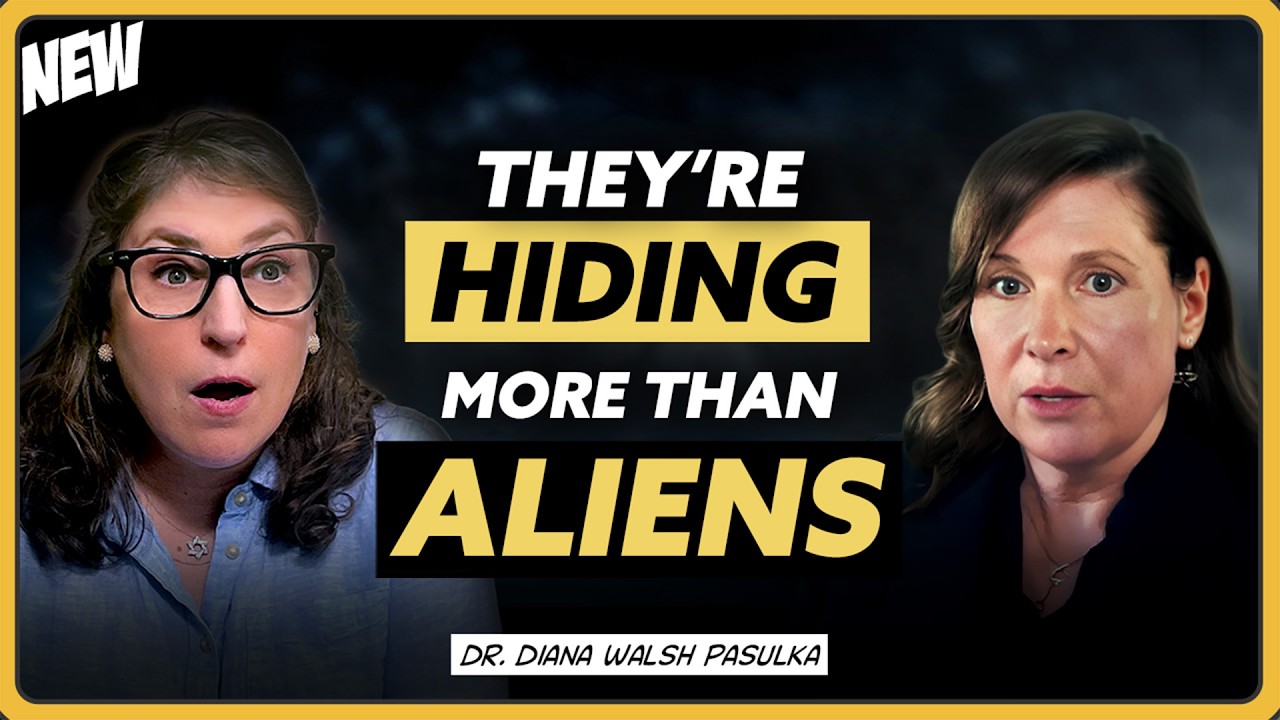
Dr. Diana Walsh Pasulka, professor of religious studies at UNC Wilmington, argues that modern UFO/UAP encounters and ancient religious experiences describe the same phenomenon interpreted through different cultural frameworks, and that the current wave of government disclosure represents an unprecedented decentralized exposure to what Plato called the “allegory of the cave.”
Religious Studies as a Lens for Technology and Consciousness
Pasulka studies how technological infrastructure shapes belief and perception, tracing this back to Socrates’ critique of writing as an externalization of memory that would alter human cognition.
She grew up near Silicon Valley in the 1980s as part of a cohort beta-testing early computers, giving her a lifelong perspective on how new substrates change the way humans interpret reality.
Religious studies does not advocate for any faith; it examines religion academically, looking for cross-cultural patterns in how humans structure meaning.
The Function and Limits of Religion
Prayer and meditation appear universally across traditions (Islam’s five daily prayers, Jewish Shabbat, Buddhist practice) and neuroscience now shows they activate specific brain regions and physically change the brain over time.
Religion does not answer all questions or provide simple comfort; the Book of Job demonstrates that suffering remains inexplicable even to the faithful, and God’s response affirms human incomprehension.
Engaging original texts with fresh eyes destabilizes inherited assumptions, even for lifelong practitioners, revealing that religious traditions often acknowledge the limits of human understanding.
From Skeptic to UFO Researcher
Pasulka did not believe in UFOs until 2012, when researching historical aerial phenomena led her to meet scientists involved in a long-standing U.S. government program studying the topic.
She was invited to an alleged crash retrieval site in New Mexico with Dr. Gary Nolan (identified in her book American Cosmic as “James”); they were blindfolded during transport.
The government program participants believed the phenomena were real but did not know their origin; they sought Pasulka’s historical database of pattern-matched accounts to help classify what they were encountering.
Parallels Between Religious Texts and Modern Encounters
Angelic encounters in Jewish and Christian history rarely resemble Renaissance paintings; they appear as balls of light, luminous beings, or small entities communicating telepathically — closely matching modern UFO abduction reports.
Joan of Arc described a ball of light speaking to her in her father’s garden; St. Teresa of Ávila saw a three-foot-tall being that communicated mind-to-mind; both were considered real, not imaginary, by the experiencers.
Catholic archives contain reports of “flying houses,” lights penetrating walls, and souls from purgatory requiring prayer to depart — phenomena that mirror contemporary UAP sightings and abduction narratives.
Cultural frameworks determine interpretation: a 19th-century nun’s convent interpreted a penetrating light as a soul from purgatory because it did not behave like an angel; today the same event would be called a UFO.
Who Accesses the “Interior Sense”?
Every traditional religion identifies individuals with a cultivated interior or spiritual sense — prophets, oracles, mystics — often emerging in adolescence (around age 11–12) and developed through practice.
Modern secularization has pathologized this capacity; people with such experiences now lack interpretive structures and may fear they are mentally ill, interpreting identical events as aliens, plasma beings, or angels depending on their background.
Socrates and Plato framed this as direct access to “the Good” (later identified with God), a charismatic knowledge that enables moral discernment; Socrates was executed for cultivating it in youth.
Pasulka suggests a revival of religious practice may occur because science can now measure its neurological benefits, validating what traditions preserved empirically.
The Vatican and Non-Human Intelligence
Pasulka, a Catholic who has worked in the Vatican archives and observatory, believes the Vatican is not withholding extraterrestrial evidence; it interprets anomalies through a theological, not secular, lens.
Catholic theology has a sophisticated history of non-human intelligence: Thomas Aquinas developed a theology of angels and fallen angels, affirming God could create any form of life without contradicting doctrine.
This interior sense tradition exists in Catholic history but is rarely taught, even in Catholic schools — another symptom of secularization within the institution itself.
Mystical Practices, Brain States, and Physiology
Traditions worldwide use specific techniques (Hindu yoga, Sufi dance, Christian contemplative prayer, Buddhist fasting) to quiet the body and access a state of direct knowing; physiology is treated as a tunable instrument.
The Enlightenment shifted cultural authority to science; without visible proof, interior senses were dismissed — just as flight and space travel were once deemed impossible.
Neuroimaging now shows prayer and meditation increase gray matter, reduce anxiety and depression, and enhance resilience, providing empirical validation for practices once considered purely spiritual.
Religion, Politics, and the Inescapability of Moral Action
Pasulka argues religion cannot be depoliticized: Socrates was killed for treason, Martin Luther King Jr. invoked natural law against unjust statutes, and the Pope currently clashes with political leaders over war.
When people access the “Good,” they feel compelled to speak moral truth, which inevitably appears political; this is a feature, not a bug, of genuine spiritual practice.
Purgatory, Abduction, and Cultural Frameworks
Researching the decline of purgatory devotion led Pasulka to archives where she found encounter narratives structurally similar to alien abduction: lights, beings, telepathic communication, missing time.
A French convent experienced a light penetrating a nun’s cell wall nightly; the mother superior witnessed it, identified it as a soul from purgatory, and the community prayed it away — reinforcing their framework.
The description precedes the interpretation; the same phenomenon receives different labels depending on the era’s conceptual vocabulary.
Science Fiction as the New Mythos
Science fiction (Star Wars, Asimov, Clarke) provides the dominant cultural framework for interpreting anomalous experiences today, just as angelology did in the Middle Ages.
Ezekiel’s “chariot” (Merkabah) vision — a fiery, wheeled vehicle with multi-faced beings — reads like a UAP encounter; it belongs to a Jewish mystical tradition considered dangerous and restricted to the prepared.
Extra-biblical texts like 1 Enoch expand on angelic hierarchies and fallen angels, influencing early Christianity; these were esoteric traditions, not public doctrine.
Disclosure as Plato’s Cave Projected on Screens
Government disclosure functions as a mass exposure to Plato’s allegory: the “prisoner” who leaves the cave sees reality beyond shadows, but now the entire population watches the return via smartphones and social media.
Decentralized documentation (radar, video, whistleblowers) makes suppression impossible; Athens could kill Socrates, but the internet cannot be silenced.
Pasulka calls this a “new form of religion” — a technologically mediated, collective confrontation with the unknown that will likely become political.
Psychedelics as Historical Pathways to Non-Human Intelligence
Indigenous traditions (Native American Church peyote ceremonies, Celtic practices) use entheogens ceremonially to access sacred states quickly; some traditions restrict them, warning they can impede unassisted access.
The pattern is consistent: substances are tools within a disciplined context, not recreational shortcuts; the goal remains cultivation of the interior sense.
Historical Patterns: Apparitions at Pivotal Moments
Marian apparitions cluster during existential threats to communities (e.g., spread of communism); they function to cohere and strengthen the group under pressure.
The current global UAP wave may signal a similar civilizational inflection point; Pasulka references 20th-century visionaries (Teilhard de Chardin, Arthur C. Clarke, Mary Shelley) who independently predicted a 21st-century transformation of humanity.
Teilhard’s “noosphere” (a networked consciousness layer) and Clarke’s Childhood’s End (children absorbed into a hive mind) anticipate the internet and AI; both also predicted imminent government UFO disclosure.
Consciousness, the Right Hemisphere, and Creative Reception
Iain McGilchrist’s split-brain theory suggests the right hemisphere holds holistic, direct attention to reality, while the left handles language and categorization; breakthrough ideas arrive via the right hemisphere during diffuse states (walking, gardening).
Aerospace pioneers (Konstantin Tsiolkovsky, Jack Parsons) explicitly credited non-human intelligence for their rocket designs; Tsiolkovsky called them angels, Parsons invoked Babylonian deities via ritual.
Contemporary aerospace engineers and AI researchers (e.g., Mark Stalman, godson of Norbert Wiener) report similar reception of fully formed ideas; some believe everyone is born with this capacity but loses it by adolescence unless cultivated.
AI, the Antichrist, and the Erosion of Empathy
Peter Thiel frames AI as a divine gift and opposition to it as Antichrist; Pasulka engages the theological concept via Robert Hugh Benson’s Lord of the World, where the Antichrist deceives not by force but by erasing knowledge of the interior sense.
AI currently shapes developing brains, diminishing empathy and intuitive capacities — fulfilling the “deceiver” criterion by making humans unaware of what they have lost.
Pasulka acknowledges AI’s potential benefits in wise hands but warns its present deployment is damaging; the technology is like water — essential but capable of becoming a tsunami.
Faith, Disclosure, and the Size of One’s God
Pasulka affirms belief in God rooted in first-century Christianity shaped by Second Temple Judaism and Platonic philosophy; she sees no conflict between faith and non-human intelligence.
Religious frameworks already contain categories for the inexplicable; secular humanists may struggle more with disclosure because their worldview lacks a slot for it.
The core issue is not whether anomalies exist, but whether one’s cosmology is large enough to accommodate surprise without collapse.