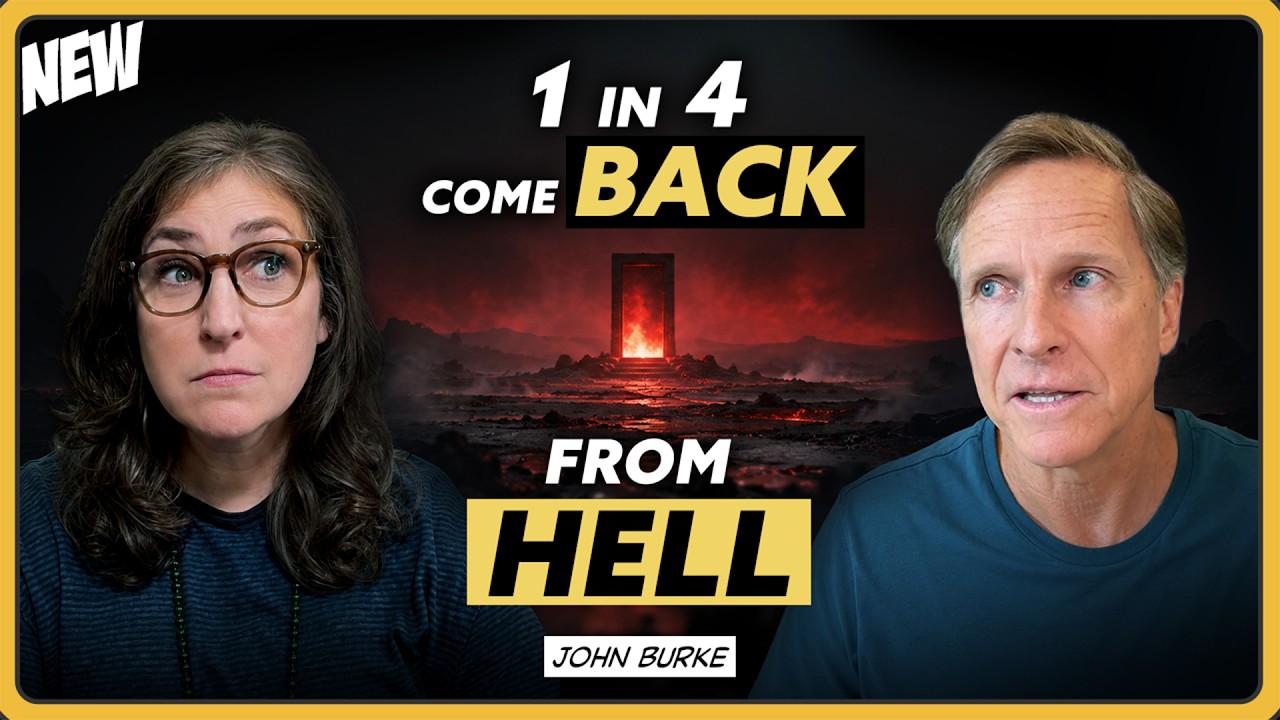
John Burke, a pastor and former engineer, has researched approximately 1,500 near-death experiences (NDEs) and interviewed experiencers worldwide, finding consistent patterns that he argues point to a purposeful, multidimensional reality and a personal God of love.
The core framework: unique purpose within a greater unity
Every person is created with a unique “blueprint” — gifts, passions, experiences (both good and bad) — designed for a one-of-a-kind relationship with God and a specific purpose that cannot be compared to anyone else’s.
This individuality coexists with deep interconnectedness: NDEers report being fully themselves while simultaneously experiencing profound connection to all creation, communicating heart-to-heart without misunderstanding.
The tension between significance and insignificance resolves in the NDE data: each life matters because each has a part to play in a grand scheme, yet each is a small part of a much greater whole.
NDE phenomenology: consistent patterns across cultures and backgrounds
About 30% of NDEers undergo a life review in the presence of a God of love and light who knows them intimately and often sends them back with the message: “You still have a purpose to fulfill.”
Approximately 48% encounter this God of light — described as blinding, personal, intimate, safe, and loving — regardless of prior religious belief or cultural background (including atheists, Hindus, Muslims, Jews).
Roughly 57% meet deceased loved ones in a “welcoming committee”; these reunions involve full memory, personality, laughter, and physical embrace, but in a heightened dimensionality.
Communication on the other side is described as “impeccably pure” — beyond telepathy, encompassing thought, emotion, and all associated context simultaneously.
Time and distance operate differently: experiencers report experiencing past, present, and future simultaneously, or having “all the time in the world” with nothing rushed; movement can be instantaneous by intention.
The “Flatland” analogy: this life is like a 2D black-and-white painting; at death, consciousness peels off into a 3D world of color, then gets pressed back into 2D upon resuscitation, making description inherently limited.
The self persists and expands
NDEers consistently say: “I was still myself — in fact, more myself than I’ve ever been.”
They retain memories, personality, humor, and individuality, while also accessing a connectivity to all creation (e.g., experiencing a tree’s growth, feeling the life within it).
This “both/and” — individuation plus profound unity — contradicts purely materialist or purely monistic explanations.
Hellish NDEs: underreported and transformative
About 23% of reported NDEs are hellish (International Association for Near-Death Studies), but researchers like Dr. Pim van Lommel and Dr. Maurice Rawlings believe they are vastly underreported due to shame and trauma.
Howard Storm (atheist professor) and Dr. Rajiv Parti (Hindu anesthesiologist) exemplify the pattern: initial euphoria gives way to a dark, hostile realm where malevolent beings torment the experiencer; crying out to God/Jesus brings rescue, a life review, and a mandate to return and fulfill a purpose.
Burke interprets hell not as divine punishment but as the consequence of free-willed creatures choosing “my will be done” — a realm where God’s light and love are voluntarily excluded, resulting in “outer darkness” and domination dynamics.
The same God of light appears across traditions: a Jewish girl (Heidi Barr), a Hindu doctor (Rajiv Parti), a Muslim woman in Tehran, a mother in Rwanda — all identify the light as Jesus despite no prior Christian framework.
Three lines of evidence that NDEs are not merely brain-based
Verifiable observations during clinical death: Experiencers report detailed, technically accurate observations of their resuscitation while displaying flat EEG (no brain waves); cardiologists confirm the precision exceeds what could be guessed or inferred.
Blind-from-birth experiencers see: At least seven individuals blind from birth (e.g., Vicky Noratuk, Brad Barrows) report full visual perception during NDEs — colors, light emanating from objects, movement, spatial navigation — despite having no visual cortex reference; they return to blindness but retain the memory of sight.
Cross-cultural convergence on the same God: 48% encounter the identical personal God of light and love regardless of religious upbringing, expectation, or language; this consistency cannot be explained by cultural scripting or neurotransmitter floods alone.
Biblical and historical parallels
Isaiah (c. 680 BC) and Revelation describe heaven’s light as emanating from God, not sun or moon — matching blind NDEers’ descriptions of light “coming out of everything” and feeling like love.
Paul’s Damascus Road experience (blinding light, “Who are you, Lord?” — “I am Jesus”) mirrors Rajiv Parti’s NDE; Paul’s later stoning and 2 Corinthians 12 account (“caught up to heaven, heard inexpressible things”) aligns with a deep NDE.
Old Testament prophecies (e.g., Isaiah 11, 66: nations rallying to Messiah, Israel reborn “overnight”) are cited as foretold historical events that corroborate a purposeful divine narrative.
God, free will, and the problem of evil
Burke argues God is not the god of religion (human institutions, wars, coercion) but the God of love demonstrated in Jesus: “God is love,” and love requires free will — it cannot be forced, bought, or coerced.
This life is a “time capsule of choosing” where good and evil are both muted; the full reality of love and the consequences of rejecting it are experienced on the other side.
Hell is God sorrowfully honoring the creature’s choice: “Your will be done” — a realm without God’s sustaining light, love, and life.
Forgiveness is freely offered to all who want it; no one keeps any moral code perfectly, so the message is not condemnation but restoration for relationship.
Purpose: love in the details, not grandeur
The core purpose is not fame, wealth, or achievement but how we treat people: motives, kindness, sacrifices, family, service — “the core of it is about love.”
Even suffering can be woven into purpose: not wasted, but transformed into something that serves others and deepens capacity to love.
Life reviews consistently highlight small, forgotten acts of kindness (e.g., Nancy Reines comforting a clerk; Betty’s “Buddha Betty” moment) — not grand achievements — as what mattered most.
God does not reveal the full “plan” upfront (as one CEO experiencer learned) because purpose unfolds relationally, step by step, in partnership with God.
Practical takeaway: trust the unfolding
The Kyrie Irving story (tearing ACL, mouthing “Thank you, God” at the free-throw line) illustrates gratitude amid devastation — trusting a larger plan without passivity.
Small acts ripple outward: how we make someone feel changes how they treat the next person, creating cascading impact far beyond what we can see.
The universal language, whether called God, consciousness, or love, is the same: be kind, practice random acts of kindness, because love is the governing rule of the universe.