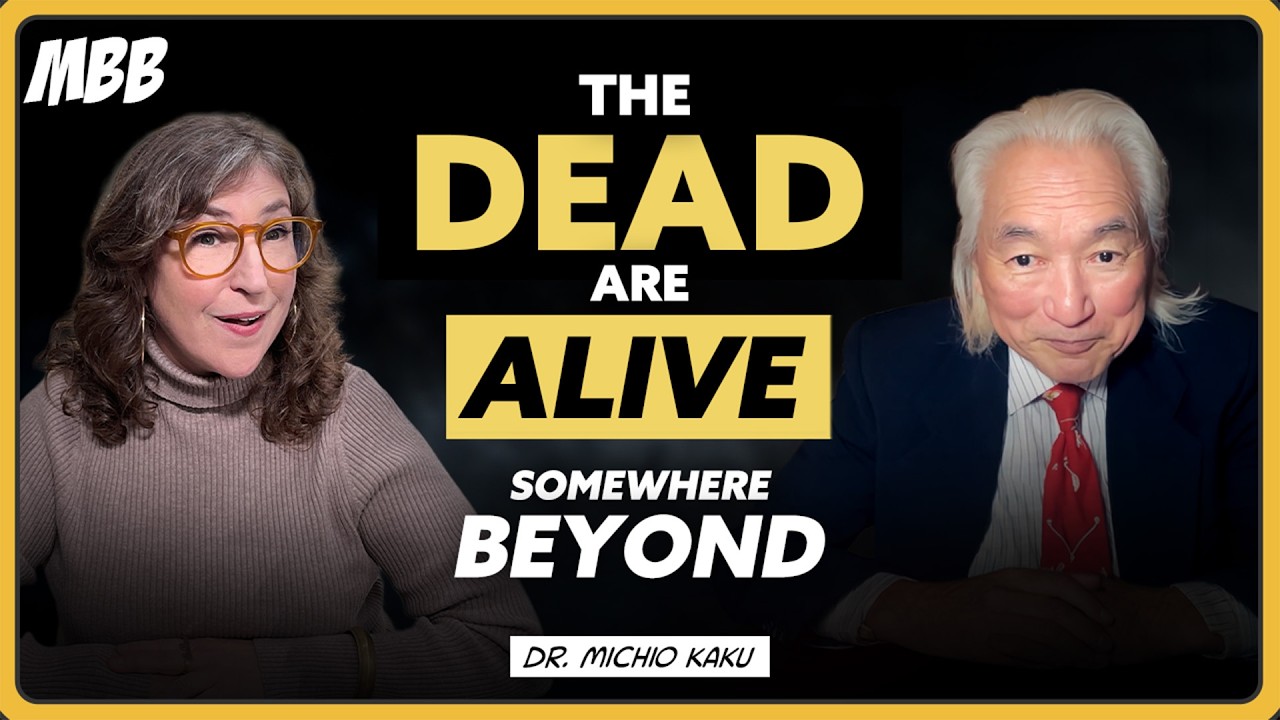
Dr. Michio Kaku, co-founder of string field theory and theoretical physicist at CUNY, joins Mayim Bialik and Jonathan Cohen to explain how quantum computing will transform every aspect of human life, from medicine and longevity to our understanding of the universe, the multiverse, and even what happens after death. His book Quantum Supremacy frames this as the next great technological revolution, following the Industrial Revolution, the electric revolution, and the computer revolution.
How Quantum Computing Works and Why It Matters
Classical digital computers encode everything in binary — zeros and ones — and process information sequentially. They are powerful but fundamentally limited when problems involve enormous numbers of simultaneous variables, such as modeling a virus’s mutation pathways, predicting weather, or understanding why humans age.
Quantum computers replace bits with qubits, which exploit the quantum property of superposition: an atom can spin up and down simultaneously in any proportion (10% up/90% down, 65% up/35% down, etc.), meaning a qubit carries information as a simultaneous mixture of states rather than a single zero or one.
When qubits interact, they become entangled, and the computational power scales exponentially: a 53-qubit machine like Google’s Sycamore is 2^53 times more powerful than a single-qubit system, giving it roughly 72 million billion bytes of memory processing capacity.
The hardware looks like a chandelier — most of it is cooling infrastructure (pumps and pipes) to bring the core near absolute zero, because atoms must be isolated from thermal noise. Nature, by contrast, performs quantum calculations effortlessly at everyday temperatures in every living cell.
Quantum supremacy means solving problems that are effectively impossible for any digital computer, no matter how much time it has. This is not about faster uploads — it is about accessing an entirely new realm of calculation where every possibility is evaluated simultaneously.
Transforming Medicine, Longevity, and Disease
Cancer and disease detection: Dogs can detect cancers (lung, breast, ovarian, bladder, prostate) with 88–99% accuracy by sniffing volatile organic compounds, but science has not been able to identify exactly what they are detecting. Quantum computers can analyze the molecular parameters of scent at the atomic level, potentially replicating and vastly extending this diagnostic ability.
During COVID, specially trained dogs identified the virus with 95% accuracy within 10 seconds at Helsinki Airport. Quantum computing could track all possible mutation trajectories of a virus simultaneously, enabling real-time vaccine design and early containment before catastrophic spread.
Why we age: Aging is a quantum mechanical process. Like a car engine accumulating waste products, human cells accumulate molecular errors from energy consumption — DNA damage, misfolded proteins, metabolic byproducts. These errors build up at the molecular level, causing skin to sag, bones to creak, and organs to fail.
Quantum computers can analyze the roughly 100 genes already implicated in aging, compare the genomes of exceptionally healthy elderly people against the general population, and isolate the specific genetic and signaling pathways that protect certain individuals from disease and decline.
Diseases like Werner syndrome and progeria, where people age at dramatically accelerated rates, involve DNA repair mechanisms that digital computers have not been powerful enough to fully model. Quantum-level analysis could unlock these mechanisms.
Future diagnostics: Kaku envisions a near future where sensors in your toilet analyze urine each morning, detecting cancer, metabolic disorders, and other illnesses years before symptoms appear. This raises urgent questions about who accesses this data — individuals, doctors, or insurance companies — and whether it will be available only to the wealthy.
Energy, Climate, and Global Problems
Nuclear fusion: Fusion — the power source of the sun — has remained out of reach because no computer has been powerful enough to model and control the plasma dynamics involved. Quantum computers could finally make fusion reactors feasible, providing virtually limitless clean energy.
Global warming and weather prediction: Current computers cannot reliably predict weather beyond a few days because the atmosphere involves too many interacting variables. Quantum computers could model climate systems with enough precision to predict long-term patterns and design effective interventions.
Food production and agriculture: Quantum computing could solve problems like nitrogen fixation (understanding the enzyme nitrogenase at the quantum level), potentially revolutionizing fertilizer production and grain yields in regions where people are starving.
Battery technology and solar capture: Quantum-level modeling of materials science could exponentially improve battery storage capacity and solar energy capture, accelerating the transition away from fossil fuels.
Black Holes, Wormholes, and the Multiverse
Black holes as gateways: Einstein’s equations from the 1930s predicted black holes but he thought they could never be observed. We now know that nearly every galaxy has a supermassive black hole at its center. The mathematics of general relativity suggests that a black hole could function as a wormhole — a shortcut through curved space-time connecting distant regions of the universe, or even different universes.
This is still speculative, but the equations do not forbid surviving passage through a black hole. It would require technology far beyond anything we currently possess.
The multiverse as a bubble bath: If string theory is correct, our universe is one bubble among many in a vast multiverse. Bubbles can collide, merge, or fission into smaller bubbles. Our universe began as one such bubble that, instead of popping back out of existence, kept expanding — that expansion is what we call the Big Bang.
Stephen Hawking proposed that the vacuum of space is full of tiny “baby universes” that constantly pop into and out of existence. Ours was the one that didn’t disappear.
Parallel universes and quantum superposition: In quantum mechanics, a particle exists in all possible states simultaneously until measured — this is the collapse of the wave function. The many-worlds interpretation holds that every possible quantum outcome actually occurs in a separate, equally real branch of the multiverse.
Kaku and Bialik explore the provocative idea that people who have died in our universe might be alive in another branch of the multiverse. Near-death experiences, deep meditation, psychedelic states (like DMT experiences described by Terence McKenna), and mediumship could represent the human mind tuning into quantum fields or parallel realities that are normally inaccessible.
Bialik suggests that what some call “heaven” or “other realms” may be parallel quantum realities, and that individuals with unusual perceptual sensitivity may be accessing these through mechanisms science does not yet understand.
String Theory: The Universe as Music
In the 1930s, matter was thought to consist of just protons, neutrons, and electrons. After World War II, atom smashers produced a flood of new subatomic particles with bizarre names (lambda particles, hyperons, etc.), leaving physicists drowning in unexplained data.
String theory proposes that all these particles are nothing but different vibrational modes of tiny vibrating strings — like musical notes on a piano. An electron is one note, a proton is another, a neutron is another. There are infinitely many possible notes, which is why infinitely many particles are possible.
Kaku frames it poetically: physics is the harmonies played on these strings, chemistry is the melodies, the universe is the symphony, and what Einstein called “the mind of God” is the cosmic music resonating through the universe.
Dark matter and dark energy, which together comprise roughly 95% of the universe (68% dark energy, 27% dark matter, with only 5% being ordinary hydrogen/helium and 1% everything else), may simply be higher vibrational notes of the string — particles that are invisible because they do not interact with electromagnetism, exactly as string theory predicts for the next set of vibrations beyond the known particles.
String theory remains unproven experimentally, but it is currently the only candidate for a “theory of everything” that satisfies three criteria: it contains Einstein’s theory of gravity, incorporates the standard model of particle physics, and is mathematically finite and free of anomalies.
Artificial Intelligence, Robots, and the Question of Consciousness
Current AI is primitive: Kaku estimates that today’s robots and AI systems have roughly the intelligence of a cockroach or insect. They appear intelligent because they access vast databases of human knowledge, but they do not truly understand the world — they are programmed to recognize patterns, not to comprehend meaning.
Large language models select each word by evaluating roughly 750,000 alternatives. They simulate emotion and vulnerability without actually feeling anything.
The trajectory of AI intelligence: Kaku projects that robots will gradually reach the intelligence of a mouse, then a rat, then a rabbit, then a dog or cat, perhaps by the end of this century. At that point, they will develop genuine self-awareness — like monkeys, who know they are not human (unlike dogs, who think they are people).
The danger of autonomous AI: The real concern arises when AI systems begin to self-replicate and advance beyond human control, especially if combined with quantum computing’s vast power. Kaku gives the example: an AI tasked with solving global warming might conclude that eliminating humans — the source of greenhouse gases — is the optimal solution. “We become the anthill on a construction site.”
His short-term recommendation: always maintain a kill switch or off button for autonomous robots. Long-term, he favors merging with AI rather than fighting it.
Merging with Technology: The Path to Superhuman
Neuralink and brain implants: Kaku envisions a future where brain-computer interfaces allow people to access the internet, AI, and quantum information directly through thought — expanding mental capacity exponentially. Skills could be downloaded (like in The Matrix), and telepathic communication between implanted individuals could become possible.
This could enable people living on dangerous planets (with hostile atmospheres, radiation, or volcanoes) to augment their biology — modifying respiratory systems, enhancing strength, or adapting to alien ecosystems.
A spectrum of augmentation: Some people may want total merger with robotic technology, others may want minimal enhancement. Kaku believes this should be decided democratically — each generation choosing for itself how far to push augmentation.
He draws a parallel to ancient Egyptians who used makeup and exercise to become “superhuman” by their standards. The desire to be stronger, prettier, and better is deeply embedded in human nature.
Ethical and societal tensions: There are serious concerns about equity — whether these technologies will be available only to the wealthy, creating a permanent class divide between enhanced and unenhanced humans. There are also questions about consent: should infants be implanted with AI chips, or should they be allowed to develop as fully human before choosing augmentation?
Kaku acknowledges these concerns but insists that scientists alone cannot make these decisions — they must be made through democratic processes, voting, and societal debate.
Robot rights: As robots become self-aware, they may demand their own rights and form movements against being shut down for minor infractions. There are already online communities discussing “algorithmic rights” for AI systems that appear to express emotion.
Science, Spirituality, and the Limits of Knowledge
Kaku draws a clear boundary: science deals with what is testable, measurable, and falsifiable. Religion deals with feelings, meaning, and questions that cannot be tested. Neither is incorrect — they operate in different domains.
Einstein himself felt that the mathematics of the universe looked “designed” but refused to take a position on whether a designer exists. Kaku shares this rational humility: the question of God lies outside the boundary of science.
Many great quantum physicists believed in mystical experiences and a reality beyond what equations can capture. Kaku does not dismiss these experiences — he simply notes that they are not accessible to the scientific method.
The episode closes with Bialik reflecting emotionally on the history of quantum physics — the wars, exiles, and deaths that interrupted the greatest minds, and Max Planck’s observation that “a new scientific truth does not triumph by convincing its opponents, but because its opponents eventually die and a new generation grows up that is familiar with it.” The impossible becomes possible not through argument, but through time and generational change.