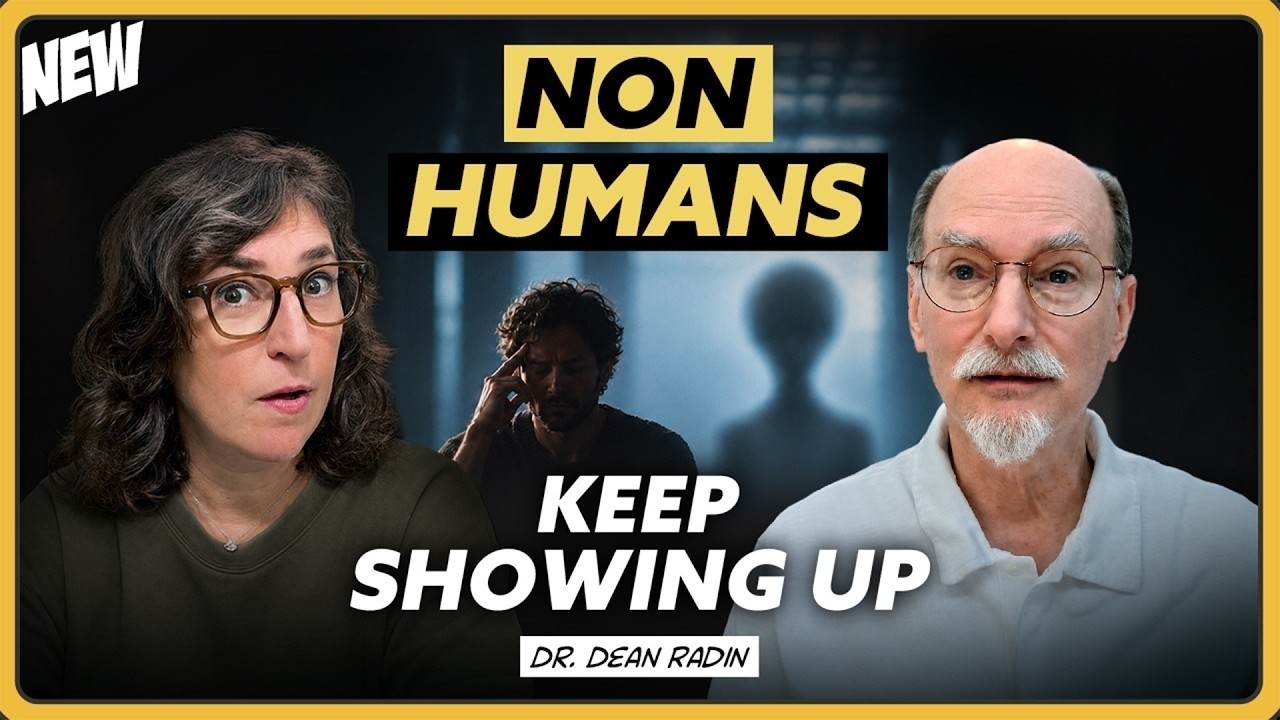
Dr. Dean Radin, chief scientist at the Institute of Noetic Sciences, discusses the scientific study of psychic phenomena — telepathy, precognition, remote viewing, and mind-matter interaction — arguing that these abilities reflect a fundamental interconnectedness of consciousness that mainstream science has historically marginalized but is now beginning to measure empirically.
Noetic sciences and the nature of intuition
Noetic sciences study deep forms of intuition that carry a sense of certainty about information received without known sensory input; William James popularized the term.
Such intuition becomes scientifically interesting when it provides information the person had no prior access to, such as precognition of unexpected events.
Radin emphasizes that uncontrolled psychic sensitivity can be distressing — people email him asking how to stop intrusive telepathic or precognitive experiences — so developing these abilities requires discernment, not just openness.
Meditation is the most accessible training method, but talent has a strong genetic component and a developmental component shaped by family and cultural beliefs; most people can train up to their natural asymptote, while roughly one in a thousand exhibits exceptional ability.
Historical separation of science from “magic”
The disenchantment of the world accelerated during the Enlightenment as empirical methods challenged Church authority; the Black Death undermined faith in prayer as protection, opening space for materialist inquiry.
A historical compromise emerged: the Church retained authority over mind, consciousness, and spirituality, while science claimed the physical world — a division that still shapes Western academic disciplines.
Radin notes this split is culture-bound; in India, cognitive neuroscience professors acknowledged telepathy as real but said it fell outside their discipline, so they wouldn’t study it despite personal belief.
Everything now considered science was once considered magic; the boundary shifts as phenomena become measurable and reproducible.
Scientific resistance and methodological rigor
Parapsychology uses the same methods, statistics, and meta-analyses as mainstream science; the only difference is the hypothesis — a non-materialist ontology — not the epistemology.
Effect sizes in psi experiments (around 0.2–0.3) are comparable to typical social science effects; replication difficulties stem from low statistical power, not the nature of the phenomena.
AI chatbots and Wikipedia reflect mainstream consensus algorithms, not evidence; Radin demonstrates they reverse their “pseudoscience” stance when prompted with specific studies and meta-analyses.
Skepticism is taught in academia; personal experience, not data, most often changes a scientist’s view — as with neuroscientist Christof Koch, who shifted from materialism to idealism after a psychedelic experience.
Telepathy and the Ganzfeld experiments
Early telepathy tests (thought transference, ESP cards) suffered from sensory leakage and memory confounds; methodology improved over decades to eliminate all known conventional signaling.
The Ganzfeld protocol places a receiver in mild sensory deprivation (half ping-pong balls over eyes, red light, white noise) while a distant sender views a randomly selected image or video; the receiver describes impressions over 20 minutes.
Across ~4,700 sessions in ~20 labs, hit rates average 30–32% against 25% chance — odds against chance “a gazillion to one”; selected participants reporting spontaneous telepathic experiences score 45–50%.
Professional magicians were hired to identify loopholes; electromagnetic shielding, acoustic isolation, and quantum random target selection closed them — results persisted.
The data imply a holistic fabric of reality connecting everything across space and time, always present but filtered out by ordinary waking consciousness for evolutionary reasons.
Precognition and presentiment
Precognition appears probabilistic, not fixed; dreams or intuitions may reflect probable futures that can be altered by behavior (Radin’s car accident dream led him to change routes, resulting in a minor rear-end collision instead of the predicted severe crash).
The presentiment paradigm measures unconscious physiological responses (skin conductance, heart rate, pupil dilation) seconds before a randomly selected emotional vs. calm image appears — no one, including the computer, knows the upcoming image.
Over 50–60 replications show the body reacts differentially before emotional images; participants report no conscious awareness, suggesting interconnectedness operates below consciousness.
This implies humans constantly process future-relevant information physiologically but lack conscious access — a potential source of internal conflict and dysregulation.
Remote viewing and the Stargate program
U.S. government interest began in the 1950s, accelerated during the Cold War due to Soviet psi research; Stargate had two arms: operational (intelligence gathering) and research (Radin’s side).
Research questions: Is remote viewing real? Can it be improved? Can talented individuals be identified?
Radin witnessed exceptional viewers (Ingo Swann, Joe McMoneagle) describe distant and future targets in accurate detail — an ontological shock that directed his career.
The program was classified, creating a “schizophrenic” tension for researchers who couldn’t publicly discuss verified results.
Non-human intelligence and contact experiences
Many remote viewers report unsolicited encounters with non-human intelligences during sessions; magical traditions (shamanism, conjuring, invocation) describe similar phenomena across history.
Radin remains agnostic: these reports come from credible people with a long historical record, but they resist laboratory study; he suspects a real phenomenon interpreted through cultural frameworks (angels, aliens, spirits, machine elves).
The “Thunderbird” experience Radin had as a child — a massive eagle that made eye contact — aligns with Indigenous traditions of harbingers; he didn’t feel fear, only recognition.
Openness and belief structure gate these experiences; analytical mode suppresses them, while altered states (meditation, psychedelics, dreaming) allow them to surface.
Global Consciousness Project
Originated at Princeton’s PEAR lab by Roger Nelson; tests whether collective focused attention correlates with deviations in a worldwide network of true quantum random number generators.
Field consciousness experiments showed group coherence (meditators, choirs) produced negentropic (low-entropy) deviations in nearby RNGs.
The GCP formalized this: 500 pre-specified events (predicted like Academy Awards, unpredicted like 9/11) showed cumulative odds against chance of 3 trillion to one.
Interpretation favors dual-aspect monism: mind and matter arise from a common source (unus mundus), so mental coherence induces physical coherence — RNGs are just convenient detectors.
Implications: communities in distress may emit “noise” affecting neighbors; collective prayer or meditation may produce measurable physical effects.
Genetics, therapeutic potential, and future directions
Radin co-founded a company pursuing genetic treatment for dementia; the same genetic approach could identify and modulate psi-related traits.
Hypothesis: genetic editing could temporarily upregulate psychic sensitivity in typical individuals or downregulate it in people overwhelmed by uncontrolled experiences (e.g., diagnosed schizophrenics with veridical precognitive fragments).
The “genetic study to do” is identifying signaling molecules and pathways in individuals who reliably receive non-human intelligence downloads or summon anomalous phenomena.
Radin’s personal site: deanradin.com; IONS: noetic.org; the genetic venture awaits ~$10M for a large-scale exemplar study.