-
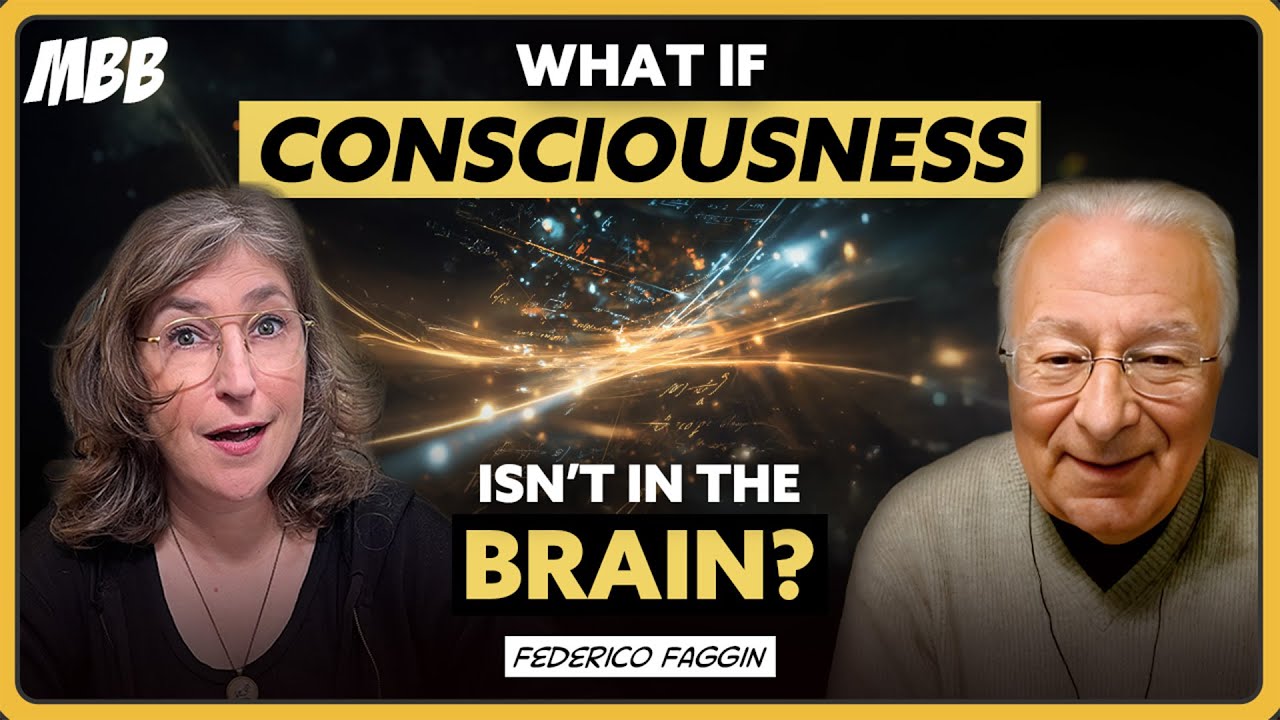
Federico Faggin is a physicist and inventor who created silicon gate technology and the microprocessor—foundations of all modern computing—and later had a spontaneous spiritual awakening in 1990 that shattered his materialist worldview and led him to develop a theory of everything unifying consciousness, quantum physics, and spirituality.
- Before the awakening, Faggin had achieved extraordinary external success: a celebrated career at Intel, founding multiple companies, financial security, and a beautiful family in Silicon Valley—yet he was deeply unhappy, restless, and disconnected from his inner life, always mentally projecting into the future rather than being present.
- He had been studying neuroscience and neural networks to build better computers, and realized that mainstream science was equating electrical and biochemical signals in the brain with conscious experience—which made no sense to him, since signals cannot explain the taste of food, the smell of flowers, or the feeling of touch; this was the “hard problem of consciousness” before David Chalmers formally named it.
-
The spiritual awakening itself was a sudden, overwhelming, fully embodied experience of white scintillating light pouring from his chest, expanding to fill all space, carrying with it an indescribable sense of love, peace, and joy—and revealing that his consciousness was not confined to his body but was everywhere, both observer and observed.
- He experienced thoughts before they became verbalized—a flash of pure insight preceding mental words—something that took him years of meditation to consciously replicate.
- The experience was so vivid, unified, and viscerally real (his body was vibrating and hot) that it carried an undeniable sense of truth more powerful than any dream or imagination, and it completely reversed his prior belief that he was a separate individual.
- He understood afterward that he was a “part-whole” of one totality—like a cell containing the genome of an entire organism, each person contains the full potentiality of the whole universe.
-
From this experience, Faggin developed a theory in which consciousness and free will are the fundamental ontology of reality—not emergent properties of matter—and quantum physics is the mathematical manifestation of that deeper reality, not the other way around.
- He argues that quantum physics is inherently about probabilities, and probabilities only exist for conscious beings trying to predict the future; therefore consciousness is already embedded in the foundations of physics.
- Reality has three inseparable aspects: body (material), mind (probabilistic predictions), and spirit (conscious experience and free will); these overlap like the primary colors combining to form white light, and the center where all three overlap is meaning, love, joy, and peace.
- The universe (“one”) is dynamic, holistic (entangled), and wants to know itself; consciousness is how one knows itself, and free will is the mechanism by which fields (not bodies) make choices that collectively construct the future.
- What we call space-time is a construct created by fields with similar bodies and similar ways of thinking; the deeper reality is a field of meaning and experience that controls the body, not the other way around.
-
Faggin distinguishes between “scientism” (the dogma that only the material world exists and we are machines) and genuine science, and argues that the refusal to recognize interiority is the fundamental problem preventing progress in understanding consciousness.
- He sees love as the force that brings the interiorities of different fields into resonance—making meaning the same across fields—and speculates that from the outside, this force may be what physicists call gravity: the only universal, purely attractive force.
- He argues that competition, racism, war, and environmental destruction are consequences of a materialist, reductionist worldview that sees us as separate bodies in a survival-of-the-fittest framework; cooperation is the natural state once we recognize our fundamental interconnection.
- He does not see himself as special—everyone must have their own direct experience of connection to “one” to truly change, because the weight of ordinary sensory experience is too powerful to overcome through belief alone.
-
Faggin explains that living cells are fundamentally different from computers: cells are quantum-classical information systems that contain the full potential of the organism and are connected to the field that we are, while computers are deterministic switches with no internal connection to meaning or consciousness.
- Each of the 30–50 trillion cells in the human body has the same genome as the original cell that created the organism, giving every cell the same fundamental capacity—a property no machine possesses.
- Cells make decisions that are highly probabilistic and cannot be explained by biochemistry alone; Faggin calls this “live information,” a new category between quantum and classical information that will eventually explain how living systems work.
- Because cells are connected to the field, the field can influence the body in ways that suggest enormous potential for self-healing—but this requires a shift in our understanding of who we are, from body to field.
- He envisions the next evolution of medicine as one that approaches cellular systems as informational rather than purely biochemical, informed by a collective understanding of oneness, consciousness, and free will—moving from outside-in interventions to inside-out healing through love and meaning.
-
Faggin addresses near-death experiences, collective consciousness, and simulation theory from his unified perspective:
- He takes near-death experiences seriously: hundreds of thousands of coherent accounts exist from people whose brains were not functioning, yet who had powerful, life-changing experiences—this is inexplicable if consciousness is produced by the brain.
- Collective consciousness is real: we are “fields of fields of fields,” each level containing the comprehension of all lower levels, like atoms being more than their parts, which are more than their parts.
- He rejects simulation theory: we are not avatars in someone else’s simulation; rather, we are both actors and creators of the reality game we collectively construct through our choices.
- He also rejects the idea of an external creator: he sees himself as self-created, a part-whole of one, indivisible from the totality—more like a holographic principle than a machine built by an outside designer.
-
Regarding technology, Faggin acknowledges that his inventions emerged from intuition and hard work, and that the microprocessor would likely have been invented by someone else—but his spiritual awakening was uniquely his, and it is sourced in the same “one” that is the ground of all existence.
- He warns that technology without a transformed understanding of who we are becomes dangerous: nuclear weapons and AI could destroy humanity if driven by competition and domination rather than cooperation and love.
- The human brain has roughly 100 trillion parameters and runs on 20 watts; GPT-3 has 3 trillion parameters and consumes vastly more energy—and still cannot do what a brain does, especially when the brain is connected to the conscious field that we are.
-
His upcoming book, Beyond the Invisible, goes further than Irreducible by starting with consciousness and free will as the foundational ontology and deriving quantum physics from there—a complete reversal of the approach in his earlier work.
- The book is structured as a conversation and uses the framework of body, mind, and spirit as three inseparable aspects with overlapping regions, where the center—the overlap of all three—is the essence of one: love, peace, joy, and meaning.
- His core message: “We are not matter, we are not mind, we are spirit—that is meaning, love, joy, and peace. If we want a better future, we must all radically change direction together, and to do this, we must first change our minds about who we are.”
-
The hosts reflect that Faggin’s framework provides a scientific foundation for practices like loving-kindness meditation, manifestation, and creating emotional states as if a desired reality has already been achieved—because changing the field (through love, meaning, and consciousness) can literally affect the body and cellular systems.
- They emphasize that hearing these ideas and opening to the possibility of more is itself the first step toward having one’s own awakening experience, as the act of imagining reality differently begins to shift the field.
Science & Spirituality Finally Merge to Explain a New Theory of Consciousness | Federico Faggin
Bialik's Breakdown • • 1h33 → 5 min • #11