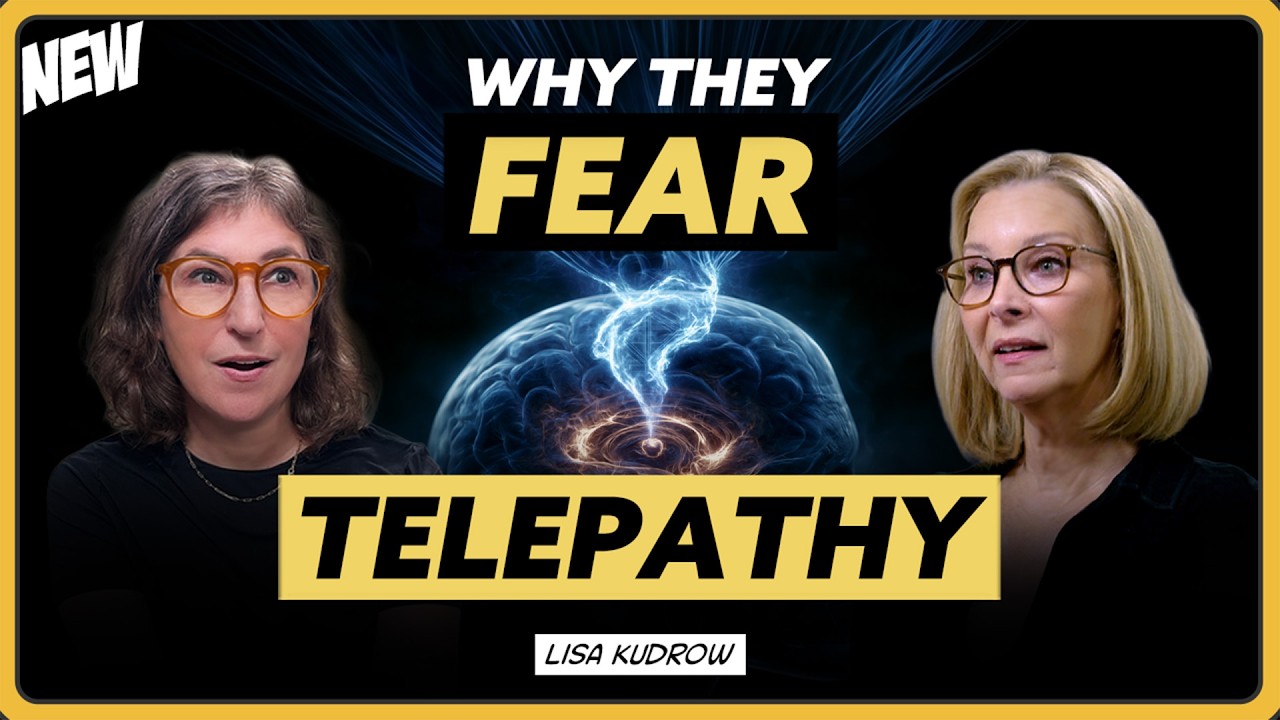
This is part two of a conversation with actor Lisa Kudrow on the Mind Alex Breakdown podcast, hosted by Alic and Jonathan Cohen, covering her creative process, the making of The Comeback, energy healing, psychic phenomena, and the nature of perception and reality.
Characters persist beyond the shows that created them
Kudrow believes characters she inhabited for years still exist somewhere and can be visited in quiet moments, not as a performance but as a kind of ongoing relationship.
She describes bringing back Amy Farrah Fowler for the Young Sheldon finale: the voice and posture returned instantly, but the rhythm felt different without a live audience and laugh track to ride.
The multi-camera sitcom format creates a specific energy — setup, setup, joke, riding laughs, physical turns — that doesn’t translate to single-camera work.
She and Don Reo tried to reboot Blossom as a single-camera series exploring what happens when the perky kid grows up, but were told there was no interest in the character outside a sitcom format.
This reflects a broader cultural reluctance to see women age beyond the “happy ending” — audiences want the fantasy preserved, not unraveled.
The Comeback as a time capsule of television and culture
The Comeback began right after Friends ended (pilot shot November 2004), born from Kudrow and Michael Patrick King’s reaction to early reality TV (Survivor, Amazing Race) which they saw as a civilizational decline.
Season 1 satirized the collision of a desperate actress (Valerie Cherish) with a manipulative reality producer and an abusive showrunner forced to rewrite his “four sexy women in their 40s” show into a Friends clone.
The show had no laugh track or music cues, making viewers uncomfortable — it was a time capsule of workplace toxicity before MeToo forced a reckoning.
Season 2 came a decade later when HBO asked for more; the landscape had shifted to single-camera dramedy, smaller writers’ rooms, and Valerie confronted real stakes (her hairdresser Mickey’s cancer, her marriage fracturing).
The season 2 finale — Valerie leaving the Emmys to be with Mickey as he collapsed — felt like “Pinocchio became a real boy.”
Season 3 (written years later) centers on Valerie landing the lead in a multi-cam written by AI, with writers kept as “beards” and Jim Burroughs directing; it explores the practical limits of AI (hallucination, studio paywalls, need for human judgment) without being simply pro- or anti-AI.
Across seasons, Valerie’s “delusion” is reframed as active reality-creation — a coping mechanism that kept her going, raising the question: what’s the difference between denial and creating your own reality?
Reality TV, writer’s rooms, and the MeToo reckoning
Early reality shows had no union protections or duty of care; Kudrow cites Amazing Race season 1 where a husband screamed at his vomiting wife to eat spicy soup — “and that’s entertainment.”
The Friends writers’ room lawsuit (over language and behavior) went to the Supreme Court and was ruled “par for the course”; at the time Kudrow thought “that’s just a writers’ room.”
MeToo forced workplaces to treat people with respect, though the pendulum swung toward hypersensitivity.
The Comeback deliberately showed Valerie speaking up (e.g., objecting to a Korean barbecue joke) and being dismissed — “you can’t tell writers their joke won’t work; let the audience tell them” — capturing the pre-reckoning dynamic.
We create our reality — perception shapes physiology
Kudrow and the hosts discuss Ellen Langer’s research: chambermaids told their work was exercise lost weight and improved health markers without changing behavior; elderly men immersed in a 20-years-prior environment showed measurable physiological rejuvenation.
Langer’s work (1970s) demonstrates that perception of surroundings changes physiology — “mindfulness” as active noticing, not meditation.
Kudrow’s husband has long held that “we can control a little more than we thought we could” and thoughts have impact; she initially resisted (e.g., “why do you want to get sick?” feels punishing when ill).
She now distinguishes: it’s not that you wanted illness, but “what had to happen” — and “when it’s your time, it’s your time” (for figuring things out, waking up, releasing self-punishment, or death).
Doubt is momentary; the key is trusting you’ll know when to apply effort, and that “it turns out okay” more often than not.
Reiki and energy healing — a personal lineage
Kudrow’s entry into Reiki came through family crisis: her sister (fibromyalgia, wheelchair-bound) and brother (traumatic brain injury from a car accident) were both severely ill.
Her sister transformed through psychosomatic work, yoga, and diet — eventually backpacking the world — and introduced Kudrow to Reiki at 17 after a toaster burn: sister cupped her hands, blisters receded in minutes.
Kudrow took a Level 1 class (four days, reluctantly), felt undeniable pulsing/heat in her hands on the final day while treating a woman, and spent the next four years practicing intensively, assisting classes twice monthly.
She witnessed consistent patterns: emotional catharsis (screaming, crying, pain arising and dissipating) across diverse recipients, and learned distance healing — “the field around them” carries the same information.
The mechanism: practitioner becomes a channel for universal energy; the recipient’s body expedites its natural healing toward equilibrium.
Kudrow notes the scientist’s caveat: pulsing could be from injury, blisters may not have been as extreme as remembered — but the anecdotal consistency across hundreds of sessions was compelling.
Her father (a scientist) valued placebo: “40% effective — same as many medications. No one studies it.”
Kundalini, meditation, and nervous-system regulation
Kudrow practices Kundalini yoga: repetitive movements, breathwork, somatic activation, a palpable pulse — “all the same thing,” different paths to connection with source/awe.
Breathwork (box breathing, walking meditation, transcendental) helps with anxiety, but what works varies wildly by person.
For some, the remedy is cognitive: remembering there’s guidance, purpose, non-randomness — that a challenge doesn’t mean “never work again” or “never love again.”
Boundaries, empathy, and emotional porousness
The hardest skill: distinguishing what’s yours to carry from what belongs to others — “if your name’s not in the sentence, it’s not your problem” (Al-Anon framing).
This doesn’t mean not caring; it means supporting without entanglement — critical as a parent, friend, or child of aging parents.
Porous physiology: taking on others’ chaos impacts immune function and healing.
Kudrow’s trigger: being lied to or manipulated unskillfully — triggers a “whole circuit” of rage, fantasies of retaliation, which never resolves anything.
The shift: recognize it’s their thing — they’re protecting themselves, advocating for themselves poorly — and hold an energetic boundary: “I can’t help you with that, but I understand.”
Host Jonathan admits he struggles with people being factually wrong; Kudrow counters: “How do you know what’s rational after what we’ve been talking about?” — sometimes the “obvious” solution isn’t wanted or ready to be received.
A spontaneous remote-viewing experience
Kudrow describes one exhausting, successful episode: husband camping in Joshua Tree (she knew this); she bathed, focused attention on “being with Michelle” (him), and perceived him outside a structure on Adirondack chairs at a fire pit.
She dismissed it as imposition (knew he was camping), but he returned saying Friday night they’d gone to a restaurant, sat on Adirondack chairs at a fire pit smoking cigars — not camping.
Multiple specific details matched (chairs, fire pit, structure, extra person, laughter); hosts note this exceeds chance.
Kudrow hasn’t repeated it — too taxing; hosts suggest “allowing it to come” vs. “forcing the going” reduces effort.
Recommended resource: How to Read the Akashic Records — intentional opening to a library of information, curious wandering rather than targeted travel.
Children, animals, NDEs, and non-ordinary perception
Host Jonathan’s son saw a terrified boy in his room; Jonathan later corroborated the presence — the boy “couldn’t get out.”
Kudrow’s younger son sensed “darkness in the house” — not physical darkness, something he picked up on.
Children’s symbolism may be literal, not cute misinterpretation — “what if they knew exactly what they meant?”
Tara Brach’s episode: saw her deceased husband at the foot of her bed; as a clinician, she’d previously recommended institutionalizing people reporting such experiences — her worldview had to collapse.
Vinny Tolman (NDE experiencer): dead two hours, zipped in body bag, revived by an EMT who defied orders; returned with ability to communicate with animals — their traumatized rescue dog (terrified of men) walked to him, made eye contact, and he received: “You were hurt, so you’re here to heal people.”
Rupert Sheldrake’s morphic resonance and animal telepathy cited — deep bonds with aging animals suggest non-verbal exchange.
Telepathy, the “four claires,” and language as primitive
The “telepathy tapes” and non-speaking autistic individuals communicating via letterboards suggest telepathy is real — intentions felt more directly than spoken language conveys.
The four claires: clairvoyance (seeing), clairaudience (hearing), clairsentience (feeling), claircognizance (knowing) — Kudrow identifies with claircognizance.
Spoken language is “fire compared to what communication probably can be” — Kudrow’s childhood realization (pre-verbal until nearly three): watching adults talk past each other, missing intentions, thinking “you get dumber as you get older.”
She made a pact to remember that insight — “just remember this thought” — and sees her role now as English-to-English translation, helping people actually hear each other.
A worldview of “why not?” — openness over shutdown
Kudrow’s stance: even if none of this is “real,” why shut it down? What’s at risk? Institutions (especially academic) suppress it; people fear shunning, grant loss, publication barriers.
Retirees often speak freely — “too old to give a damn.”
“Why not?” makes life more fun — a choose-your-own-adventure where meeting people in their world (improv “yes, and”) creates connection without invalidating your own.
Kudrow has glimpses of what’s next (“maybe or maybe not”), recognizes them only in retrospect — “everybody has that, you just don’t pay attention.”