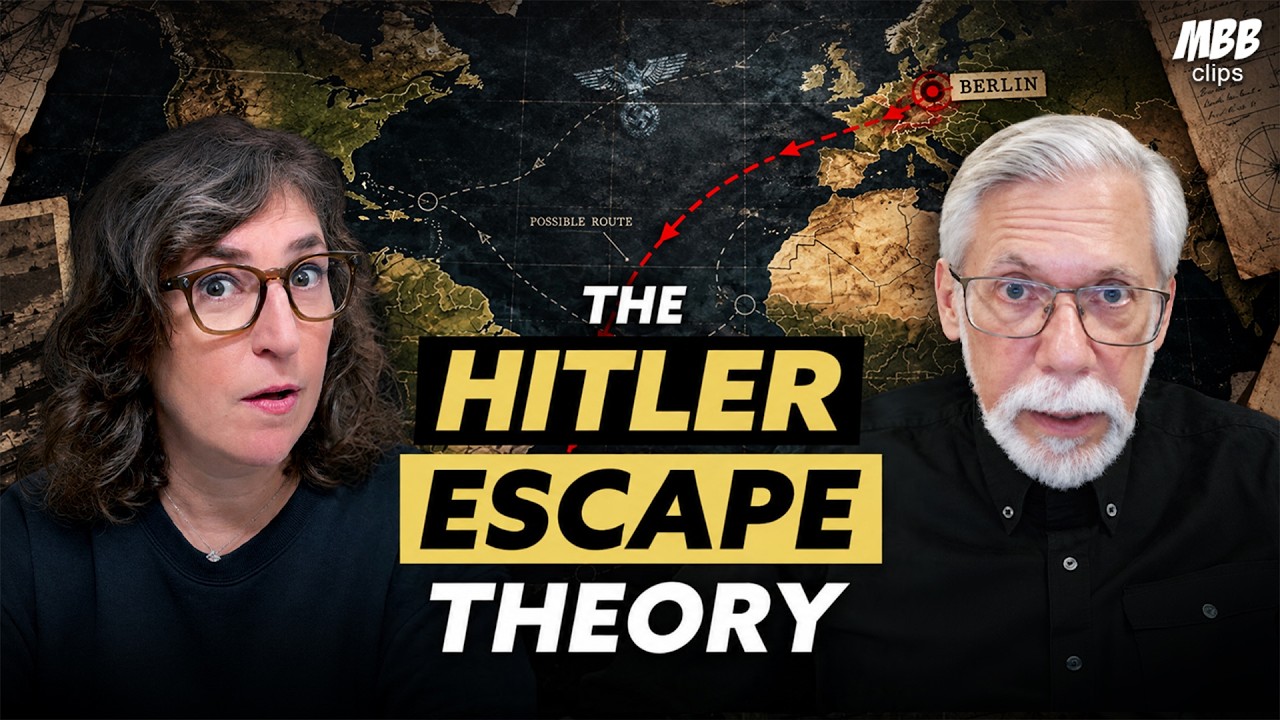
Peter Levenda investigates the persistent theory that Adolf Hitler did not die in the Berlin bunker in April 1945 but instead escaped, possibly to Indonesia, drawing on his own archival research, Soviet records, dental and forensic evidence, witness testimony, and a trail of Nazi personnel and gold movements.
The standard narrative and its weak points
The accepted story holds that Hitler committed suicide in the Führerbunker on April 30, 1945 (Walpurgisnacht), and his body was burned with kerosene in a makeshift cremation outside the bunker.
Levenda initially accepted this account until graduate research in Indonesia exposed him to detailed local claims, German-language documents, and witness testimony suggesting Hitler lived out his life in Surabaya.
The only primary physical evidence for the suicide comes from the Soviets, who reached Berlin first and controlled the bunker site, the remains, and the initial witness interrogations.
Cremation with only kerosene in an open pit would have been far too cool and brief to destroy a body completely; significant dental and bone fragments would remain, which the Soviets claimed to have recovered.
Dental evidence raises questions
Hitler and Eva Braun each had two full sets of dentures made roughly a month before Berlin fell, an unusual expenditure of time and resources during the final collapse.
The dentist confirmed making two sets for each; one set could have been planted as false evidence while the other traveled with the escapees.
Soviet dental identification relied on these records, but the duplicate sets undermine the certainty of the match.
The skull in the KGB archive is not Hitler’s
An archaeologist colleague of Levenda’s examined the skull kept at former KGB headquarters in Moscow after the Soviet collapse and immediately identified it as a woman’s skull, with a bullet hole in the top of the cranium.
He reportedly removed a small fragment, conducted DNA analysis in the United States, and confirmed it matched neither Hitler nor Eva Braun.
Soviet records show SMERSH/KGB units repeatedly exhumed and reburied the bunker cremains across East Germany for years, finally interring them under a parking lot at their East Berlin headquarters.
In 1970, Yuri Andropov ordered the remains dug up, pulverized further, and thrown into a river — yet a skull later appeared in the KGB archive with no documented provenance.
Witness testimony from the bunker is contradictory
Soviet, British, and American interrogators each questioned different survivors from the bunker staff (fewer than ten individuals total).
Their accounts diverged on the method of death (gunshot vs. cyanide), the timing, the location within the bunker, and the handling of the bodies.
No consistent narrative emerges across the three Allied intelligence streams.
Walter Hewel (“Surabaya Wally”) links the bunker to Indonesia
Hewel was one of the last people to leave the bunker, a veteran of the 1923 Beer Hall Putsch who spent the interwar years in the Dutch East Indies (Indonesia) organizing the local Nazi Party branch.
Photographs document active Nazi Party cells in Batavia (Jakarta) and other northern Indonesian cities during the 1930s.
Hitler recalled Hewel to Germany in 1933, nicknamed him “Surabaya Wally,” and kept him close — reportedly because he could stay awake during Hitler’s marathon monologues.
Hewel’s reported suicide in Berlin lacks a body; the site was bombed and no remains were recovered.
A plausible escape route: Hanna Reitsch’s flight
Days before Berlin’s fall, famed test pilot Hanna Reitsch landed a light aircraft near the Chancellery despite heavy bombardment and Soviet encirclement.
She met with Hitler and departed; the plane had capacity for a passenger, and the flight corridor she used was considered impassable by Allied intelligence.
Levenda considers it plausible Hitler could have left on that flight, though he personally prefers the suicide narrative.
High-level disbelief in Hitler’s death
Stalin told Roosevelt he believed Hitler was still alive.
J. Edgar Hoover maintained an active FBI file on Hitler sightings in South America for years after the war.
Levenda notes the South America route was risky (Eichmann’s capture proved Nazis could be found), whereas Indonesia had virtually no American intelligence presence and only a small OSS operation focused on Japan.
Sustained submarine traffic between Germany and Indonesia
Throughout the war, German U-boats shipped raw materials (including uranium) and munitions to Japanese-occupied Indonesia, and returned with strategic commodities.
One captured U-boat carried a disassembled Messerschmitt fighter and uranium oxide destined for Indonesia — a matter of public record.
This established a proven, secure logistics pipeline that could have transported personnel late in the war.
A Hitler lookalike and a suspicious diary
Levenda physically examined a diary purported to be Hitler’s, kept in Indonesia; he judges it a forgery but notes it belonged to a wanted war criminal who vanished after the war.
The diarist’s passport photo closely resembles young Hitler (World War I era): same birth year, both Austrian, near-identical facial structure.
The diarist was married to a blonde woman resembling Eva Braun, creating a plausible decoy couple that could have seeded the suicide narrative.
Nazi gold shipments to Southeast Asia after the war
During the Clinton administration, U.S. records confirmed 40 metric tons of Nazi gold were shipped to Macau in the late 1950s.
Half remained in China; the other 20 tons went to Jakarta, Indonesia — aligning with the escape and lookalike evidence.
The overall picture remains deeply ambiguous
Every pillar of the official account — forensic remains, dental records, witness consistency, chain of custody for the skull, and the absence of an escape route — has significant gaps or contradictions.
The Indonesia connection (personnel, submarine logistics, Nazi Party infrastructure, gold, and a physical double) forms a coherent alternative that has never been seriously investigated by Western intelligence.
Levenda stops short of asserting Hitler survived but concludes the evidence is “very muddy” and the suicide narrative is far from proven.