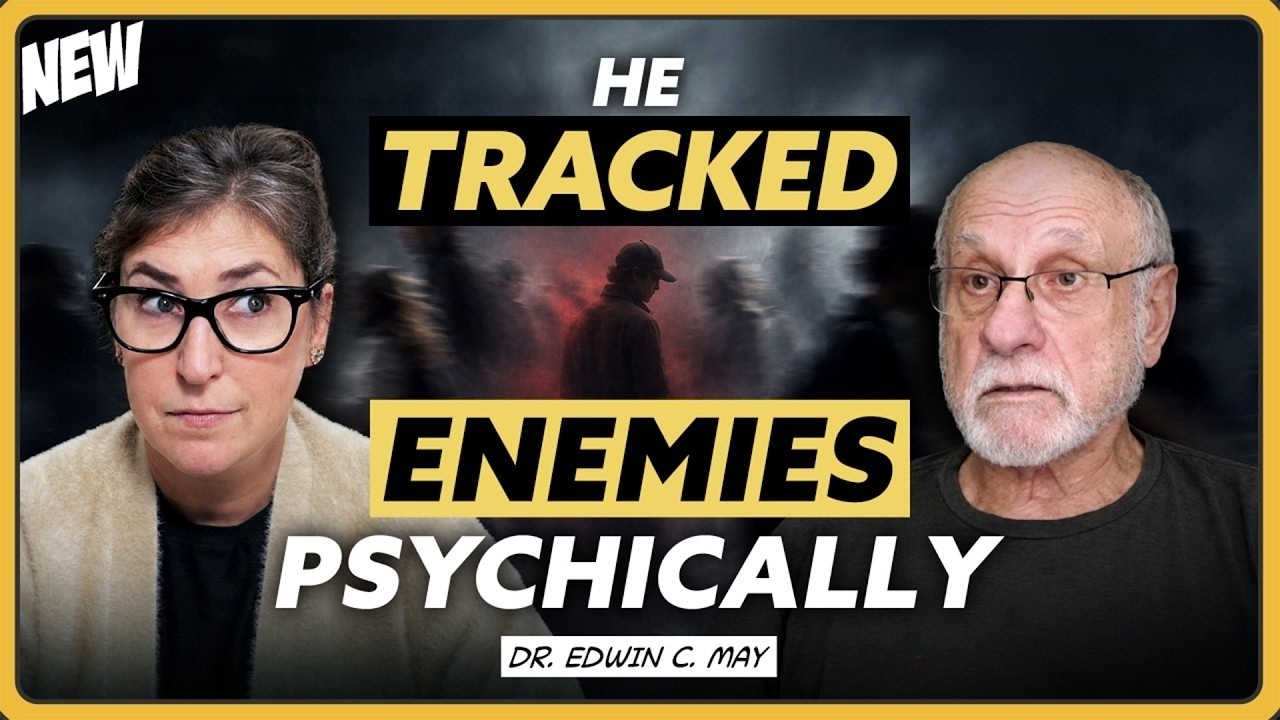
Dr. Edwin C. May, a physicist turned parapsychologist, spent 20 years (1975–1995) as a lead scientist in the U.S. government’s Stargate program, which used remote viewing — a form of precognition — for intelligence collection across 19 federal agencies; he argues the phenomenon is real, measurable, and rooted in physics and neuroscience, not mysticism, and that only about 1% of the population demonstrates reliable ability under controlled conditions.
Dr. May’s Path from Physics to Parapsychology
At 35, as a postdoc at UC Davis, May attended a talk by Robert Monroe on out-of-body experiences, tried and failed to replicate it, then later heard Charles Honorton present ESP as science; Honorton became his mentor and drew him into the field.
May joined the Stanford Research Institute (SRI) program in late 1975 after seeing compelling data from Pat Price, a Burbank police chief who used psychic ability to identify kidnappers from mug shots; Price later worked directly for the CIA but was found passing classified data to the Church of Scientology.
The Stargate Program: Scope, Mandate, and Secrecy
From 1975 to 1995, the intelligence community tasked the program with over 500 missions across 19 agencies (NSA, CIA, State Department, DEA, FBI, NASA, etc.); 17 of 19 agencies returned with new missions, including the CIA with 41 separate requests.
The program was kept entirely secret; early on, researchers were forbidden from doing basic science and told to “continue your spying activity.”
A key driver was fear of Soviet progress: Russian scientist E.M. Kogan claimed in 1969 to have a model of telepathy (10 Hz brainwave carrier), which alarmed the West; May later told Kogan his model was wrong — telepathy cannot exist, only precognition.
Practical missions included: locating tunnels under the Korean DMZ, assessing threats from China and Cuba, interdicting drug-smuggling boats off California (171 missions post-Cold War), and assisting law enforcement — e.g., Joe McMoneagle pinpointed a murder victim’s body within 30 feet.
The Science: Entropy, Precognition, and Why Telepathy Is Impossible
May’s core hypothesis: ESP is a sensory system that responds to change — specifically, the gradient of Shannon entropy of the target system; when entropy changes, the signal strengthens.
He argues telepathy is logically impossible: if you guess a number I’m thinking of, and I die before telling you the answer, you cannot read my mind; but if I later reveal it, you could have used precognition to access the future answer — thus all “telepathy” is actually precognition.
Precognition works by “peeking into the answer book” before it’s written: a viewer describes a photograph that will be chosen tomorrow, accessing future information that doesn’t yet exist in the present.
The physics problem: how information travels backward in time (quantum retrocausation); the neuroscience problem: how it enters the brain; May’s team uses diffusion tensor imaging (DTI) to measure white-matter neural pathway density as a potential biomarker for ability.
Remote Viewing in Practice: Protocols, Recruitment, and Individual Differences
No single protocol works for everyone: five top viewers at a 1990s meeting all used different methods — dreaming, automatic writing, stimulus-response, out-of-body, analytical sitting — confirming “individual differences” are fundamental.
Recruitment: tested groups like Mensa, SRI staff; one skeptical arms-crossed participant scored highest in second-round testing; intelligence or analytical tendency hinders performance (like overthinking a golf swing).
May estimates ~1% of selected populations show verifiable lab ability; possibly up to 10% if sampling were broader.
Unconscious psi use is common: May recounts driving to meet a friend an hour late, only to find the friend had been detained and unable to contact him — his “unconscious sigh ability” maneuvered the timing.
Accuracy Statistics, Bit Rate, and Fundamental Limitations
Joe McMoneagle, one of the best: 44% hit rate over 1,500 trials (chance = 20% with 5-choice judging); figure-of-merit metric (accuracy × information density) predicts experimental success reliably.
Bit rate is extremely low: winning a lottery would require ~50 continuous hours of psychic effort; Angela Ford made $8,000 in a binary-option market but failed replication due to boredom and fatigue.
Fatigue, novelty loss, and repetition degrade performance: viewers cannot sustain output; Ford “could not remote view her way out of a paper bag” on a second run.
Monks meditating 30 years show no better psi performance than novices — only less anxiety; meditation does not improve remote viewing.
Why Training Fails and the “Ingo Swan Cult”
Ingo Swan developed a rigid training protocol (“structure is all that matters”); SRI rejected it — content matters, not structure — but it leaked and spawned a lasting “cult” that still distorts the field.
May: “You cannot train a natural ability” — like high jumping, coaching helps only to a genetic ceiling; millions in tax dollars failed to train military officers.
Joe McMoneagle’s book Remote Viewing Secrets contains only “what not to do”; top rule: don’t worry — but anxiety is trait-like, not easily trained away.
Julia Mossbridge’s claim that anyone can learn is “full of it” per May; he prefers skeptics over believers because skeptics improve the science.
Materialism, Consciousness, and Survival After Death
May identifies as a staunch materialist: he quantifies psi with hard science (statistics, physics, neuroscience) — that is materialism.
He does not believe in survival after bodily death; his Indian philosopher/psychologist colleague agrees.
Near-death experiences: a $5M study found they are standard neurophysiological procedures, not evidence of survival; May is comfortable with death as “last breath… like going to sleep.”
Acknowledges puzzling cases (e.g., a man revived after two hours in a body bag who reported veridical observations), but maintains materialist framework.
Why the Program Ended and What Remains
No active government program currently exists; May hopes he’s wrong but thinks it’s accurate.
The capability is valuable: more intelligence reduces war likelihood (e.g., Iran scenarios); agencies returned because it solved problems they couldn’t otherwise.
May (86) wants to live long enough to see the mechanism solved; sees entropy as key — possibly linking to Erik Verlinde’s entropic gravity theory and retrocausation.
Spontaneous remote viewing happens naturally: Lisa Kudrow, never trained, accurately viewed her husband’s changed plans (cigars, fire pit, building) while “sending awareness” — May says “we all use remote viewing whether you’ve heard of it,” and some have stronger natural access.
The challenge remains: a natural human ability, real and measurable, but rare, fragile, and not yet understood — waiting for physics and neuroscience to catch up.