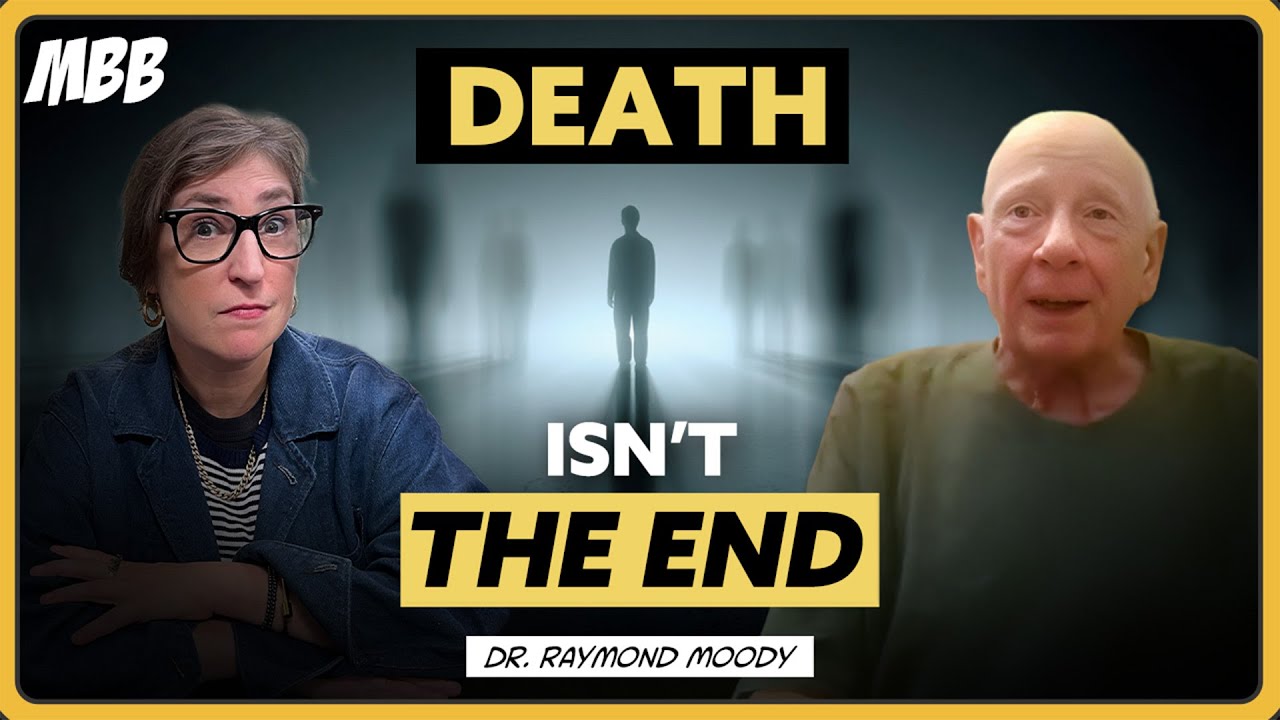
Dr. Raymond Moody is the physician who coined the term “near-death experience” in 1975 and has spent 50 years studying consciousness, death, and the afterlife. Originally a philosophy professor who studied Plato, he later became a psychiatrist. He argues that the “veil” between life and the afterlife is breaking down, that rational proof of an afterlife is within reach, and that the real barrier is no longer logical but psychological — people are intellectually lazy and prefer comforting stories to rigorous thinking.
Near-Death Experiences: Core Features and Common Aftereffects
People who have NDEs report a remarkably consistent set of experiences and emerge with similar transformations:
Common elements of the experience itself:
A life review where one’s entire life flashes before them, sometimes like a montage or like browsing album art
A sense of timelessness — feeling like they were gone for a long period when only minutes passed
360-degree vision and heightened senses, including overwhelming colors
The ability to travel through space unbound by the physical body
Receiving instantaneous answers to questions — a “download” of information
Encountering a bright light associated with love and understanding
Meeting deceased relatives
The experience is often described as ineffable — words cannot capture it
Common aftereffects:
Loss of the fear of dying
A deep understanding that love is central to existence
A universal sense of connection with all things
A new appreciation for learning and knowledge
A feeling of control over one’s own destiny
A focus on small things as sources of great joy
A difficult re-entry or transition period back to normal life
Some people return with psychic or extrasensory abilities
The George Ritchie Case: An Exceptional Out-of-Body NDE
Dr. Moody considers the 1943 case of Dr. George Ritchie to be the finest NDE he has ever encountered:
Ritchie, a soldier with pneumonia and a 105-degree fever at Camp Barkley, Texas, got out of bed and saw his own body still lying there
He traveled in his consciousness to Virginia to see his mother, stopping first at a town he’d never visited
He was declared dead twice — a sheet was placed over him, but a technician noticed movement; the doctor overruled the tech both times
Years later, on a bus to Richmond, he stopped at Vicksburg, Mississippi — the same town he’d visited while out of body — and accurately described the geography and a diner to a companion who tested him by asking what was around each corner
He also became psychic after returning
Shared Death Experiences and Deathbed Phenomena
Bystanders at the moment of someone else’s death frequently have experiences identical to NDEs, despite being healthy and uninjured:
They report rising out of their body and traveling partway toward the light with the dying person
They see apparitions of the deceased person’s dead relatives entering the room to guide them away
The room fills with light
Some bystanders empathically co-live the dying person’s life review
Moody’s own experience: When his mother was dying, the space he was in seemed to “bend,” and he heard her say “I love you” twice without her mouth moving. His wife had a separate experience, and his sister felt the presence of their father who had died 18 months earlier.
Other deathbed phenomena people report:
A mist rising from the body at the moment of death (white or pink)
Hearing music, sometimes described as a choir of young girls singing
Parallel dreams are another phenomenon: two people simultaneously dreaming the same event from different perspectives. Moody and his then-wife both had the same graphic dream about losing their baby — his from the observer’s perspective, hers from the mother’s perspective. The baby was stillborn. This raises the question of whether the dream revealed what was already going to happen or somehow participated in creating it.
The Psychomantium: A Modern Oracle of the Dead
Moody created an experimental setup inspired by ancient Greek “oracles of the dead” — subterranean chambers where people would go to commune with deceased relatives:
The Greek originals: Five main sites existed in ancient Greece. The most famous, excavated in the 20th century, featured an underground chamber with an enormous bronze cauldron surrounded by a gallery. People would stay for 29 days before entering the apparition chamber.
Moody’s modern version: A dark, comfortable room with a mirror positioned so the sitter cannot see their own reflection — they appear to gaze into infinite space. A small light source diffusely fills the room. Ed Mitchell (Apollo 14 astronaut) noted this creates the “sheen” quality of actual outer space.
Protocol: Moody spent a full day with each participant, discussing the deceased loved one — memories, unfinished business, relationship difficulties — before placing them alone in the room for 90 minutes.
Results: Moody expected maybe 1 in 10 would have an experience. Instead, 8 out of 16 (50%) saw the dead person they were seeking. Many saw someone unexpected — one woman seeking her husband instead saw her father, who stepped out of the mirror into the room. About 10% saw no one during the session but encountered the person later at home. Participants were graduate students, counselors, and professionals — mentally stable seekers. Many other researchers have replicated the study with similar results.
Key insight: “If we’re opening some portal, it doesn’t mean that the person that you want to come through is going to come through.”
The Philosophical Foundation: Why the Greeks Matter
Moody’s entire framework begins with ancient Greek philosophy, which he sees as the origin of all Western rational inquiry into the afterlife:
Plato’s Republic culminates in the story of a soldier who revived at his funeral and described leaving his body, passing through a passageway, and having his life reviewed
Parmenides, the founder of deductive logic, developed the concept of “truth” — that which is the case independently of what anyone perceives or believes — in connection with the oracles of the dead
Moody argues that deduction itself (if A > B and B > C, then A > C) has a quality of truth that seems to come from “the other side”
The oracles of the dead were known to every major Greek philosopher, including Democritus the atomist, who interpreted the experiences as biological activity continuing at the atomic level even when invisible
Moody criticizes modern parapsychology and psychical research as ahistorical — they trace their origins to 1848 and the Fox sisters cracking their toes, not to the Greek philosophical tradition
Moody’s Breakthrough: The Unintelligibility Axis and a New Logic
Moody claims to have solved what David Hume identified as the core problem: proving the immortality of the soul requires “some new species of logic” and “some new faculties of the mind”
The problem with current NDE research: People describe NDEs using a travel narrative format (“I left my body, went through a tunnel, entered a light”), but they also say the experience involved no time, no space, and no words. The travel narrative format is therefore inherently inadequate — it forces an ineffable experience into a framework that distorts it.
The “unintelligibility axis”: Moody has worked out a new logic that takes seriously the fact that some experiences are genuinely unintelligible in conventional terms — and that this unintelligibility itself can be studied and understood rationally. He calls this “nonsense logic.”
His upcoming book Swan Song: Just completed, it presents this new logical framework. It has attracted interest from people in advertising, literary studies, business, and intelligence work (including individuals connected to NASA’s Saturn V program).
Why it won’t be popular: The “afterlife establishment” — parapsychologists, psychical researchers, and the skeptical/humanist movement — are invested in hearing inspiring stories and in scientism (the belief that science is the only rational means of securing knowledge). Moody argues scientism is itself a circular, self-contradicting belief system, not a rational position. The afterlife question is not yet a scientific question.
Moody’s challenge to critics: He invites people to find errors in his logic. If they can, he’ll be closer to truth. If they can’t, it suggests he’s on the right track.
Moody’s Personal Journey and Legacy
Moody came from a law enforcement family and was originally drawn to medicine out of fascination with homicide and forensic pathology. He pursued philosophy first (PhD from University of Virginia), then medical school (College of Georgia), then psychiatry.
He describes himself as having been destroyed by ego — specifically jealousy — and now sees life as service to others. He is “finished with ego” not through spiritual achievement but through the painful experience of nearly killing himself with it.
He sees his legacy as discovering that “unintelligibility is an intelligible phenomenon” — that nonsense has a logic, and that this opens an entirely new way of rationally investigating the afterlife.
He believes we are on the verge of a breakthrough in understanding consciousness and the afterlife, but it will require people to do something most Americans are unwilling to do: think carefully through material that is normally boring to them.