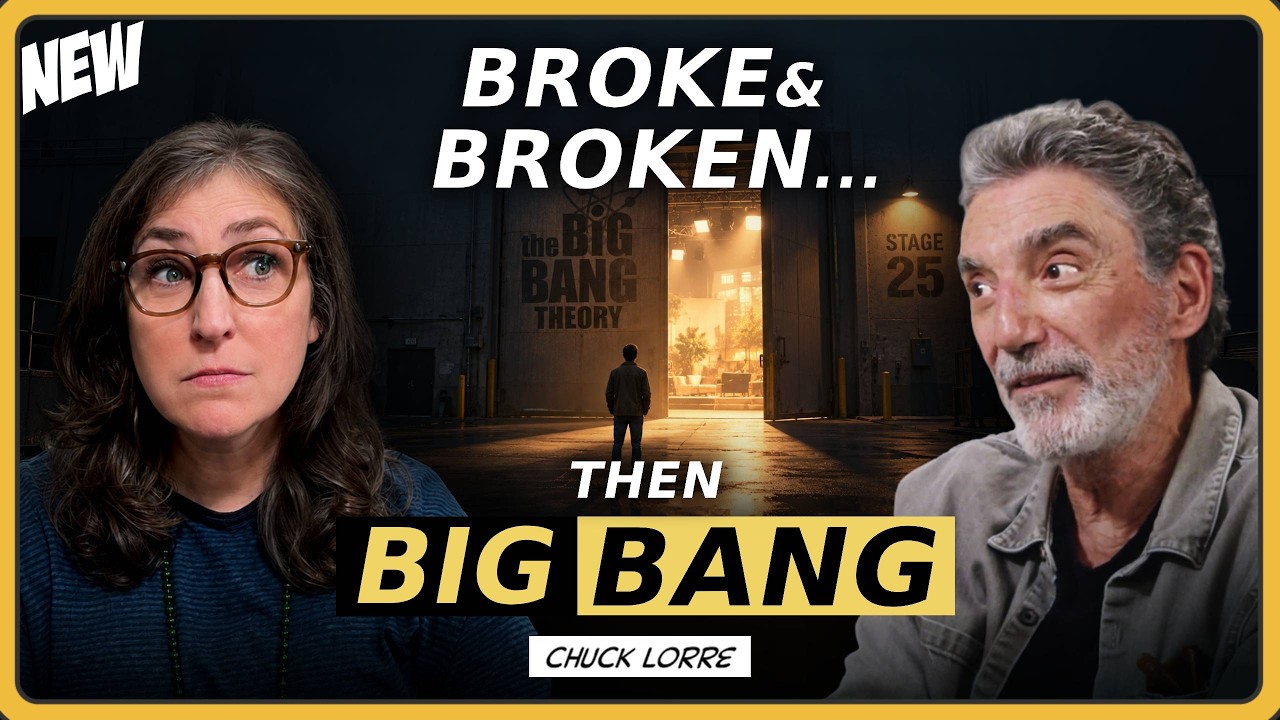
Chuck Lorre, creator of The Big Bang Theory, Two and a Half Men, Young Sheldon, Mom, Dharma & Greg, and other hit sitcoms, sits down with hosts Balik and Jonathan Cohen to discuss his memoir Sitcom: A Memoir, tracing his path from a fearful, addiction-prone childhood on Long Island through a failed music career, a decade in Scientology, and into television writing—where he built a multi-show empire while battling alcoholism, high-profile cast conflicts, and the emotional toll of success.
Childhood and family origins
Lorre grew up on Long Island with a mother whose anger and resentment could twist any benign comment into hostility—“Isn’t it a beautiful day?” met with “Isn’t it sad they’re all not like this?”—a dynamic he later channeled into Holland Taylor’s character on Two and a Half Men (“my mother with money”).
His father, a Jewish Republican who worked six days a week running a luncheonette, had one night off: Sunday, reserved for The Ed Sullivan Show, exposing Lorre to every great Borscht Belt comic and shaping his comedic sensibility.
He describes himself as a kid with “low self-esteem combined with arrogance”—the “piece of shit at the center of the universe” syndrome—driven by a desperate need to escape poverty and prove he could write a song that would lift him out.
Music, addiction, and Scientology
Lorre started drinking at 10–11 via NyQuil (then ~25 proof), graduated to the liquor cabinet, and used substances not for transcendence but for annihilation: “My goal was to wipe myself out, at which point I’d be comfortable.”
At 14–15, a colonoscopy without anesthetic in front of medical students at Cedars of Lebanon (a teaching hospital) became a formative humiliation he later recognized as preparation for show business.
In his 20s, touring with a cover band, a saxophonist introduced him to Scientology via a “communications course” promising better communication skills; he “drank the Kool-Aid,” signed the billion-year Sea Org contract (predicated on belief in immortal spirits and reincarnation), and stayed ~10 years.
He left when poverty—two kids, no health insurance, no steady income—made clear the organization’s promises (freedom from illness, divorce, accidents) weren’t materializing; he and his wife were excommunicated, losing their entire social world, but “nobody chases you when you’re broke.”
Break into television writing
Desperate for income, Lorre went door-to-door selling FM radios; a bad day led him up a dark stairwell above a hair salon to DIC Animation, where he bluffed his way into a freelance script for Heathcliff (“An Officer and an Alleycat”) after reading Syd Field’s Screenplay overnight.
He wrote 2–3 scripts a week, got hired on staff, then moved to Marvel Animation; along the way he co-wrote the Teenage Mutant Ninja Turtles theme song in an afternoon with guitarist Dennis Brown, recorded at midnight–8 a.m. on Journey’s amps, singing the sped-up turtle voices himself.
When the show exploded, he and Brown were bullied in a Century City office by suited executives who refused VHS and Nintendo royalties, threatened to scrub their music from 100+ episodes, and bluffed them into signing away rights—a moment that echoed the Scientology pressure tactics.
Prime time and the Writers Guild
Lorre targeted prime time solely for Writers Guild membership: health insurance for his kids and residuals—“magic” money that arrived when a script re-aired.
First prime-time credit: Charles in Charge ($5,000 script fee, exactly the Guild initiation fee); he wrote specs at night (Golden Girls, Miami Vice with a Weiss/Vice pun) and landed My Two Dads, Webster, Facts of Life.
He credits Mad Magazine and Borscht Belt farce for his comedic DNA; the Turtles theme’s “heroes in a half shell” tapped a kid’s fantasy: teenager (empowered) + mutant (ugly is okay) + ninja (power).
Dharma & Greg: a different kind of female lead
After years of “angry, sarcastic, malicious” female leads (Roseanne, others), Lorre asked: “Can I create a female lead who’s loving, joyful, life-affirming—and would she be funny?”
Dharma (Jenna Elfman) fed strangers’ parking meters; the tension with straight-laced Greg (Thomas Gibson) became the engine; the show also let him write “old Jewish hippies,” which “was not a stretch.”
Alcoholism and sobriety
Success did not cure his alcoholism: “The American dream was a lie. It didn’t solve the problem of being me.” Drinking escalated from social lubricant to solitary isolation.
In 1999, reading a trade article by a writer he admired who called himself a “functioning alcoholic” gave him the language to recognize himself; that writer “Eskimoed” him into recovery.
He never wrote drunk—“you write drunk, you regret”—but wrote maniacally then celebrated; sobriety reverted his emotional age to ~14 (when he started drinking), forcing him to process loneliness, grief, boredom, and horniness without anesthetic.
He entered his second marriage with that 14-year-old’s emotional maturity; later, seeing Anne Bancroft laugh uproariously at Mel Brooks’s work made him sad—his own partner didn’t find him funny, so he compartmentalized work and relationship.
Two and a Half Men and the Charlie Sheen crisis
The show launched as a “dream”: perfect cast (Sheen, Cryer, Angus T. Jones, Holland Taylor, Conchata Ferrell), massive ratings, genuine fun.
By year 8, Sheen’s addiction unraveled; Lorre admits he “purposely put blinders on,” had no training to handle a star in crisis, and feared Sheen would hurt himself or others.
When Sheen left and went on the “Tiger Blood” media tour, Lorre had “no skills or understanding how to deal with this”—it was “cunning and baffling,” daily for years.
The Big Bang Theory set became his safe harbor: “We felt like you had two kids and one was misbehaving. We wanted to be the kid that wasn’t misbehaving.”
He and Sheen eventually reconciled; Sheen guested on Bookie as a degenerate gambler, and Lorre woke up one day realizing “the anger and the hurt and the grief and the strain of it all is gone. It happened to another guy.”
The Big Bang Theory: process, audience, and culture
The unaired first pilot had a different female lead (Katie, played by Amanda Walsh); Lorre recast with Kaley Cuoco (Penny), and the show clicked.
He insists on live studio audiences for every episode: “Comedy makes you laugh out loud. If you’re not laughing, it ain’t comedy.” Even VFX-heavy scenes were played back for a live audience to capture real laughter.
A bad episode risks permanent viewer loss; this fear made him “maniacal” about fixing scenes—sometimes staying late, sometimes reshooting a week later.
The writers’ room was deeply collaborative (Steve Molaro, Steve Holland, Eric Kaplan, Maria Ferrari, Tara Hernandez, etc.); Lorre’s “secret sauce” is trusting his own involuntary laughter: “Laughter is involuntary. You don’t laugh on command. It’s done to you.”
A pivotal moment on Two and a Half Men: after 15 years, he pitched a joke the room rejected; for the first time he felt quiet confidence—“I want to do this. I think this could work”—and realized he no longer needed consensus or feared mistakes as self-worth indictments.
Later shows and spin-offs
The Kominsky Method (Michael Douglas, Alan Arkin) let him explore aging, mortality, and friendship in a single-camera format.
Young Sheldon (single-camera, no audience) expanded the Big Bang universe; Stuart Fails to Save the Universe originated from a lunch with Peter Roth (who yawned) and later David Zaslav (who said “Sold” before hearing the pitch)—Kevin Sussman’s Stuart gets a multiverse portal in his comic shop.
Lorre directed Stuart episodes despite panic attacks (“I knew nothing about cinematic elements”); Zack Penn reassured him: “It’ll be okay. They’re not done.”
Memoir, memorable scenes, and reflections
The memoir includes annotated scripts showing cuts, rewrites, and notes—revealing the blueprint nature of teleplays.
The “tiara” episode (Big Bang): Amy’s unadulterated joy over a tiara was “hilarious and touching at the same time”—a rare moment of pure, unguarded delight.
The “spanking” episode: not in the original script; Lorre told Mayim Bialik and Jim Parsons it was just audio for the end credits, but cameras rolled—“I don’t think I’ve ever laughed harder in my life.”
Core lesson repeated in the book: “The true character of a person is revealed by how they handle success. Failure brings only grief and maybe resentment. Success shows you who’s who.”
Lorre acknowledges his own past behavior, the industry’s shifting tolerance for misconduct (Sheen, Roseanne, himself), and the amends he’ll be making to his children “for the rest of their lives.”
He never gave up songwriting; music available at ChuckLorreMusic on Spotify/Instagram.