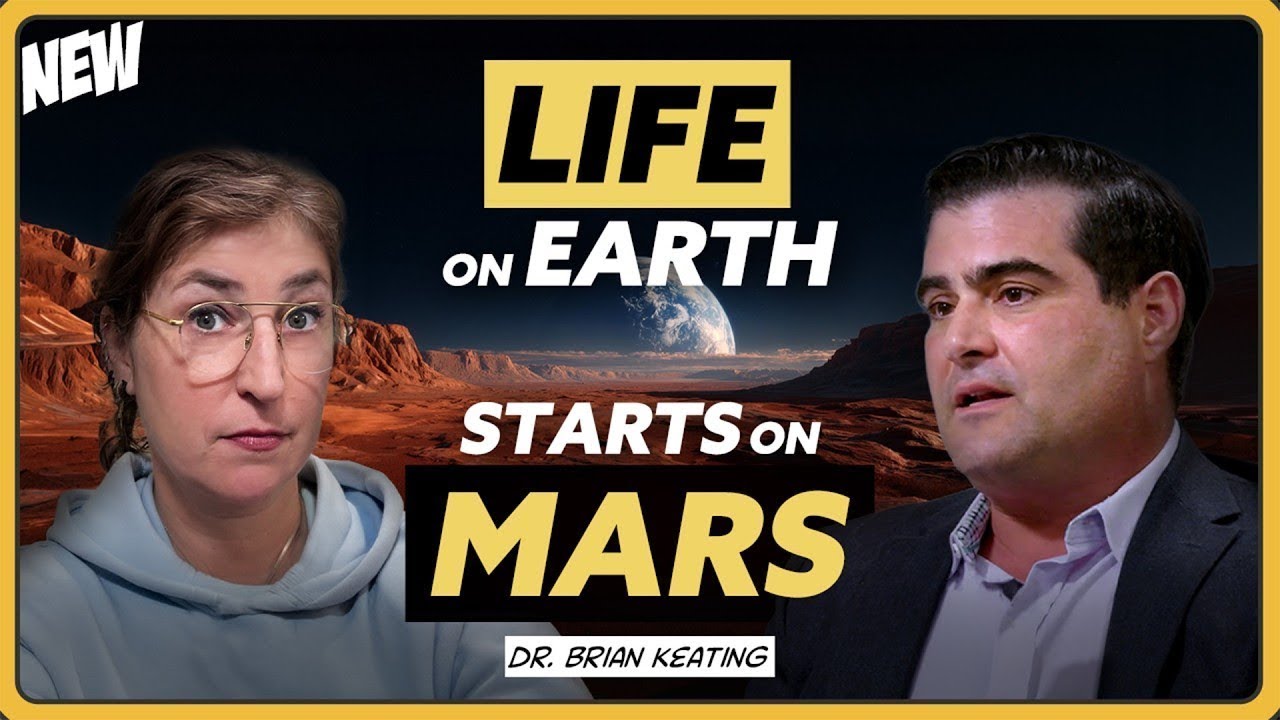
Dr. Brian Keating, experimental cosmologist and Chancellor’s Distinguished Professor of Physics at UCSD, discusses what came before the Big Bang, whether God’s existence can be subjected to scientific test, and why consciousness may be fundamental to reality. He argues that science must be grounded in evidence and falsification rather than speculation, while also exploring the limits of both science and religion, the search for extraterrestrial life, and the role of wonder in scientific inquiry.
Keating’s Mission as a Scientist and Public Figure
Keating sees himself as an evangelist for experimental science, emphasizing that his job is to collect data and try to prove theories wrong, not to confirm them.
He criticizes the proliferation of untestable “theories of everything” and argues that physics has become detached from experimental verification and epistemology.
He believes scientists have a moral obligation to share their work with the public and that communication skills must be deliberately cultivated.
What Came Before the Big Bang
The Big Bang describes the expansion of the universe from an extremely hot, dense state, but it does not explain what caused it or what preceded it.
The leading candidate theory is cosmic inflation: a hyper-accelerated expansion of spacetime that produced the heat of the Big Bang.
Other possibilities include a preceding universe that collapsed and “bounced” into our own, or the idea that time itself began at the Big Bang, making “before” a meaningless question (Hawking’s “north of the North Pole” analogy).
Keating argues the question “what happened before the Big Bang” is legitimate if time existed in some form prior, but may be incoherent if time began at that moment.
He draws a parallel to the Old Testament creation narrative, noting that only about 35 of the Torah’s ~35,000 verses concern cosmology, and that the sun being created on the fourth day was a deliberate theological statement against sun-worshipping civilizations, not a scientific claim.
The Cosmic Microwave Background (CMB)
Keating’s primary research uses the CMB, the oldest light in the universe, produced about 380,000 years after the Big Bang when the universe cooled enough for hydrogen to form and become transparent.
Originally emitted as X-ray/gamma radiation, the expansion of the universe has stretched it into the microwave band.
The CMB’s polarization encodes information about the physical conditions of the early universe and can potentially reveal evidence for inflation or violations of Einstein’s relativity.
Keating also pursues a “side hustle” using optical light to test whether the speed of light varies by color, which would violate relativity.
Consciousness, Near-Death Experiences, and the Limits of Science
Keating acknowledges that consciousness is a deep mystery with no agreed-upon scientific explanation for where it resides or whether it is fundamental or emergent.
He takes near-death experiences seriously as data points but insists they must be subjected to scientific scrutiny and falsification, not simply accepted on anecdotal authority.
He criticizes both religious apologists and militant atheists for intellectual dishonesty: apologists for inserting God into gaps in knowledge, and atheists like Lawrence Krauss for dismissing religious claims based on a frozen, adolescent understanding of religion.
He argues that confirmation bias—“if I didn’t believe it, I wouldn’t have seen it”—is the most destructive force in science.
Science and Faith
Keating was raised in a Jewish household, converted to Catholicism as a child (serving as an altar boy), became an atheist after learning about the Church’s persecution of Galileo and Giordano Bruno, and returned to Judaism later in life.
He sees science and religion as addressing fundamentally different questions and rejects the idea that they must conflict.
He argues that God’s existence should be subject to scientific test, and that religious claims that cannot be questioned or falsified are no more than “a hobby with a yamaka.”
He notes that 90% of the U.S. National Academy of Sciences identifies as atheist or agnostic, but that religious scientists have made enormous contributions throughout history.
The Search for Extraterrestrial Life
Keating is skeptical of claims that UAPs represent alien technology, pointing out that anecdotal reports are not data and that the plural of anecdote is not evidence.
He criticizes the “aliens of the gaps” reasoning—invoking extraterrestrials to explain the small percentage of UAP phenomena that current analysis cannot account for.
He presents a meteorite from Mars as a gift, explaining that Mars and Earth have exchanged material for billions of years, making it plausible (though unproven) that life could have traveled between them via panspermia.
He notes that despite Mars once having liquid water and habitable conditions, we have found no evidence of life there.
Simulation Hypothesis
Keating treats the simulation hypothesis as an interesting but largely unfalsifiable speculation, noting that even prominent atheists like Hawking and Dawkins cannot refute the proposition that reality is being rendered by some intelligence.
He argues that the absence of “glitches” is not evidence against simulation, but that the hypothesis currently lacks the kind of testable predictions that would make it scientific.
Recent Deaths and Disappearances of Scientists
Keating is troubled by conspiracy theories linking scientists’ deaths to UAP cover-ups, citing a case where a scientist working in Chile’s Atacama Desert died while hiking with inadequate water—a tragic but explainable event that was exploited to generate mistrust.
He maintains a healthy skepticism of government but insists the first explanation for anomalous events should not be the conspiratorial one.
Cattle Mutilations and Unexplained Phenomena
Keating acknowledges that cattle mutilations are genuinely puzzling but warns against jumping to extraordinary explanations without evidence.
He references Arthur C. Clarke’s adage that “any sufficiently advanced technology is indistinguishable from magic,” illustrating with a WWII radar spoofing example how seemingly physics-defying phenomena can have prosaic explanations.
Imposter Syndrome Among Scientists
Keating discusses how imposter syndrome afflicts even the most accomplished scientists, including Einstein, Isaac Newton, and Nobel laureate Barry Barish, who described feeling like an imposter even after winning the Nobel Prize.
He notes that Newton considered dying a virgin his greatest accomplishment, as it made him most Christlike.
Alfred Nobel’s Near-Death Experience
Alfred Nobel had a near-death experience in 1889 when he mistakenly read his own obituary, which called him the “merchant of death” for inventing dynamite.
This experience motivated him to establish the Nobel Prizes, specifying they should benefit all humankind.
The prizes are awarded on December 10th, the anniversary of Nobel’s death, not his birthday, because of this near-death experience.