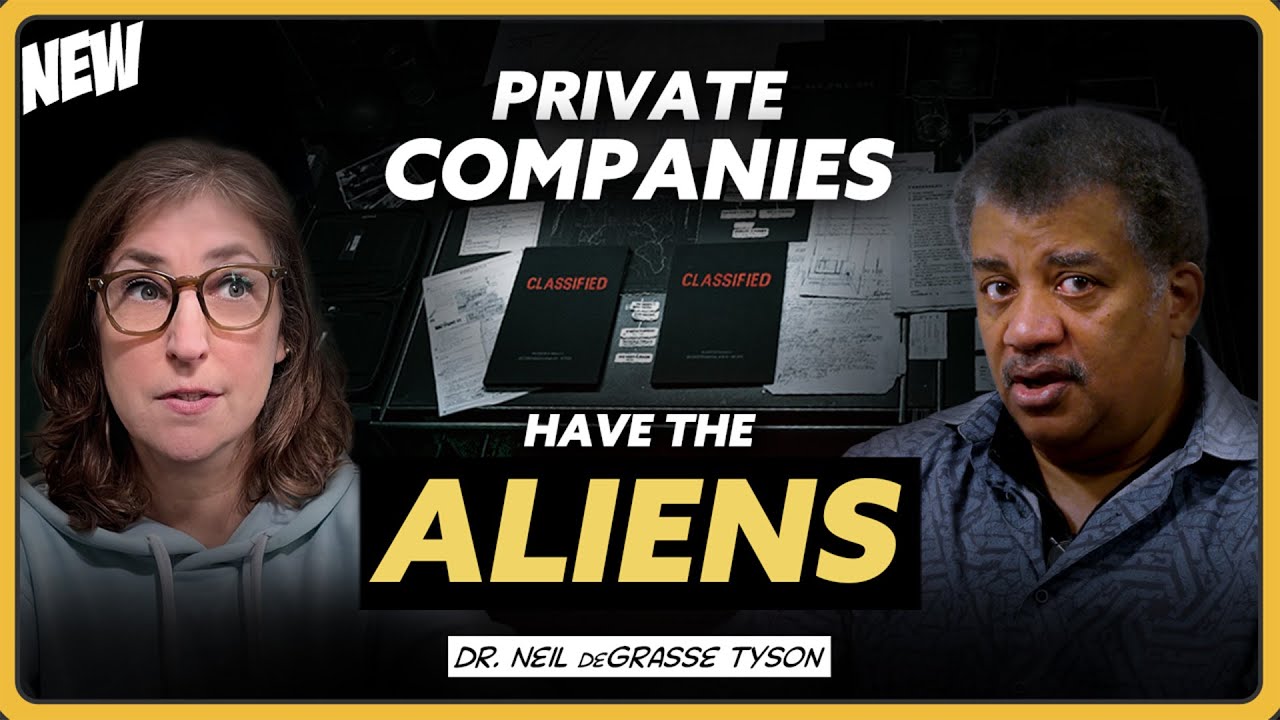
Astrophysicist Neil deGrasse Tyson returns to discuss his new book Take Me to Your Leader: Perspectives on Your First Alien Encounter, the recent wave of government disclosures about UFOs/UAPs, and what it would actually take to scientifically prove aliens exist — while also weighing in on near-death experiences, DMT, Antarctic underground lakes, and the limits of human knowledge.
The Shift from Fringe to Official
For decades, UFO reports were easy to dismiss because they came from unreliable witnesses — farmers, late-night bar patrons — but starting around 2023–2025, a parade of insiders, whistleblowers, and ex-military intelligence officials began testifying under oath that the government has living aliens, crashed saucers, and reverse-engineered technology.
What struck Tyson was that these hearings were nonpartisan — Congress was unusually unified, which he found remarkable.
Ronald Reagan had speculated in a 1987 UN speech that hostile aliens might unite humanity as one species.
Tyson’s response: stop asking “do you believe in aliens?” and instead demand material evidence — the battle cry of “I need a witness” works in courtrooms but not in science.
He uses the octopus analogy: if dozens of trusted witnesses described a boneless, eight-legged, shape-shifting creature, you wouldn’t keep asking “do you believe in octopuses?” — you’d just bring one out.
His bottom line: “Is it too much to ask to bring out the alien? It’s not.”
Improving the Data
A colleague of Tyson’s, an astrophysicist, headed a committee to improve how UAP data is collected — moving beyond fuzzy photos and testimony.
The idea: create a smartphone app that captures metadata (longitude, latitude, elevation, brightness, color) for every sighting, enabling triangulation when multiple people see the same phenomenon.
One of the hardest things to establish is the distance to an unfamiliar object — a small nearby object and a large distant one can subtly appear the same size.
Hollywood Aliens vs. Physics
Tyson’s book is partly a “love letter” to human fascination with aliens, examining roughly a hundred movie aliens for how they hold up against known physics.
Arrival (2016): He critiques the septapod aliens — if you’re entirely squishy, how do you build things? You need either an exoskeleton or an internal skeleton. He also notes the aliens drew on glass in mirror image, like Leonardo da Vinci’s mirror writing.
He originally said he’d send an astrobiologist and cryptographer rather than a physicist and linguist, then felt bad because linguists rarely appear in movies.
Contact (1997): He notes you never actually see the alien — a deliberate and effective choice.
Star Wars: The Force Awakens: The Death Star sucks energy from a star to destroy eight planets, but a star’s energy could destroy roughly 50,000 planets — the dark side could have been far more diabolical with better science.
Why Carbon, Not Silicon?
Silicon is often proposed as an alternative basis for life because it sits directly below carbon on the periodic table and can form similar molecules.
But carbon is the fourth most abundant atom in the universe and the third most chemically active — it’s far more available and “sticky,” making it better suited for building complex molecules.
A silicon-based organism would essentially look like it’s made of strudel or pastry — silicon is the active ingredient in rock.
Tyson calls the preference for carbon an “authentic, justifiable bias.”
Reverse Engineering and Cover-Ups
One theory: private contractors (not government agencies) are reverse-engineering captured alien technology, which is why it’s not traceable through budgets.
The incentive to keep it secret: cracking the technology could upend energy production, oil markets, and natural gas markets — a massive disruption to global economic powers.
Tyson’s response: cover the technology if you want, but show us the alien.
He pushes back on the idea that post-Roswell technological leaps (sound barrier broken 3 months after Roswell, orbiting Earth 10 years later, walking on the moon 12 years after that) must be due to reverse-engineered alien tech.
He argues this pace is consistent with exponential growth in a culture with free scientific research and strong science-engineering connections — like the United States in the 20th century.
He illustrates exponential thinking with the algae-in-a-lake puzzle: if algae doubles every week and half the lake is covered after a year, how long to cover the entire lake? One week, not another year.
The Mexican Mummy Invitation
After Tyson said “bring out the alien” on Colbert, he received a letter from a Mexican contact inviting him to inspect mummified aliens found on the Nazca Plains of Peru, then on display in Mexican Congress.
The specimens were archetypal — bald heads, big eyes, gray skin, humanoid bodies — and X-rays of one showed what appeared to be three elongated eggs inside.
Tyson noticed the eggs showed up completely white on the X-ray, meaning X-rays couldn’t penetrate them — suggesting they were made of lead or a similar dense material, not biological eggshell.
He declined the invitation, saying he’s not the right expert — a biologist or biochemist should examine them, and tissue samples should be sent to labs worldwide, just as Apollo moon rocks were shared.
He was later skeptical because the specimens were humanoid — if aliens aren’t from Earth and share no DNA with us, why would they look human? Most life on Earth doesn’t look human.
A Peruvian investigator later exposed the mummies as a hoax, with some biological tissue and some papier-mâché — raising questions about how Peruvian mummies ended up in Mexican coffins.
The Missing Scientists Question
Michio Kaku recently noted that 11 scientists have died or gone missing over the past 4 years, sparking conspiracy theories.
Tyson cites an unverified analysis: thousands of scientists die every year, and cherry-picking those with overlapping interests creates a pattern that isn’t statistically significant.
Some of the deceased were long retired from the field — not active researchers.
He references the sharpshooter effect: drawing a bull’s-eye around bullet holes after shooting blindfolded at a barn, then claiming to be a good shot. You create the target after the data exists.
He suggests a better test: have UFO enthusiasts list the 10 people most likely to be targeted, then see if any of the missing appear on that list.
Three Kinds of Truth
Tyson distinguishes three categories of truth:
Personal truth: What you hold dear to your bones — religious faith, cultural identity, Taylor Swift as your queen. These require persuasion, and historically, violence when imposed on others.
Political truth: Something repeated so often it becomes accepted as true — propaganda hijacks the evolutionary tendency to trust repeated patterns.
Objective truth: Established through the scientific method — testable, verifiable, reproducible. Examples: Earth is round, air is 78% nitrogen, food has energy content.
These were all established by science but are now taken for granted.
He applies this to the 1995 Fox “alien autopsy” documentary: it was subtitled “fact or fiction,” and Tyson spotted anachronisms — a coiled phone handset not invented until years later, cinéma vérité camera work not possible in 1947, and organs with no connective tissue, like the board game Operation. The producer later admitted it was a hoax.
Near-Death Experiences and Consciousness
Tyson is skeptical that consciousness survives bodily death, citing the mini-stroke scenario: as strokes progressively disable brain function, consciousness fades incrementally — there’s no point at which it clearly “leaves” the body.
He recounts a story of a second cousin who, while identifying her father’s body in a morgue, saw it sit up and have a conversation with her.
His response: either she contacted the great beyond (testable) or she had an acoustic and visual hallucination.
His suggested test: next time, ask specific questions — “Where are you? Do you eat? Who else is there? How old are you?” — and have the deceased read a sealed message.
She never reported another such experience.
He tells the story of a New York criminal who, after being shot and resuscitated, described going toward a bright light, meeting his dead brother who pushed him back to Earth. Tyson suggests the “bright light” could have been operating room lights and the “big hands” could have been chest compressions — the brain constructing meaning from semi-conscious sensory input.
He proposes a practical experiment: place a message on the ceiling of hospital rooms where cardiac patients are treated, visible only from above, and ask those who report out-of-body experiences to read it.
About 30% of cardiac arrest patients report near-death experiences, making this a viable study population.
Mayim Bialik notes the practical and ethical difficulties — you can’t get informed consent from someone being wheeled into emergency surgery.
DMT and the “Code Behind Reality”
Danny Goler’s pilot study uses a 650-nanometer red laser, diffracted into horizontal and vertical stripes, mounted on a wall for DMT users to observe.
Participants report seeing Japanese katakana-like characters, stable geometric structures (triangles, shapes reminiscent of Doctor Who), and the experience is persistently visible — once observed, it can be accessed later even with minimal DMT doses.
The hypothesis: DMT may peel back a layer of reality, revealing a code or deeper structure of consciousness.
Tyson’s critique: if multiple people see the same thing, they should be separately isolated and asked to write down what they see to avoid contamination. Then bring in a cryptographer.
He also notes that lasers have a particular intensity at a specific wavelength that may trigger certain neurons — the experience may be a neurological response to that frequency, not a window into objective reality.
He’s highly skeptical that adding chemicals to a brain that already struggles with optical illusions could provide better access to objective truth.
Bialik points out that transcendental meditation can produce similar experiences but takes much longer to learn.
The Ruwa, South Africa School Sighting
Tyson references a well-documented case in Ruwa, South Africa, where an entire elementary school class on recess reported seeing a flying saucer land and an alien emerge.
The children’s drawings showed strong agreement.
Tyson’s questions: the children drew their pictures together, not separately — so peer influence can’t be ruled out. And how many children’s testimonies equal one adult teacher’s? How many teachers’ testimonies equal one alien?
Antarctic Underground Lakes
Lake Vostok in Antarctica has been sealed beneath ice for roughly 150 million years — it hasn’t seen light or air on an evolutionary timescale.
It’s a target for astrobiologists because it could serve as a model for Europa, Jupiter’s icy moon, which likely has a liquid interior kept warm by tidal forces.
If life exists there, it would need to be a self-sustained ecosystem — you can’t have only cannibals; someone has to convert an external energy source (like sunlight) into the food chain.
Expectation: microbes and simple organisms, not complex life — unless there’s an unknown energy source.
Tyson’s Epilogue Fantasy
In the book’s epilogue, Tyson writes that if he ever goes missing during a night of telescope observing, people should look to the stars — he’ll be with the aliens.
He imagines they might confiscate his smartphone, keep him as a pet, or let him visit their science academy to trade ideas and technologies.
He’d want to bring back insights enabling us to visit other civilizations — becoming the aliens of someone else’s fantasies.
He also notes that on Earth, we often treat needy pets better than needy humans.