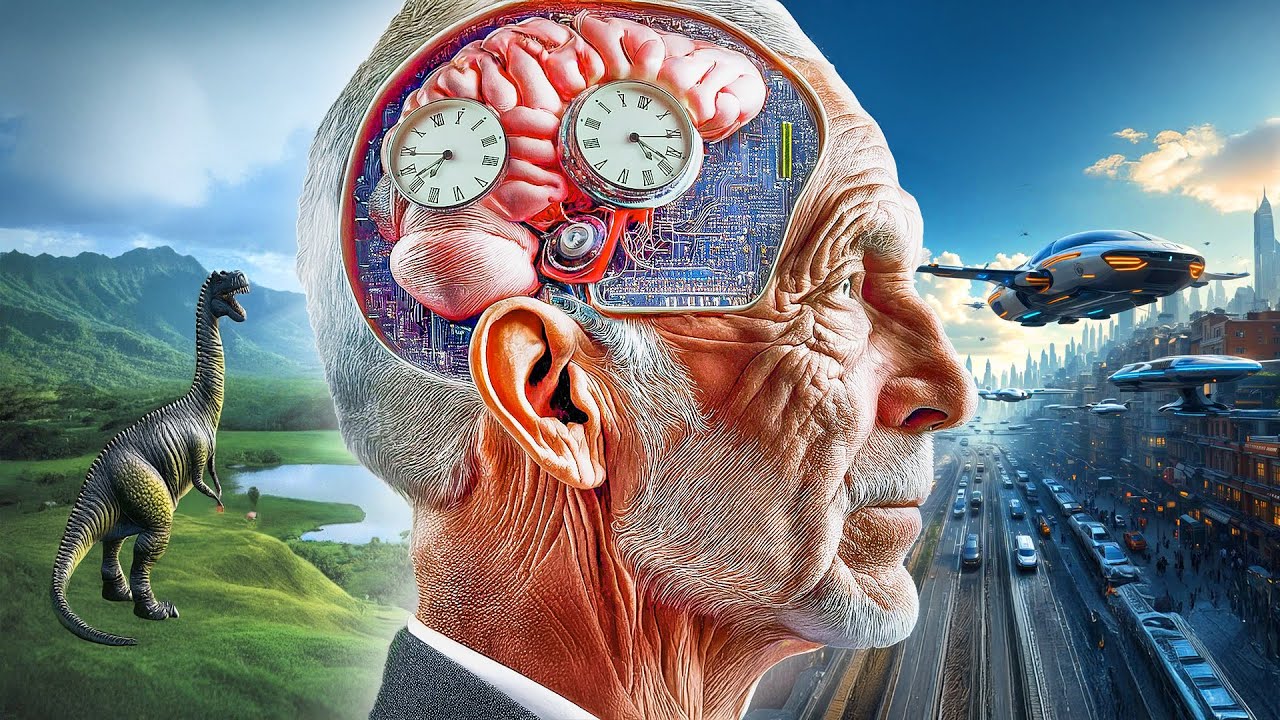
Eric Wargo, a science writer and author of Time Loops and Precognitive Dreamwork and the Long Self, argues that the human brain functions as a “quantum time machine” — a hybrid classical-quantum system capable of receiving information from the future. His thesis is not mystical but grounded in quantum biology, neuroscience, and information theory: our brains may exploit temporal non-locality (a real phenomenon in quantum mechanics) to access future knowledge states, especially in high-stakes or life-death situations. This could explain common experiences like premonitions, gut feelings, and precognitive dreams — not as magic, but as an evolved biological capacity.
Precognition Is Common — and Often Ignored
People routinely report dreams or intuitions that later come true: foreseeing a loved one’s death, sensing a phone call before it happens, or making a life-changing decision based on a “download” with no rational basis.
These experiences are so frequent that therapists regularly hear precognitive dreams from patients — yet they’re rarely labeled as such because mainstream science lacks a framework to explain them.
Historical “Prophecies” Suggest a Pattern
Dean Koontz’s 1981 novel The Eyes of Darkness described a bioweapon called “Wuhan-400” created in a lab near Wuhan, China — eerily presaging the COVID-19 pandemic in 2020.
Morgan Robertson’s 1898 novel Futility, or the Wreck of the Titan depicted an unsinkable luxury liner named Titan hitting an iceberg in the North Atlantic in April — 14 years before the Titanic disaster. Both ships were nearly identical in size, speed, route, and lack of lifeboats.
Wernher von Braun’s 1952 sci-fi book Project Mars described a Mars mission led by a figure named “Elon.”
The 1958 Western Trackdown featured a charismatic con man named Trump who promises to build a wall and is accused of fraud.
Mark Twain predicted he would die when Halley’s Comet returned — and did, one day after its closest approach in 1910.
Sculptor Michael Richards, whose work centered on flight and martyrdom, created Tar Baby vs. St. Sebastian — depicting himself impaled by airplanes. He was the only artist to stay overnight in his Twin Towers studio on September 10, 2001, and died in the attacks the next morning.
While skeptics cite survivorship bias, the specificity and clustering of such cases suggest something beyond chance — especially when combined with controlled scientific data.
The U.S. Government Took Psychic Spying Seriously — for 23 Years
Project Stargate (1972–1995) was a CIA- and DIA-funded program employing “remote viewers” to gather intelligence. It was refunded annually because it produced actionable results.
Joseph McMoneagle, the program’s top remote viewer, used psychic methods to identify Soviet nuclear bases, predict critical events, and help locate kidnapped General James Dozier. He received the Legion of Merit for contributions to over 200 national security cases.
In 1979, he described a massive nuclear submarine with missile tubes in front of the superstructure — dismissed as fantasy until the USSR launched the Typhoon-class submarine eight months later, matching his description exactly.
Rosemary Smith, another remote viewer, was tasked with locating a downed Soviet Tu-22 spy plane in Africa. Given the entire continent as a target, she drew a 3-square-mile area in Zaire — where the plane was found. President Jimmy Carter called it “the most miraculous thing” during his term.
Jessica Utts, a statistician and former president of the American Statistical Society, reviewed decades of psychic experiments — including Stargate data, Stanford Research Institute trials, and studies at Duke and Edinburgh.
In one protocol: remote viewers in isolated rooms drew images from a random set of 200 National Geographic photos. The hit rate was 35% — far above the 25% expected by chance — and replicable across labs.
Utts concluded: “Using the standards applied to any other area of science, it is concluded that psychic functioning has been well established.”
Ray Hyman, a prominent skeptic and critic of paranormal claims (including James Randi’s work on Uri Geller), partnered with Utts. Though he had minor methodological critiques, he agreed the data were too consistent and large to dismiss as flukes.
Utts argued further research should focus not on whether psychic phenomena occur, but how they work — comparing it to early anomalies like black body radiation or Mercury’s orbit, which were real before they were explained.
Quantum Mechanics Allows for Temporal Non-Locality
Quantum entanglement isn’t just spatial (“spooky action at a distance”) — it’s also temporal.
In delayed-choice experiments, measuring a photon days after its entangled partner has been tested appears to retroactively determine whether the first photon behaved as a wave or particle.
This suggests retrocausality: future events can influence past states — a feature, not a bug, of quantum theory.
Quantum computers use qubits in superposition (not “both 0 and 1,” but in a distinct probabilistic state). Some theorists and engineers believe quantum computations can, in principle, send information backward in time.
The Brain as a Quantum System
Roger Penrose (Nobel laureate) and Stuart Hameroff (anesthesiologist) propose that consciousness arises from quantum processes in microtubules — cylindrical structures in neurons.
Anesthetics shut down microtubules while leaving other brain functions intact — suggesting they’re central to conscious awareness.
Microtubules may act as quantum sensors, collapsing wave functions into definite states.
Migratory birds navigate via cryptochrome proteins that sense Earth’s magnetic field through electron spin.
Photosynthesis may rely on quantum entanglement.
A Neuroanatomical Basis for Intuition
Gary Nolan, a Stanford professor, found that individuals with high intuition (e.g., expert Go players making irrational-but-successful moves) show increased neural density in the caudate nucleus and putamen — parts of the basal ganglia involved in reward prediction and habit formation.
This trait appears to run in families, suggesting a genetic component.
The basal ganglia may be where future knowledge states are “received” and integrated into present-moment decisions.
Wargo doesn’t claim psychics can view arbitrary future events. Instead, confirmation feedback is required: you can only “remote view” something if, in the future, you learn it’s true.
Example: You dream of a plane crash. Only if you later confirm the crash occurred can that information be sent back to your past self.
This aligns with Hal Puthoff, founder of the Stargate program, who found that remote viewing accuracy improved with feedback — suggesting the brain accesses future knowledge states that include the viewer’s own future confirmation.
This makes precognition adaptive: it’s strongest in life-death situations where survival depends on anticipating threats.
Why This Matters Now
In an age of AI hype, Wargo’s model highlights a uniquely human advantage: intuition as quantum time-travel.
Classical computers (including AI) process data sequentially and causally. They cannot access future states.
The human brain, as a hybrid classical-quantum system, may exploit temporal non-locality — giving us a “sixth sense” no machine can replicate.
Marshall McLuhan’s warning applies: merging with classical computers (e.g., via transhumanist tech) could amputate our native quantum capacities.
Instead of outsourcing cognition, we should investigate quantum biology — especially microtubules in the basal ganglia — to understand and enhance our innate precognitive abilities.