-
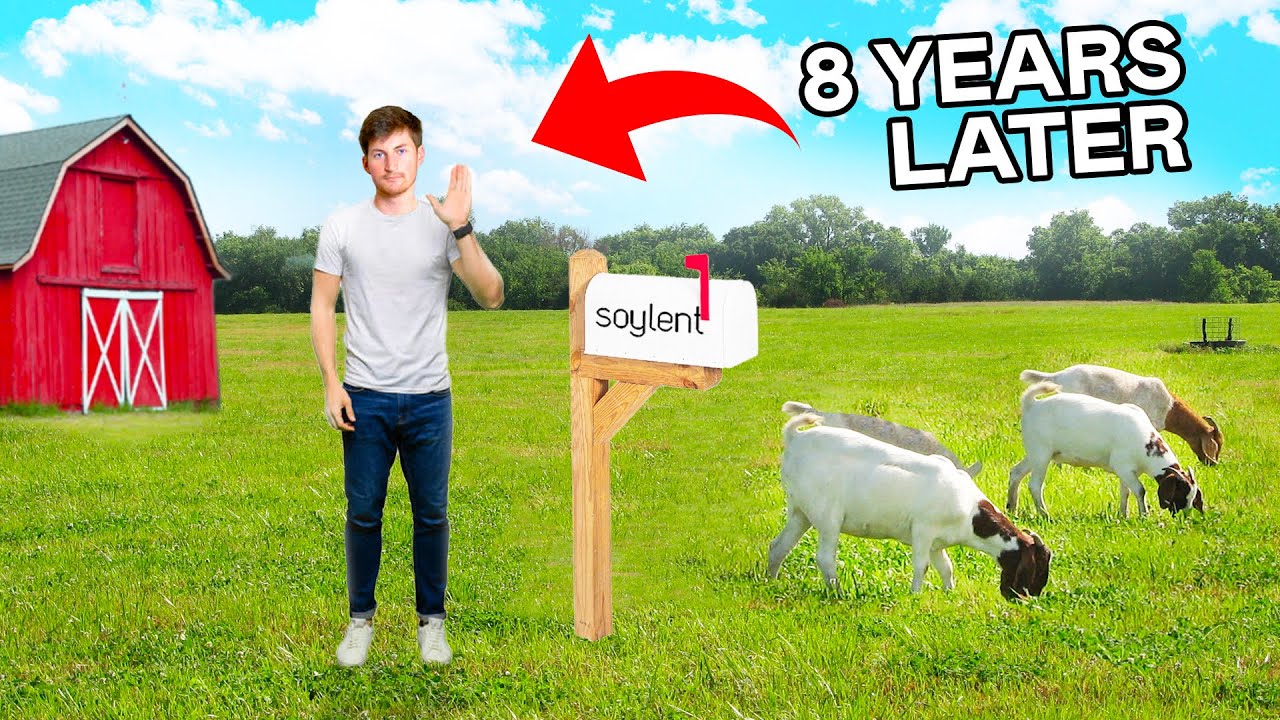
Rob Rhinehart, founder of Soylent and partner at Mars Bio, discusses his unconventional life on a secluded Malibu goat farm, his philosophy of self-experimentation, and his vision for the future of food and human optimization.
- He lives with goats and horses, eats homemade ice cream constantly, and approaches life as a series of personal experiments in biology, nutrition, and engineering.
- His central idea is that humans can treat their own bodies and environments as systems to be optimized through data, iteration, and a willingness to ignore social norms.
-
Soylent began as a personal engineering project to eliminate the inefficiency and cost of traditional food.
- Rhinehart was frustrated with the time, money, and decision-making involved in eating, and set out to design a single liquid that could meet all nutritional needs.
- He started by researching nutritional science, buying raw chemical ingredients, and mixing them himself, then documented the process publicly on his blog.
- The project attracted a cult following, then venture funding, and eventually became a widely distributed consumer product.
- He describes the early days as a kind of obsessive self-experiment: he lived almost exclusively on his own formulation for extended periods, tracking biomarkers and subjective well-being.
-
Rhinehart’s approach to food is fundamentally reductionist and systems-oriented.
- He sees food not as culture or pleasure primarily, but as an input to be optimized for health, energy, and cognitive performance.
- He is skeptical of dietary dogma and fads, preferring to rely on blood tests, self-experimentation, and first-principles reasoning.
- He acknowledges that this view is controversial and that many people find it alienating, but he argues that most food traditions are accidents of history rather than optimal solutions.
-
His current life on the goat farm is an extension of the same experimental mindset.
- He raises goats and horses, makes his own dairy products, and continues to iterate on his personal diet and lifestyle.
- The farm is partly a retreat from the intensity of building a company and partly a laboratory for thinking about food systems, land use, and self-sufficiency.
- He describes the animals and the land as part of a broader interest in biology and ecology, not just agriculture.
-
Rhinehart is interested in long-term human enhancement and the intersection of biology and technology.
- He talks about the body as a platform that can be hacked, upgraded, and maintained like any other system.
- He is curious about longevity, cognitive enhancement, and the possibility of redesigning human biology to reduce suffering and increase capability.
- He frames this not as a distant sci-fi fantasy but as a natural extension of what people already do with medicine, supplements, and lifestyle choices.
-
He reflects on the tension between being a public figure and wanting a private, unconventional life.
- Soylent made him well-known, but he is ambivalent about fame and the expectations that come with it.
- The Malibu farm represents a deliberate move away from conventional success markers toward a life structured around personal curiosity and autonomy.
- He describes himself as both highly social in conversation and fundamentally solitary in lifestyle.
-
Throughout the episode, Rhinehart emphasizes intellectual honesty and a willingness to be wrong.
- He treats beliefs as hypotheses to be tested rather than identities to be defended.
- He is open about mistakes and course corrections, both in Soylent’s formulation and in his personal experiments.
- He sees this iterative, evidence-oriented mindset as the common thread between his work on food, his farming, and his broader philosophy of life.