-
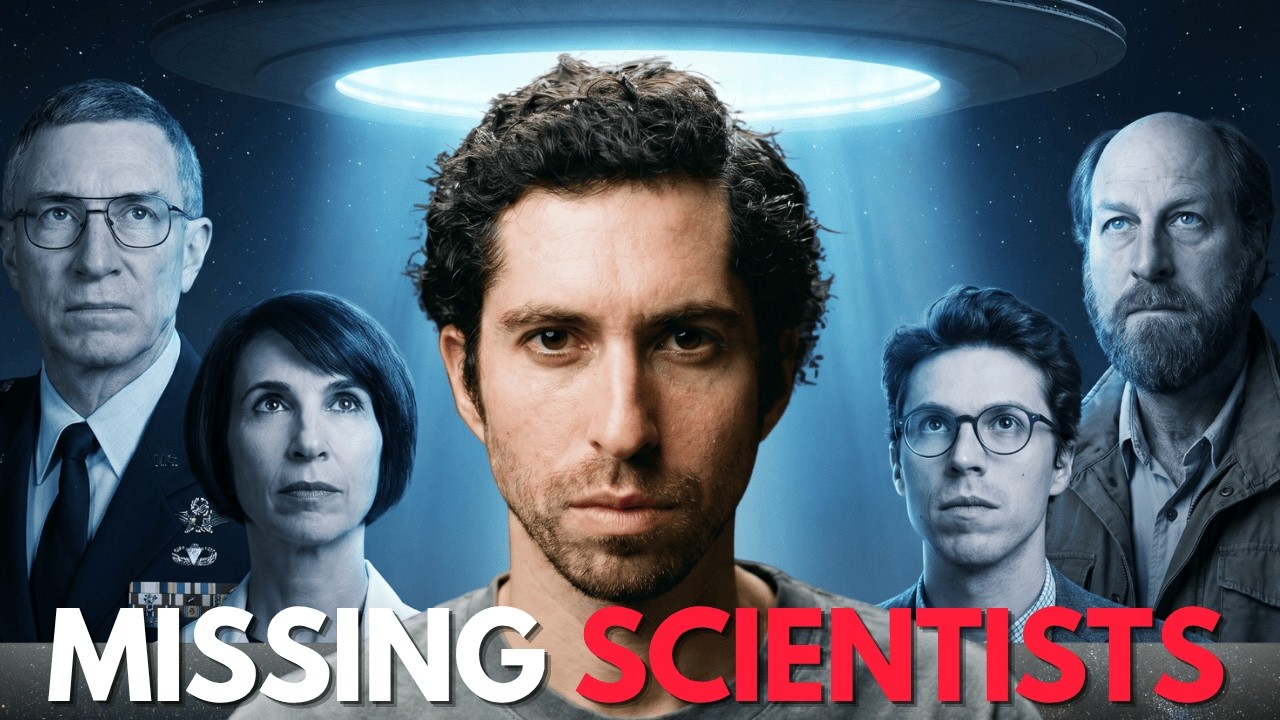
A wave of disappearances and killings of top American scientists and defense insiders has raised urgent questions about whether these are isolated tragedies or symptoms of a deeper, systemic pattern. The episode investigates roughly a dozen cases from 2025–2026 in which physicists, materials scientists, astronomers, and retired military officials with access to the nation’s most classified programs either vanished or were murdered, and it asks whether the cause is geopolitical rivalry, internal black-budget housekeeping, or something stranger still.
-
The disappearance of retired Air Force General Neil McCasland anchors the story. On February 27, 2026, McCasland vanished from his Albuquerque home, leaving behind his phone, smartwatch, and glasses but taking a red backpack, wallet, and .38 caliber revolver. Despite one of the largest search efforts in New Mexico history—involving the FBI, Air Force OSI, drones, helicopters, K-9 units, and 700 canvassed homes—no trace of him was ever found.
- McCasland was no ordinary retiree. He had directed the Pentagon’s Special Access Programs office (overseeing ~75–80% of the Department of Defense’s most classified projects), commanded the Air Force Research Laboratory at Wright-Patterson AFB (a $2.2 billion S&T portfolio), and was linked through WikiLeaks emails to Tom Delong and John Podesta’s early UFO disclosure efforts via To the Stars Academy.
- His wife, Susan—a PhD astrophysicist, Air Force Reserve colonel, and NASA astronaut semi-finalist—made a carefully worded public statement that neither confirmed nor denied the existence of Roswell materials at Wright-Patterson, instead saying only that Neil lacked “special knowledge” about them, a phrasing many listeners treated as a deliberate cipher.
- The timing was notable: McCasland disappeared eight days after President Trump announced on Truth Social that he was directing the Pentagon to release government files on aliens and UAPs. A retired intelligence officer, Danny Sheehan, described a secret “association” of 24 retired DoD, CIA, and aerospace officials working to pull UAP programs back into government oversight—McCasland fit the profile, though his membership was never confirmed.
-
Monica Jasinto Reza, co-inventor of the breakthrough rocket alloy “Mandaloy,” vanished on a California hike in June 2025. Reza had solved one of the hardest problems in American rocketry: a nickel-based super-alloy strong enough to survive high-pressure, oxygen-rich rocket engines without catching fire, ending U.S. dependence on Russian RD-180 engines. She disappeared on the Waterman Mountain trail, 30 feet behind fellow hikers, leaving behind only her beanie and visor. An eight-day official search found nothing; volunteer teams searched for 150 days.
- The connection to McCasland is structural: the Air Force Research Laboratory under McCasland’s command had co-funded Mandaloy’s development, and Reza’s co-inventor Dallas Hardwick worked at Wright-Patterson in the materials directorate during McCasland’s tenure. Both scientists operated inside the same classified research ecosystem—and both are now gone.
-
Melissa Casillas, an administrative assistant at Los Alamos National Laboratory, disappeared in June 2025 under ambiguous circumstances. She dropped her husband at the lab gate (he says he watched her swipe in), then drove home, told her daughter she’d forgotten her badge, and was last seen on doorbell cameras walking toward Carson National Forest. Her phone had been factory reset; she took a toothbrush and hair straightener but left her purse, wallet, and keys. A blue Dodge truck was reported following her. Her family suspected financial stress and personal crisis; the evidence pointed more toward a voluntary disappearance than foul play, though the Los Alamos connection drew public attention.
-
Caltech astronomer Carl Grillmair was shot dead on his porch in February 2026 by a neighbor with a prior trespassing incident. Grillmair was a polymath: he mapped dark matter via stellar streams, pioneered exoplanet atmosphere analysis (co-discovering the first water vapor on an exoplanet), and was working with NEOIS on planetary defense. He had also begun testing new instrumentation at Palomar Observatory for the Vera Rubin Observatory, a telescope whose imagery is reviewed by the Pentagon before public release—a fact highlighted by The Atlantic. His killer, Freddy Snyder, had been arrested four months earlier for trespassing on Grillmair’s property with a loaded rifle, was released on his own recognizance, and was later linked to a nearby carjacking. No clear motive was established.
-
MIT plasma physicist Nuno Loureiro was assassinated at his Brookline home in December 2025. Loureiro, 47, was deputy director of MIT’s Plasma Science and Fusion Center and one of the world’s leading experts on magnetic reconnection—a key obstacle to sustained nuclear fusion. He had just received the Presidential Early Career Award from President Biden. His killer was Cláudio Valente, a former classmate from Lisbon who had failed to get into MIT, dropped out of Brown’s PhD program, and harbored apparent resentment. Valente had spent six semesters planning a mass shooting at Brown (killing two students, injuring nine), then drove to Boston and shot Loureiro on his doorstep two days later.
- The case had eerie anomalies: Valente meticulously surveilled Brown but then paced openly in Boston with cameras everywhere; the 48-hour gap between the two attacks was unaccounted for; and Loureiro reportedly said nothing to paramedics, possibly recognizing his killer.
- Two days after Loureiro’s death, TAE Technologies—a private fusion company and competitor to MIT-spinoff Commonwealth Fusion Systems—announced a merger with Trump Media & Technology Group, valuing the combined entity at ~$6 billion despite TAE having no revenue or commercial product. The timing was noted as “odd” but not explained.
-
The episode places these cases in a longer historical pattern of scientists dying or disappearing near strategic technologies. During the Cold War, 25 engineers working on Britain’s GEC-Marconi defense projects (the “Marconi deaths”) died in bizarre circumstances—suicides, accidents, and impossible scenarios—between 1982 and 1990; no one was ever charged. Mexican neuroscientist Jacobo Grinberg vanished in 1994 after publishing his “lattice” theory of consciousness. Israeli-American inventor Itzhak Bentov, whose work influenced the CIA’s Stargate program, died in the Flight 191 crash. Chinese-American physicist Ning Li, who worked on gravity control via superconductors, vanished into classified work, suffered brain damage from a hit-and-run, and died with Alzheimer’s in 2021.
-
The episode closes with the speculative frame of Liu Cixin’s The Three-Body Problem—a novel the Bush administration reportedly urged officials to read—in which an alien civilization systematically sabotages human scientific progress by targeting frontier researchers. Whether the forces behind these disappearances are human (foreign adversaries, black-budget cleanup crews, continuity-of-government programs) or something stranger, the episode argues the pattern is real: the people closest to the edges of what we know—the ones rewriting the rules of physics, energy, and defense—are the ones being lost, and their minds are the true crown jewels.
Why America’s Top Scientists Are Going Missing
American Alchemy • • 1h47 → 4 min • #117