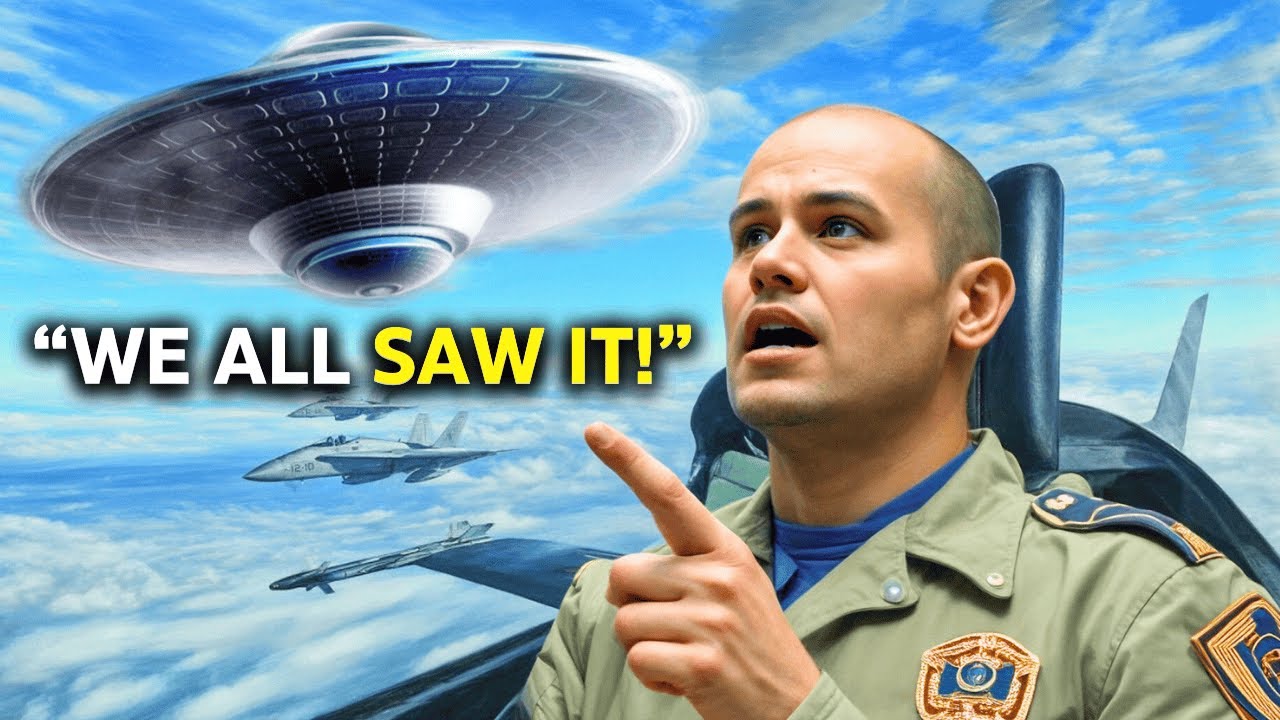
Ryan Graves, a former U.S. Navy F/A-18 fighter pilot with a decade of service, describes routine encounters with Unidentified Aerial Phenomena (UAP) off the U.S. East Coast, including a near-miss with a dark gray or black cube inside a clear sphere that came within 50 feet of a cockpit. He explains how these sightings were initially dismissed as radar errors but were later confirmed across multiple sensor systems, how the objects displayed anomalous capabilities such as instantaneous acceleration to supersonic speeds, perfect station-keeping in hurricane-force winds, and transmedium behavior, and how he became a leading public advocate for aviation safety and government transparency around UAP, testifying before Congress alongside David Fravor and David Grusch.
The Fighter Pilot Experience
Graves describes the intense “flow state” of flying a fighter jet, where after extensive briefing and preparation, the pilot becomes so synchronized with the aircraft that it feels like an extension of the body, with the most extreme example being night carrier landings where a single light in total darkness gradually fills the visual field.
He recalls serious in-flight emergencies, including a canopy leak at 30,000 feet at night and a catastrophic failure of a bleed air line in Saudi Arabia that was essentially cutting through control feedback lines, forcing him to use both hands to move the stick and nearly preventing a safe carrier landing.
He reflects on the gap between academic ground training and actual flight performance, noting that the best students were not always the best pilots, and that over-reliance on memorized mental models could be a liability when real situations demanded being fully present and physically adaptive.
The Radar Upgrade That Changed Everything
Around 2014–2015, Graves’s squadron transitioned from the older APG-73 mechanically scanned radar to the new APG-79 Active Electronically Scanned Array (AESA) radar on their F/A-18 Super Hornets, a process that took about eight months with jets flying mixed configurations.
Immediately after the upgrade, pilots began detecting persistent objects in their training area off Virginia Beach that the older radar would have dismissed as false tracks from ground clutter or weather, but the new system was specifically designed to filter out such errors.
The objects behaved unlike any radar artifact: they held perfectly stationary positions in Category 3 hurricane-force winds with no oscillation, flew at speeds between 250–350 knots in racetrack or circular holding patterns, and some reached speeds of Mach 1.1–1.2, all with no visible exhaust plume or IR signature.
Multi-Sensor Correlation
Pilots initially kept the sightings to themselves, assuming the new radar had bugs, but the situation changed when the ATFLIR (infrared/electro-optical targeting pod) began detecting higher-energy returns at the exact locations the radar showed objects, and the AIM-9X missile system’s infrared seeker was also locking onto them.
Three independent sensor systems—radar, ATFLIR, and missile seeker—were now confirming physical objects at these locations, making it irresponsible to continue ignoring them as they posed a direct flight safety risk.
Pilots attempted visual confirmation by flying merge maneuvers with sensor data piped into their helmet-mounted displays as augmented reality, but despite precise cueing, they could not see the objects visually, even though sensors reacquired them immediately after the pass.
The Near-Miss and the Cube-in-Sphere
The turning point came when two aircraft flying in formation, about 150 feet apart, entered the training area and an object shot down the wing of the lead jet, coming within approximately 50 feet of the cockpit, prompting an immediate cancellation of the flight.
The pilot described the object as a dark gray or black cube inside a clear sphere, estimated at 5 to 15 feet in diameter, a description that triggered a strong reaction in the squadron because it was the first visual confirmation of what had been appearing on radar for months.
A safety report (HAZREP) was filed, and the safety officer’s survey revealed four additional unreported near-midair collisions in the squadron over the preceding months, and when Graves later asked pilots in his ready room, about half raised their hands when asked if they had seen cubes and spheres.
Anomalous Characteristics
The objects displayed several features that Graves considers genuinely anomalous: the ability to remain perfectly stationary in extreme wind without any visible propulsion or stabilization effort, instantaneous acceleration to supersonic speeds with no sonic boom or exhaust plume, low observability with masked IR signatures that appeared as a uniform blur across the entire surface rather than showing engine hot spots, and geometric shapes (cubes inside spheres) with no aerodynamic surfaces.
They were observed in groups of three to seven, operated only over water, and seemed to respect no boundaries of the designated training area, flying through international commercial air channels.
Graves notes that the objects did not appear to react to the presence of his squadron’s aircraft, unlike some other reported cases where UAP seemed to detect and respond to pilots, such as David Fravor’s 2004 Nimitz encounter.
The Broader Pattern of Sightings
Graves emphasizes that these experiences were not isolated to his squadron: pilots at Norfolk, Virginia Beach, Naval Air Weapons Station China Lake in California, NAS Fallon in Nevada, and Patuxent River in Maryland have all reported similar encounters, and the phenomenon appears to be pervasive across U.S. military aviation.
He notes a long historical pattern of fighter pilot UAP encounters, including Gordon Cooper, Ted Stevens, and Buzz Aldrin (who reportedly saw one as a fighter pilot in WWII), and says that before he spoke publicly, these stories were common as informal “water cooler” conversations among pilots but were never discussed officially.
The 2023 incursions over Langley Air Force Base, where unidentified drones swarmed the base for 17 days forcing F-22s to relocate, and similar incursions at Norfolk Naval Base, represent an escalation of the same phenomenon operating closer to critical national security infrastructure.
Testifying Before Congress
In July 2023, Graves testified before a Congressional hearing alongside David Fravor and David Grusch, describing the experience as historic and surreal, noting that the hearing was remarkably non-partisan with members across the political spectrum working together.
He was struck by the massive public turnout, with lines of hundreds of people waiting to get into the hearing room, and described the experience as requiring the same locked-in presence as landing on an aircraft carrier.
Fravor and Grusch physically pushed Graves to the front of the group heading into the hearing, telling him “You first, this is your show,” a moment he found both humbling and powerful.
On Government Reverse Engineering Claims
Regarding David Grusch’s testimony that the U.S. government has run a covert crash retrieval and reverse engineering program for decades, Graves says he respects Grusch’s integrity and the specificity of his claims, including that he provided over a thousand pages of documentation to the Intelligence Community Inspector General, who deemed the information “urgent and credible.”
Graves personally had no exposure to such programs during his Navy service and can only evaluate the claims based on public information, but he finds Grusch’s willingness to name specific locations and bring 40 firsthand witnesses to the Inspector General as evidence of high confidence.
He believes the only satisfying resolution would be official government acknowledgment, and he thinks the public would accept that not all technical details could be shared for national security reasons, but that withholding the basic reality of the situation is “a crime against humanity.”
The Disclosure Process
Graves sees disclosure as an emergent, step-function process driven by an interplay between government insiders willing to share information and civilian/commercial efforts to detect and study UAP, with each side motivating and pressuring the other forward.
He does not believe in “catastrophic disclosure” where everything is released at once, noting that no serious advocate wants this, and he thinks the process is more likely driven by individual human motivations—whistleblowers seeking recognition, insiders coordinating for national security—rather than a single coordinated strategy.
He is skeptical of the All-domain Anomaly Resolution Office (AARO) as a vehicle for public disclosure, noting that it is a DoD organization answering to national security customers rather than the American people, and that the UAP Disclosure Act’s review panel mechanism (removed from the first version) is essential for declassifying information for public consumption.
Aviation Safety and National Security
Graves frames the UAP issue as both an aviation safety concern and a national security threat: military pilots operating at the edge of cognitive capacity with no ability to identify unknown objects in their airspace face elevated risk, and the possibility that these objects represent an adversary capability conducting reconnaissance on U.S. radar waveforms, radio communications, and tactical procedures is deeply concerning.
He notes that the stigma surrounding UAP reporting creates a dangerous blind spot, as pilots who do not report unknown contacts could be allowing an adversary to map U.S. capabilities, and that lessons from past conflicts (like WWII foo fighters in Bavaria) appear to have been forgotten.
He receives reports several times a month from a researcher about aircraft that have mysteriously gone missing or crashed after encounters with airborne objects, though he cautions that not all such cases are necessarily UAP-related.
The Private Sector and Technology
Graves has started a company building next-generation space situational awareness cameras designed to detect non-traditional orbital trajectories, which can serve commercial satellite operators while also functioning as a UAP detection system that could be sold as intelligence product to DoD or commercial markets.
He believes the current moment—with commercial space being deregulated and startup culture pushing technological boundaries—is ideal for private-sector contributions to UAP detection and understanding, and that the Bell Labs model of quasi-public/private funding may be necessary if the U.S. is in an arms race with China or Russia over this technology.
He sees two parallel tracks for private-sector work: developing technologies inspired by UAP observations (advanced propulsion, energy generation in vehicle skins, advanced materials) and building better sensing systems to detect, characterize, and understand what is being observed.
Physics, Academia, and the Frontier
Graves and Jesse Michels discuss how the most interesting work on advanced propulsion and physics is happening in the aerospace industry and startup world rather than academia, where grant competition, tenure pressures, and career risk discourage exploration of unconventional ideas like faster-than-light travel, warp drives, or gravity manipulation.
They reference figures like Miguel Alcubierre (warp drive theory), Sonny White (NASA warp field experiments), and the former head of revolutionary technology at Lockheed Skunk Works as examples of serious researchers working on concepts that mainstream academia dismisses.
Graves speculates that if UAP represent technology from elsewhere, it may come from a civilization that developed along a completely different technological trajectory—perhaps one where chemical rockets were never viable due to high gravity, forcing the development of spacetime metric engineering as the only path to space.
The Go Fast Video Connection
Graves reveals that a very close friend from his training and squadron days—who was in his wedding party and with whom he spent most of his 11-year career—was the backseat weapons system officer who recorded the now-famous “Go Fast” infrared video released by the New York Times in 2017.
This friend shared new information with Graves: the “Go Fast” video did not capture a single object but actually four objects in a line-abreast formation about a mile apart, flying in precise coordination, which suggests they were digitally connected and aware of each other’s positions.
The friend remains interested in the topic and Graves expects more information to come from him in the future.