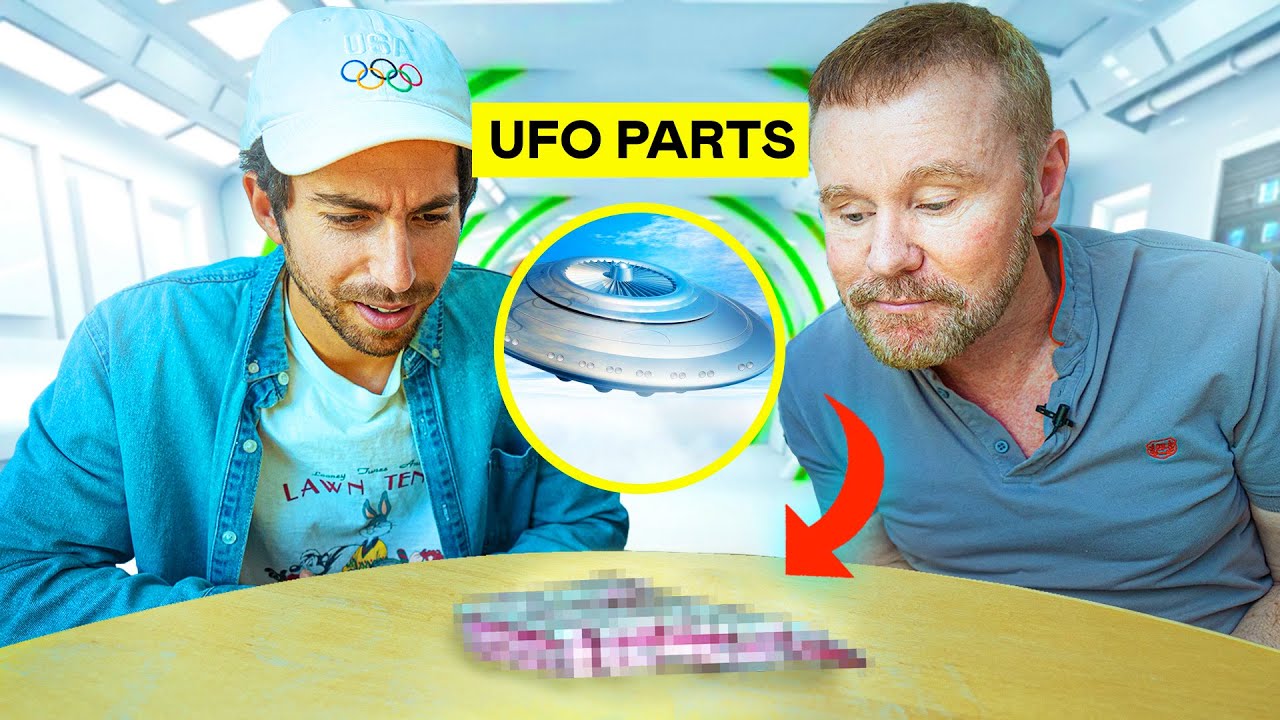
Stanford microbiologist and geneticist Dr. Garry Nolan is a mainstream academic who also studies UFOs, and he claims to possess physical materials that may be UFO parts. The episode covers his CIA-backed neurological research on people who report UFO encounters, his analysis of anomalous materials, and his broader theories about what these phenomena might represent.
Nolan’s background and entry into UFO research
Nolan is a professor in the Department of Pathology at Stanford, with over 300 research articles and 40 US patents, and he has spun out multiple companies that sold for nine figures.
He describes himself as someone who looks at problems and finds that the tools everyone else is using are not sharp enough.
His interest in UFOs began early with science fiction, citing Arthur C. Clarke and Ian Banks, and he draws a parallel between Clarke’s monolith in 2001: A Space Odyssey and the idea that alien sightings might be “breadcrumbs” that inspire technological innovation.
He notes that UFO research suffers from a severe lack of funding: the Pentagon’s main UFO program, ATIP (Advanced Aerospace Threat Identification Program), had a $22 million budget, which is less than 1% of the F-35 fighter jet budget.
CIA involvement and brain research on UFO experiencers
The CIA came to Nolan’s office asking for help analyzing people who claimed UFO contact, specifically to see if they had neurological or physiological differences.
He was introduced to a network he calls the “invisible college,” including Jacques Vallée, Hal Puthoff, Eric Davis, Robert Bigelow, and Col. John Alexander (referred to as “Kellaher” in the transcript).
The CIA showed him MRIs of Department of Defense and intelligence personnel who had reported UFO interactions.
Analysis revealed increased neural density in a region between the head of the caudate nucleus and the putamen, and this structure was larger in all the individuals studied.
The same structure appeared in family members, suggesting a genetic component.
Nolan hypothesizes that this brain region may be linked to intuition or the ability to make rapid decisions, and that it might widen perception so that people can see phenomena that exist “interstitially in reality.”
He compares this to a study of Japanese chess masters, where the caudate-putamen area lit up during intuitive moves.
He also notes that this area can be damaged in autism and schizophrenia, and he speculates that schizophrenics may be like a broken transmitter that cannot turn off, picking up signals others do not.
Materials analysis and anomalous isotope ratios
Nolan works with materials collected by Jacques Vallée, who publishes his address so that people who witness UFO crashes can send him parts.
Vallée helped develop a computerized map of Mars at NASA, worked on ARPANET with Doug Engelbart, and inspired the French scientist character in Close Encounters of the Third Kind.
One key sample came from Ubatuba, Brazil, where a fisherman saw a glowing object explode and collected fragments.
Analysis with a nanoSIMS (secondary ion mass spectrometer) showed the material was magnesium of extremely high purity, but with anomalous isotope ratios that do not occur naturally on Earth.
Creating such ratios would require something like a centrifuge, and Nolan says there is no obvious natural or industrial reason to produce them.
He raises the question of whether these ratios are a deliberate feature of the material or a byproduct of some process, and whether they might be linked to the “five observables” of UAP, such as transmedium travel and apparent violation of momentum.
Another sample on the table consists of thin layers of bismuth and magnesium that were allegedly sent anonymously by someone claiming to be an army officer who found them in his grandfather’s archives with a note saying they were from Roswell.
Hal Puthoff told Nolan that these layers could act as microwave waveguides for terahertz frequencies, reducing the required size to about 1/30th of the wavelength, which would enable much denser and faster communication technology.
Nolan notes that one piece from the same event had normal Earth-like isotope ratios, while the other was inhomogeneous, like a swirl of chocolate and vanilla ice cream, suggesting partial mixing.
Broader theories about the phenomena
Nolan entertains multiple hypotheses: aliens could be from another planet, from another level of reality, interdimensional, or even humans from the future.
He discusses the Jacques Vallée / Diana Pasulka theory that 1947 and the Roswell crash marked a dividing line: before that, people saw angels, demons, fairies, or leprechauns; after that, the cultural template shifted to “aliens.”
He uses the analogy of intelligent ants in a garden: if you wanted to communicate with them, you might make a little ant-like thing that does something comprehensible to them, and that might be what aliens are doing with us.
He suggests that when humanity split the atom in 1945 (Trinity), aliens may have become more interested, both because of nuclear weapons and because we were probing the building blocks of reality.
He imagines that a civilization a million years ahead might see humanity as “a bunch of angry monkeys with bombs” and want to keep tabs on us.
Open questions and next steps
Nolan says he has more parts in a locked bank vault and that some larger pieces cannot be shown due to national security sensitivities.
He argues for a standardized, flowchart-like process for analyzing materials, so that both skeptics and believers can work from data rather than hearsay.
He receives occasional emails from people claiming to have new samples, including one recent case involving a glowing object that drops molten metal, which he plans to follow up on.
He suggests basic tests based on UAP observables: subjecting materials to extreme velocities, temperatures, and underwater conditions, and testing whether they are conductors or insulators.
He speculates that hyper-intelligent aliens are presumably aware of the research, but may not care, or may have left the materials behind as a “breadcrumb trail” for us to figure out.