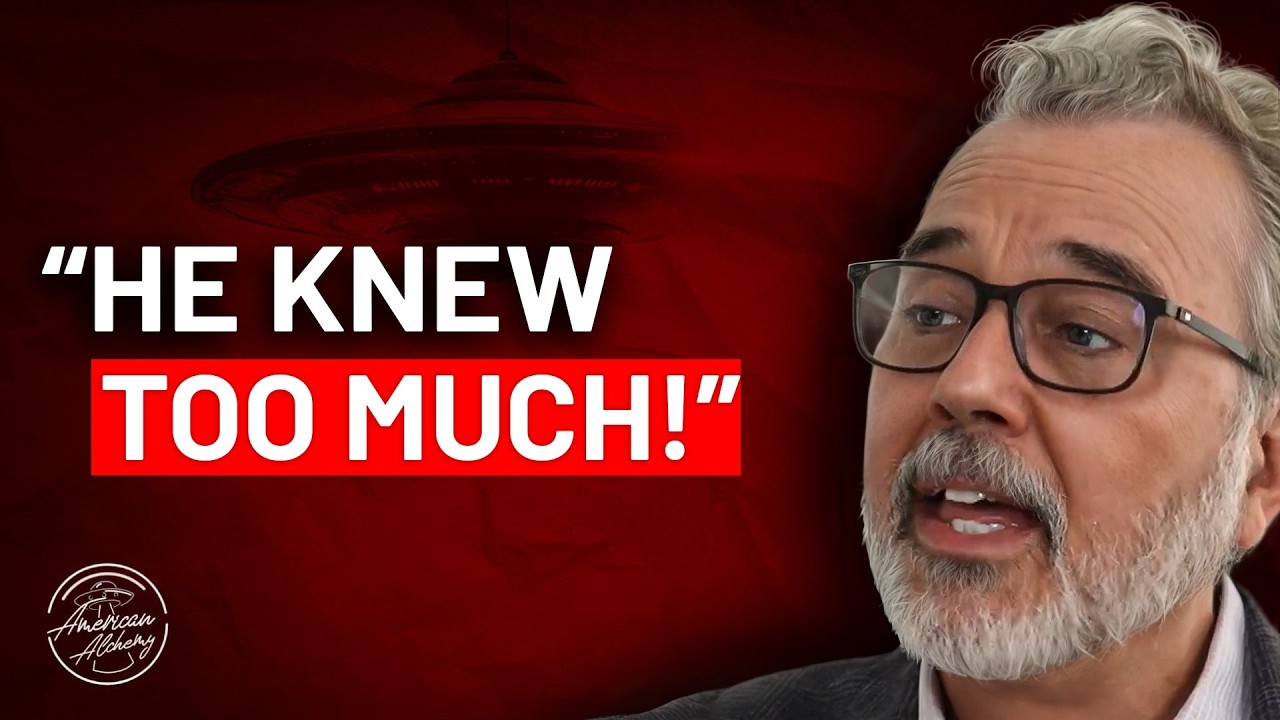
This episode features a wide-ranging conversation with Richard Dolan, a leading UFO and UAP researcher and historian, covering the history of UFO secrecy, military encounters, crash retrievals, the mysterious death of the first U.S. Secretary of Defense James Forrestal, the role of the Navy in UFO investigations, the breakaway civilization hypothesis, financial discrepancies in the Pentagon, and the prospects for disclosure. Dolan draws on decades of research to argue that the UFO phenomenon is real, deeply embedded in national security structures, and has profoundly shaped modern history in ways that mainstream institutions continue to ignore.
Richard Dolan’s Path into UFO Research
Dolan was originally an academic historian studying U.S. diplomatic history and Soviet affairs, with two unfinished dissertations on German history and 1950s national security strategy.
In 1994, at age 32, he encountered Timothy Good’s book Above Top Secret, which described a worldwide UFO coverup and referenced U.S. government departments he recognized from his own historical research.
His central question was not whether UFOs were real, but why such an intense government response in the late 1940s was completely absent from academic history books—even if it had been a mistake, it would still be historically significant.
He became obsessed, left his PhD program at the University of Rochester, and spent a year grappling with the implications: if UFOs were real, then his understanding of postwar American history was fundamentally incomplete.
He describes losing faith in academia and the mainstream historical system, which he felt had ignored or suppressed a reality-shattering phenomenon.
The Breakaway Civilization Concept
Dolan coined the term “breakaway civilization” almost 20 years ago, inspired by historian Arnold Toynbee’s meta-histories of civilizations.
The idea is that if crash retrievals like Roswell occurred, a deeply classified structure would have developed to study and exploit the technology, leading to scientific and technological advances kept secret from the public.
Over time, this classified group could develop functional flying saucers, off-world capabilities, and contact with non-human intelligences—effectively becoming a separate civilization with its own legal protections and infrastructure.
Dolan sees evidence for this in financial discrepancies, underground bases, and the consistent pattern of secrecy and compartmentalization.
Financial Discrepancies and Off-the-Books Funding
Katherine Austin Fitts, a former assistant secretary of HUD under George H.W. Bush, uncovered massive accounting fraud and discrepancies in federal spending, concluding the system is deliberately designed to be unauditable.
In 2001, Donald Rumsfeld publicly stated that $2.3 trillion in Pentagon expenditures were unaccounted for—a figure briefly acknowledged before being dismissed after 9/11.
Fitts and Dolan believe some of this missing money funds the breakaway civilization, including secret UFO research, underground facilities, and off-world programs.
Fitts was reportedly offered a UFO sighting by John Peterson of the Arlington Institute if she stopped her research, and she later regretted not attending a 1998 conference on open extraterrestrial contact due to fear of retaliation.
The Navy’s Deep Involvement in UFOs
Dolan argues the Navy has been deeply involved in UFO encounters from the beginning, often in rivalry with the Air Force.
In 1950, Secretary of the Navy Dan Kimble and Admiral Arthur Radford both had UFO encounters while flying to Hawaii, prompting Kimble to launch a separate Navy investigation—though it was reportedly shut down.
The Office of Naval Intelligence (ONI), the oldest U.S. intelligence agency, has long tracked UFOs, and recent UAP reports (2020–2021) were ONI-led.
Dolan emphasizes that the Navy’s role has been underappreciated compared to the Air Force, but their encounters and institutional interest go back decades.
Historical USO (Unidentified Submersible Object) Encounters
Dolan has compiled a database of over 670 USO cases and is writing a multi-volume study on the subject.
One of the earliest cases is from 1825, recorded by naturalist Andrew Bloxom aboard HMS Blonde near the Cook Islands: an orange spherical object rose from the ocean, lit the ship’s deck brightly enough to pick up a pin, descended, rose again, then disappeared.
In 1971, aboard the USS John F. Kennedy, communications officer James Copp witnessed a glowing orange sphere that caused all weapons and communications to go offline for 20 minutes; the ship went to battle stations, and the crew was later ordered not to discuss the event.
Dolan notes that about 10% of USO cases involve electromagnetic interference, but this doubles in military cases and quadruples when missing time or beings are reported, suggesting the EM effects are intentional—possibly a tool or weapon.
The Mysterious Death of James Forrestal
James Forrestal, the first U.S. Secretary of Defense, was a brilliant but troubled figure who opposed centralization of military power under a strong Secretary of Defense, yet ironically became the first to hold the position.
He clashed with President Truman over military budget cuts and was forced out in January 1949 after meeting with Truman’s political rival Thomas Dewey.
After leaving office, Forrestal became increasingly paranoid, claiming he was being followed by foreign men, developing nervous tics, and repeating phrases like “You are a loyal fellow.”
He was taken to Bethesda Naval Hospital and placed on the 16th floor against medical advice. On May 22, 1949, he fell to his death from a window while allegedly transcribing Sophocles’ The Death of Ajax.
The official story claims he tied his bathrobe cord to the radiator and jumped, but the cord supposedly slipped—a method Dolan calls implausible.
Dolan believes Forrestal was murdered, likely thrown from the window by Navy personnel, and that the investigation was a sham: the guard on duty disappeared, the replacement guard was barely questioned, and no serious inquiry was conducted.
Forrestal’s diaries were seized and expunged before publication, and he was denied access to his spiritual adviser.
His brother Henry threatened to “raise holy hell” if James wasn’t released by the next day—May 21—and James died that night.
Dolan speculates Forrestal may have known about UFOs or other national security secrets and was silenced.
JFK, Assassination, and the UFO Connection
Dolan sees JFK’s assassination as having multiple motives—Vietnam, the Federal Reserve, nuclear disarmament, Operation Mongoose—but believes UFOs were also a factor.
JFK signed a memo on November 12, 1963 (11 days before his death), directing the CIA to share UFO data with the Soviet Union.
The so-called “burned memo” in the Majestic documents refers to “Lancer” (JFK’s code name) and states that “an operation has to be done on him if he’s too dangerous” and that it “must be wet”—slang for assassination.
Dolan notes that many JFK researchers avoid the UFO connection due to stigma, but he believes it is part of the picture.
He also mentions that the first CIA director, Roscoe Hillenkoetter, was deeply involved in UFOs and resigned suddenly in 1962 when congressional hearings seemed imminent, then publicly downplayed the issue.
Crash Retrievals: Roswell, Aztec, Kingman, Kecksburg, and Others
Roswell: Dolan considers it real and the most well-documented crash, though it was buried until the late 1970s when researchers like Leonard Stringfield and Jesse Marcel Sr. brought it back into public view.
Aztec (1948): Dolan believes this crash in New Mexico was real, despite being smeared by journalist J.P. Conn in a 1950 debunking motivated by resentment over being scooped. The main witnesses, Silas Newton and Leo Gebauer, were successful businessmen with no motive to hoax, and FBI files on them from the 1930s are heavily redacted. Scott and Suzanne Ramsey have rehabilitated the case with physical evidence and documentation.
Kingman (1953): Dolan considers it real, based on research by Raymond Fowler and others. A witness reported a disc-shaped craft and non-human beings.
Kecksburg (1965): Dolan does not believe it was a Soviet satellite, as officially claimed. Researcher Stan Gordon has gathered strong evidence of a bell-shaped object recovered by the military. Local radio reporter Frank Murphy’s life was destroyed after he investigated.
Long Island (1989): Dolan finds the case plausible. John Ford, head of a Long Island UFO group, claimed crashes near Brookhaven National Lab, home to the Cosmotron particle accelerator. Ford was later imprisoned in a bizarre plot involving radioactive toothpaste, which Dolan believes was a setup to silence him.
Nazi Bell (Die Glocke): Dolan does not believe it was a flying device, but rather a high-voltage torsion chamber possibly using rotating mercury, related to electrogravitics. He references Igor Witkowski’s research and the involvement of SS doctor Ernst Gravitz and physicist Walther Gerlach.
The MJ-12 Documents and Disinformation Strategy
The MJ-12 documents first appeared in 1984, likely originating near Kirtland Air Force Base and linked to Richard Doty, a controversial Air Force counterintelligence figure.
They describe a secret group formed by President Truman to manage the UFO secret after Roswell, including crash retrievals.
Dolan is uncertain about their authenticity but notes they are highly sophisticated, with accurate formatting and data consistent with the eras they claim to represent.
He contrasts them with the broader Majestic documents curated by Ryan and Bob Wood, which he finds even more compelling.
In the 1980s, Dolan believes the U.S. shifted from pure secrecy to a “flood the zone” strategy—releasing partial truths mixed with disinformation to inoculate the public against the full truth, much like a vaccine uses a weakened virus.
Richard Doty and Managed Disclosure
Doty was a Air Force special agent tasked with protecting UFO secrets at Kirtland AFB. He misled researcher Paul Bennewitz and was present during the 1977 Mario Woods abduction case at Ellsworth AFB.
Dolan met Doty and found him gracious and likable, but notes that likability does not imply truthfulness.
Doty’s father was deeply involved in Area 51 and UFOs, and Doty claims to know the truth about UFOs from personal experience.
Dolan criticizes those who reflexively reject all government statements as lies, arguing this leads to being “thought-controlled” and missing real disclosures when they occur.
Secret Science and Electrogravitics
Dolan recounts a 2008 conversation with a retired Air Force colonel involved in the B2 stealth bomber project. When Dolan mentioned Paul Lavoie’s paper suggesting the B2 used electrogravitic principles for lift, the colonel whispered “That’s bullshit” and refused to discuss it further—confirming, in Dolan’s view, that the technology is real.
Thomas Townsend Brown, a Navy scientist in the 1930s–40s, worked on electrogravitics and is a key figure in USO and anti-gravity research.
Dolan believes secret science has advanced far beyond public knowledge, with breakthroughs in propulsion, materials, and energy kept classified.
The Pascagoula Abduction and Nuclear Submarine Connection
In 1973, fishermen Charles Hickson and Calvin Parker were abducted by a dome-shaped craft near Pascagoula, Mississippi—next to the largest nuclear submarine production facility in the U.S. at the time.
The beings they described looked like 1950s movie aliens, which Dolan finds odd, but the men were recorded by police without their knowledge and appeared genuinely terrified and sincere.
A week or two later, a genuine USO incident occurred in the same area, which Dolan includes in his USO study.
China and UFOs: A Black Box
Dolan researched Chinese UFO history for his members’ website and found it fascinating but tightly controlled.
Before Mao Zedong’s death in 1976, UFO research was forbidden as a challenge to Communist Party authority.
After Mao’s death, a massive wave of public interest in UFOs emerged, including contactee cases and metaphysical interpretations, despite official materialism.
The Falun Gong movement, which incorporated explicit extraterrestrial beliefs, grew so large in the 1980s–90s that the Chinese government crushed it in the late 1990s, fearing its power.
Dolan concludes that disclosure in China would be seen as an even greater threat to the regime than in the U.S., and Chinese ufology remains tightly managed today.
The People’s Liberation Army has a sophisticated system for collecting, analyzing, and storing UFO reports, but almost no data leaks to the West.
Disclosure: Prospects and Obstacles
Dolan does not believe in voluntary, honest disclosure from the U.S. government. Any disclosure will be forced by undeniable revelations—perhaps from a high-level official or a major leak.
He is skeptical of the mainstream media, which he sees as part of the system that must protect itself. Despite the 2017 New York Times article by Leslie Kean, Ralph Blumenthal, and Helen Cooper, there has been no sustained investigative follow-up.
Media outlets rely on consultants like David Sproule, who explained away UAPs as light reflections and temperature inversions—echoing debunker Donald Menzel from the 1950s.
Dolan argues that disclosure threatens trillions of dollars in military, energy, and transportation investments, and those who own them will fight to protect their interests.
He sees the current era as one of flux, with AI, global communications, and technological change making total control impossible, but governments are adapting rather than collapsing.
Science Fiction and Personal Influences
Dolan co-authored After Disclosure with Bryce Zabel, who also produced the TV show Dark Skies, which he praises for its portrayal of MJ-12 machinations.
He admires Steven Spielberg’s Taken and the work of author Lou Baldwin, particularly In League with UFOs and A Day with an Extraterrestrial, which describe insider knowledge of Roswell and a full-day alien encounter. Dolan is unsure if they are true but finds them compelling.
Among academic influences, he cites sociologist Max Weber, especially his concept of the “disenchantment of the world.”
In UFO research, he admires Donald Keyhoe, James and Coral Lorenzen, Edward Ruppelt (who was pressured to recant his pro-UFO book before dying at 37), Linda Moulton Howe, Stanton Friedman (despite disagreements over Bob Lazar), and Timothy Good.
Final Reflections
Dolan reflects on the injustice faced by truth-seekers like John Ford and the Galileo-like persecution of those who challenge the establishment.
He sees the U.S. as a “pretend democracy” where hierarchy and wealth concentration inevitably lead to manipulation and control, managed through propaganda and public relations.
Despite frustration, he remains committed to research, writing, and speaking, viewing the UFO phenomenon as the elephant in the room of 20th-century history.
He encourages audiences to subscribe to his YouTube channel Richard Dolan Intelligent Disclosure, buy his books (especially the USO volumes), and continue seeking truth.