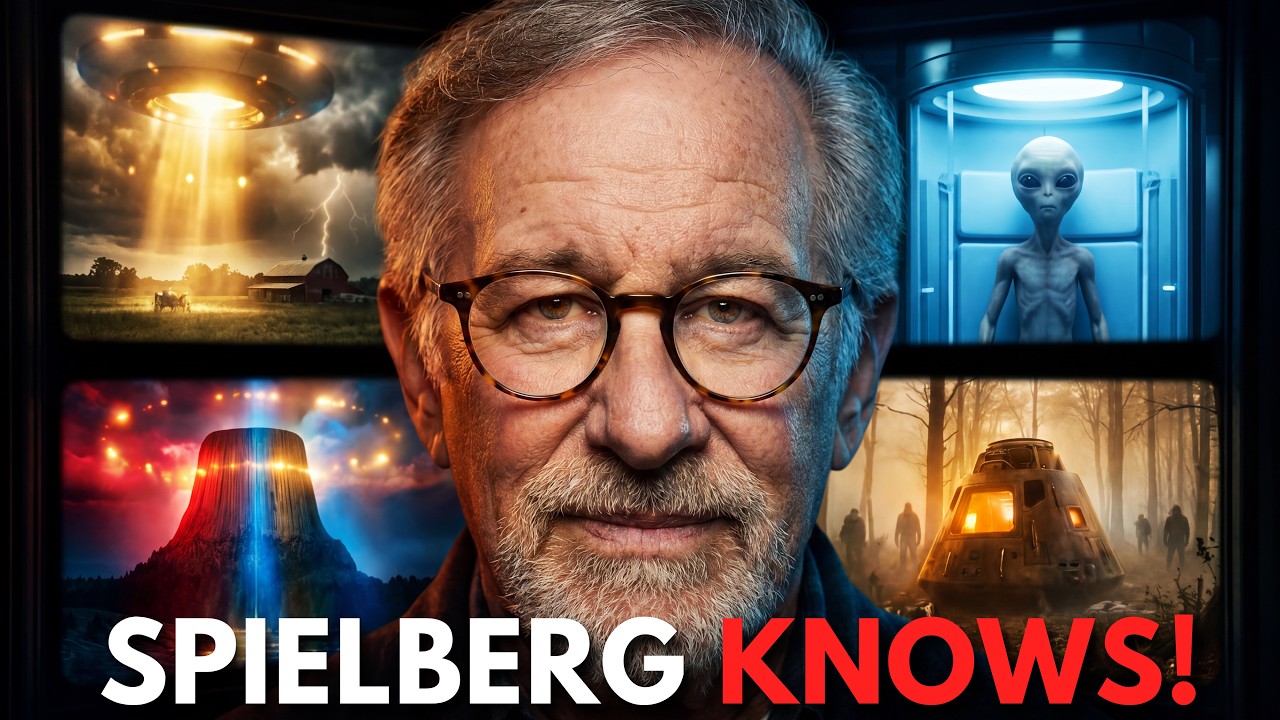
- This episode examines Steven Spielberg’s 2026 film Disclosure Day as a vehicle for serious UFO truths, arguing that Spielberg — who has explored extraterrestrial themes since his 17-year-old debut Firelight — embedded decades of real UFO lore, intelligence community history, and frontier science into the movie. The host, Jesse Michaels of American Alchemy, treats the film as both a capstone to Spielberg’s career-long obsession and a potential act of controlled disclosure, while acknowledging Spielberg’s own claim that he “only knows what you know.”
Spielberg’s long history with UFOs and possible intelligence connections
- Spielberg’s UFO interest is deep and genuine: he cast Jacques Vallée (played by François Truffaut) and modeled J. Allen Hynek into Close Encounters of the Third Kind, praised James Fox’s 2009 documentary I Know What I Saw, and has said Disclosure Day “rose above” five competing ideas organically.
- The 2017 New York Times article on the Nimitz “Tic Tac” incident, Harry Reid’s Pentagon UFO program (AATIP), and a decade of whistleblower testimony all fed into the film’s inspiration.
- Tobe Hooper (director of Poltergeist) claimed that after Jaws, Spielberg was approached by Naval Intelligence and that Close Encounters and even E.T. were based on real case files — a claim the host presents as unverified but suggestive.
- Reagan, after a White House screening of E.T., reportedly told the room, “There are a number of people in this screen who know that everything on that screen is absolutely true,” without smiling.
- Chase Brandon, the CIA’s official Hollywood liaison from 1996 onward and cousin of Tommy Lee Jones, worked on Men in Black (produced by Spielberg’s Amblin Entertainment) — raising the question of whether the “Men in Black” phenomenon was being depicted by someone with real access.
- The host is careful to say he is not calling Spielberg a “deep state plant,” but argues the “I wrote this on my notes app” origin story may not be the full picture.
The film’s plot as a map of real UFO structures
- Disclosure Day centers on Wardex, a shadowy private corporation in Northern Virginia that has suppressed proof of a peaceful alien presence for decades. A defector, Hugo Wakefield (played by Colman Domingo), orchestrates a mass data dump with the help of Daniel (Josh O’Connor), a cybersecurity specialist carrying videos of alien bodies, crash retrievals, and a telepathy-enhancing artifact called “the Device.”
- Emily Blunt’s character, news anchor Margaret Fairchild, spontaneously begins speaking in alien clicking sounds and manifesting psychic abilities, drawing Wardex’s attention. Daniel and Margaret are revealed to have been imprinted with encrypted messages during childhood abductions.
- The host draws direct parallels between Wardex and real-world entities:
- Grey Fox / ISA (Activity / Task Force Orange): A JSOC intelligence unit headquartered in Northern Virginia, nicknamed the “Army of Northern Virginia,” historically first on the scene for the most sensitive operations — and, the host argues, a likely first responder for UFO crash retrievals.
- SAIC (Science Applications International Corporation): A Northern Virginia contractor openly studying exotic propulsion, anti-gravity, and directed energy, with ties to the CIA’s Stargate remote-viewing program. Former NSA director Bobby Ray Inman and former AARO head Sean Kirkpatrick both worked there.
- Lou Elizondo, the former AATIP whistleblower who inspired much of modern UFO disclosure, is a Grey Fox alumnus — a data point the host finds significant.
- In the film, Wardex’s leader Noah Scanland (Colin Firth) regularly “dives” (remote views) targets; the host notes Scanland physically resembles former CIA director of science and technology Glenn Knapp, whom journalist George Knapp (no relation) accused in congressional testimony of blocking UFO material transfers from Lockheed Martin to Bigelow Aerospace in 2008.
Majestic 12, timeline manipulation, and the “deep state war”
- Hugo Wakefield is one of 12 defectors from Wardex — a number that evokes the alleged Majestic 12 committee. The name “Nathan Twinning” (one of the defectors) references General Nathan Twining, author of the famous 1947 Twining memo and rumored MJ-12 appointee.
- Chase Brandon’s novel Crypto’s Conundrum depicts a committee matching MJ-12 that possesses a crystal tablet allowing access to future timelines — closely paralleling the “Device” in the film.
- The host connects this to real claims from Diana Pasulka’s American Cosmic: NASA mission controller and NRO operative Tim Taylor told Pasulka his work involved “adjusting timelines” (like the film The Adjustment Bureau), and separately told Chris Bledsoe’s son that he was part of a secret time-travel group led by Thomas Townsend Brown.
- Thomas Townsend Brown — the obscure anti-gravity inventor — is, the host argues, the real-life model for “Doc Brown” in Back to the Future (produced by Spielberg, directed by Robert Zemeckis), whose flux capacitor, Pasadena home, and 1985 death date all map to Brown’s biography.
- The host reads the Back to the Future scene where Marty poses as “Darth Vader from the planet Vulcan” as Spielberg’s suggestion that UFOs may be a cultural cover for time-traveling future humans — an idea Spielberg reportedly confirmed privately to Deadpool creator Robert Leefield.
- In Disclosure Day, Wakefield functions as a reality architect — staging synchronicities, adjusting minimal variables, and engineering escapes — while Scanland represents the faction suppressing disclosure. The host frames this as a genuine “deep state war” over timelines, not just fiction.
Humans as encrypted storage and the science of contact
- Daniel and Margaret represent left-brain logic and right-brain empathy, respectively; both were imprinted as children by aliens using a Hansel and Gretel–style lure (friendly animals leading them from their bedrooms). The host cites UFO researcher Carla Turner’s work on this motif.
- The aliens’ method — encoding messages in human biology rather than leaving artifacts in space — is presented as strategically sound: DNA self-replicates and persists as long as the species survives.
- Hugo Wakefield’s role mirrors Harvard psychiatrist John Mack, who used Holotropic Breathwork and hypnotic regression to recover abduction memories. Actor Colman Domingo reportedly confirmed this inspiration.
- Margaret’s powers are reactivated by a Red Cardinal at her window; the host speculates this is an homage to Project Bluebird (the precursor to MKUltra), named after Maurice Maeterlinck’s 1908 play The Bluebird — a fairy tale about two children searching for the bluebird of happiness, only to discover their pet dove was blue all along. Occult researcher Peter Levender reads this as an initiatory, Masonic-coded ritual of consciousness transformation.
- The film depicts real crash footage: Roswell (including bismuth wreckage, which the host links to Thomas Townsend Brown and Hal Puthoff’s work on anti-gravity materials) and Kecksburg (the film incorrectly shows a saucer rather than the bell-shaped craft).
- The Kecksburg cleanup in the film is overseen by a civilian figure the host identifies as likely Dr. Eric Walker, alleged MJ-12 member and Penn State president, who told UFO researcher Bill Steinman he had known about MJ-12 for decades.
- The alien design in the film traces back to drawings Hynek gave Spielberg, which themselves matched experiencer descriptions collected by Budd Hopkins in the late 1960s and early 1970s.
Jackie Gleason, Homestead AFB, and Nixon
- The host recounts the well-known but unverified story that Nixon took Jackie Gleason to Homestead Air Force Base in February 1973 to show him small alien bodies in what looked like glass-topped Coke freezers. Gleason’s wife Beverly confirmed the account after their divorce, saying Gleason came home “white-faced” and told her what he saw. Spielberg depicted this scene in Disclosure Day with the core details intact.
UFO science in the film
- When Margaret grabs the “Device,” her house becomes a floating, flaming object — which the host reads as an illustration of the holographic principle (a lower-dimensional surface encoding higher-dimensional information), a concept UFO whistleblower David Grush has alluded to.
- The host cites Jacques Vallée’s San Jose case, where a UFO appeared small on the outside but contained an amphitheater-sized interior — “the inside bigger than the outside.”
- Signature management — the idea that UFOs can manipulate human perception — is depicted when Margaret shapeshifts into loved ones of Wardex operatives, even Scanland’s ex-wife, to escape.
- A recurring trope — that you cannot “dive on” (remote view) an experiencer — strikes the host as too specific to be invented, suggesting an inside source.
- A trailer line — “7 billion people have the right to know” — was changed in the film, prompting speculation (hosted by researcher Chris Ramsay) that a billion people on Earth may not be fully human, or that the film’s timeline is not the present.
Production coincidences and the possibility of real footage
- Disclosure Day began production in February 2025 in Morris County, New Jersey, near Picatinny Arsenal, during the well-publicized New Jersey drone UFO flap. The host and reporter Rob Jones speculate that UFO material — possibly the Lockheed Martin craft blocked from transfer to Bigelow Aerospace in 2008 — may have been moved to Picatinny Arsenal by a company called Peritin Labs, and that its handling may have triggered the drone sightings.
- The closing montage shows Wardex’s evidence broadcast live, including crash footage, alien bodies, thermal UFO imagery, and V-formation flights. The host raises the possibility that Spielberg — given his access and track record — may have been given real material to embed in the sequence as a final act of truth-in-fiction.
The film’s core question
- The host concludes that Disclosure Day’s most real element is its closing moral choice: uncomfortable truth versus convenient fiction, individual enlightenment versus institutional stability, self-interest versus the whole — and that if there is a “prime directive” condition for alien contact, it may be humanity’s capacity to listen to one another with humility.